
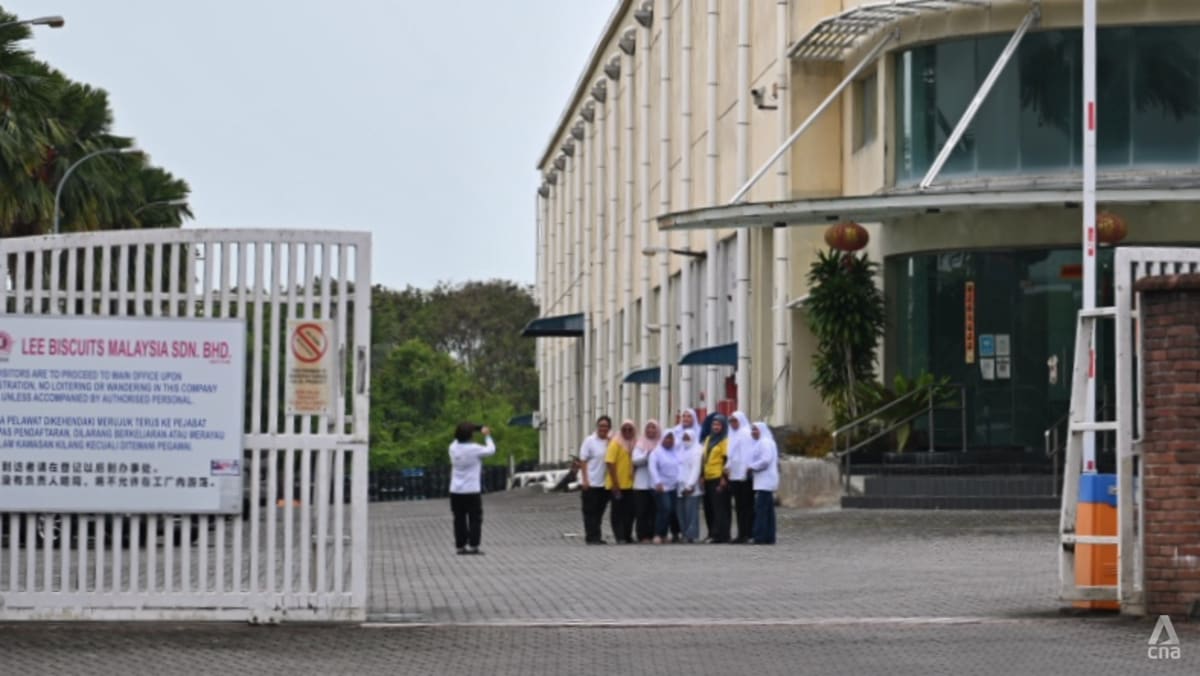
Asia From Marie biscuits and cream crackers to colourful iced gems, Lee Biscuits' snacks were household staples for generations of Singaporeans and Malaysians. After 92 years, production is coming to an end. Workers taking photos outside the Lee Biscuits factory in Pontian, Johor on Oct 29, 2026. (Photo: CNA/Zamzahuri Abas) New: You can now listen to articles. This audio is generated by an AI tool. JOHOR BAHRU/SINGAPORE: For generations of Malaysians and Singaporeans, Lee Biscuits' Marie biscuits, saltine crackers, banana puffs and colourful iced gems were familiar snacks.Now, after 92 years, the biscuit maker, also known as Nam Lee, is preparing to cease production at its factory in Pontian, Johor at the end of October. Founded in Singapore in 1934 by prominent businessman and philanthropist Lee Kong Chian, the company moved its manufacturing operations to Johor in 1955, first to Tampoi and later to Pontian.When CNA visited the factory on Thursday (Oct 29), workers declined to comment on the impending closure. Some were seen taking photographs outside the factory as its final days approached.For those whose lives have become intertwined with the factory, however, the closure is a personal loss.Rogayah Othman, 62, has run a food stall just outside its gates since 2012, with workers stopping by regularly for breakfast and lunch.“I am sad as I’ve grown close to some of the workers. They are like my own kids,” she told CNA. Some Lee Biscuits products were still listed for sale on supermarket chain FairPrice’s website as of Thursday. CNA looks back at the biscuit maker’s journey from Singapore to Johor. Lee Biscuits' factory in Pontian, Johor on Oct 29, 2026. (Photo: CNA/Zamzahuri Abas) 1934-1955: From rubber empire to biscuit manufacturing Lee Biscuits’ origins can be traced to 1934, when it was established in Singapore by Lee Kong Chian, one of Southeast Asia’s most prominent businessmen of his time. Also known as the “Rubber King” and “Pineapple King”, Lee built a vast business empire spanning rubber plantations, pineapple cultivation, manufacturing and other industries.According to Singapore’s National Library Board, Lee amassed much of his wealth through the rubber trade before diversifying into businesses such as Lee Pineapple, Lee Biscuits and Lee Sawmills. He was also the son-in-law of rubber tycoon and philanthropist Tan Kah Kee, who introduced him to the rubber industry.Beyond his business ventures, Lee was known for his philanthropic contributions, particularly in education. He contributed extensively to numerous schools and universities across Malaysia and Singapore. A selection of biscuits produced by Lee Biscuits. (Photo: Facebook/Heritage SG Food) Established while Singapore was still under colonial rule, Lee Biscuits set out to produce affordable biscuits for consumers in the region. Its early offerings included cream crackers, banana puffs and Marie biscuits, products that would go on to become familiar snacks in households across Singapore and Malaysia. The company also developed brands such as Shield, Turkey and Bell. 1955: Crossing the Causeway to Johor BahruAfter 21 years in Singapore, Lee Biscuits moved its manufacturing operations across the Causeway to Tampoi in Johor Bahru in 1955. The relocation was aimed at giving the company greater access to Malaysia’s agricultural supply chains and industrial space, according to The Rakyat Post. According to Lee Biscuits' website, the move was accompanied by acquisitions that allowed it to expand its operations and range of products. A worker seen outside the Lee Biscuits factory in Pontian, Johor on Oct 29, 2026. (Photo: CNA/Zamzahuri Abas) 1965 onwards: More biscuits, more varietyAs its manufacturing capabilities grew, so did its selection of biscuits.From 1965, Lee Biscuits expanded its range to include lemon puffs, iced gems biscuits, animal cookies and chocolate and butter cream biscuits. 2000s: Another move in Johor In 2000, Lee Biscuits fully upgraded its production facility into a modernised plant. It also began researching and developing products to cater to increasingly health-conscious consumers, according to the company’s website. Five years later, the company relocated its manufacturing operations from Tampoi to Pontian, also in Johor, to accommodate further expansion. The former Tampoi site subsequently made way for a Giant hypermarket, according to The Edge Malaysia. In 2008, the company obtained ISO and Hazard Analysis and Critical Control Points (HACCP) certifications, as part of efforts to improve manufacturing standards and food safety. An aerial view of the Lee Biscuits factory in Pontian, Johor. (Photo: CNA/Zamzahuri Abas) 2023-2026: Winding down Lee Biscuits' impending closure follows the shutdown of another longstanding food manufacturer under the Lee Group.In November 2023, the group closed its decades-old Lee Pineapple cannery in Skudai, Johor, as it shifted focus towards oil palm cultivation. That closure prompted its own wave of nostalgia, with large crowds of people queuing to snap up its pineapple water before production ended. Nearly three years later, it is Lee Biscuits’ turn.Malaysian media reported this month that the Pontian factory would cease production at the end of October. Tan Eng Meng, the assemblyman for Pekan Nanas in Pontian, confirmed the closure to Malaysian Chinese news outlet China Press.The shutdown is part of a restructuring by the parent group, which is reportedly moving away from snack manufacturing to consolidate its assets and focus on core businesses including rubber and palm oil operations, according to the New Straits Times. Rogayah Othman, 62, runs a food stall just outside the Lee Biscuits factory in Pontian. (Photo: CNA/Zamzahuri Abas) Suppliers and customers began receiving notices about the production halt in September, while the factory is also reportedly laying off workers.About 300 employees were expected to remain until the end of October, mainly to carry out cleaning and other work at the factory, China Press reported.Additional reporting by Zamzahuri Abas.
End of an era: Tracing Lee Biscuits' 92-year journey from Singapore to Johor
Full Article
Original Source
Read the full article at Channelnewsasia →KhanList aggregates and links to publicly available news content. We do not host full articles from third-party sources. Always verify important information with original sources.