
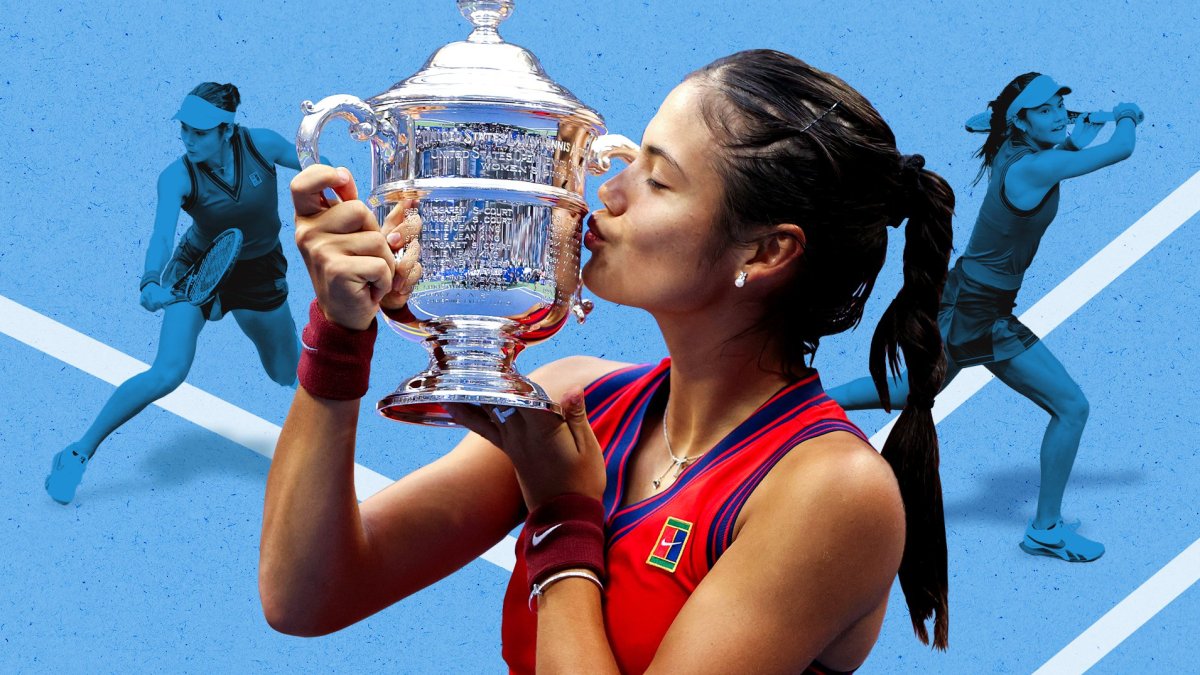
FLUSHING MEADOWS — “Is it really five years?” says one player incredulously when I ask them what they were doing the night Emma Raducanu won the US Open. For many of us, it feels like yesterday. Raducanu’s run from qualifying to the title, never achieved at a grand slam before or since, has shaped the last five years in British tennis like few three-week periods ever have. She became and remains this country’s biggest star in women’s tennis, her every match, interview, coaching change and practice session closely followed and scrutinised. It is typical of the rocky road Raducanu, now 23, has ridden since becoming US Open champion that she is not even here in New York to look back at the half-decade that has passed. The Big Apple has not been a happy hunting ground in that time either: she has won just two matches at this tournament since she won it. So in Raducanu’s absence, I asked those who were here watching, supporting and indeed playing against her for their memories of that remarkable three-week run. Three Brits ‘just excited to be there’ Raducanu was part of a five-strong team of British women hoping to make it through qualifying for the 2021 main draw. “It’s like a tournament of its own,” says one experienced observer of the week before a major. “If you’re in qualis, the first round of the man draw is your goal, rather than the beginning of the tournament proper.” It turned out to be a bumper year for the Brits, as Raducanu was one of three to make it through. “I think we have a picture and we may have practised on courts next to each other after that,” says Katie Boulter, who is now British No 1. “We’re all in such a great mood before our first round, and we were all just excited to be in the main draw.” Raducanu’s 10 US Open victims Qualifying R1: Bibiane Schoofs R2: Mariam Bolkvadze R3: Mayar Sherif Main draw R1: Stefanie Vogele (LL) R2: Zhang Shuai R3: Sara Sorribes Tormo R4: Shelby Rogers QF: Belinda Bencic (11) SF: Maria Sakkari (17) F: Leylah Fernandez Harriet Dart, one of the last British players standing in the singles draw in 2026, got in as well, but then lost in the first round to Caroline Garcia. “I left after I lost. But I remember we all use the same brand of supplements and electrolytes from the LTA [Lawn Tennis Association], and I remember she had run out of some, so I gave her some of that before leaving. “I think some of the other boys were then giving her more because obviously she kept winning, winning, winning!” Raducanu’s campaign seems to have quickly become a British team effort, with everyone doing whatever they could to help out. Even from afar. Boulter came through qualifying along with Raducanu (Photo: Getty) “I was texting her the whole time. I was never expecting a reply, I don’t know if she’s the best replier, but I consistently was texting her to try and keep the momentum that we had, because we were talking about it after each round,” Boulter adds. “I kind of got to the point that I was like, ’Is this chick ever gonna lose? I can’t keep texting you. You’re probably sick of seeing my name on your phone every day,’ but I wanted to keep it going just in case. “And I’m sure it’s not the reason why she won. But I kept texting her.” Boulter did most of her messaging from her next tournament in Slovenia after, like Dart, she lost first round. In fact, Raducanu was quickly one of the last remaining British hope in the draw in New York, after Andy Murray lost a fractous five-setter to Stefanos Tsitsipas and Cam Norrie was beaten by a young up-and-comer named Carlos Alcaraz. Dan Evans kept the Union Jack flying until the fourth round in the men’s draw, but all the women’s hopes were on Raducanu by the first Wednesday. A big step forward She was handed a kind enough draw. Stefanie Voegele, now retired and happily bringing up her daughter in Switzerland, had lost in qualifying but got a lucky loser spot, and was dispatched for the loss of just five games. Zhang Shuai in round two was and still is mainly a doubles player, and was a familiar sight across the net. “We played in San Jose, three tournaments before, and when we meet here second round, I was like, ’Ooh, she’s got so much improvement from when I played her from San Jose’. I felt like she had everything,” Zhang tells The i Paper. They congratulated each other afterwards in Chinese, the language of Raducanu’s mother Renee, and whose accent she retains. Zhang explains: “She’s so cute when she speaks Mandarin, super cute, because her Mum, and her grandma are from Shenyang.” (The Shenyang accent is the unofficial language of comedy in China, with the comic turn in a sitcom often played in the sing-song style of people who come from the northern city. It is, I am told, a bit like a Yorkshire accent in English.) But even after five wins, this was still seen as a bit of a freak run. Raducanu had gone one round further at Wimbledon and crumbled under the pressure. I ask one Brit who spent the whole fortnight in New York when, if at all, they thought she could win the title. “Sorribes Tormo, third round,” he replied. “She just put her away so calmly and easily.” ‘I was not myself’ It remains the most one-sided win of Raducanu’s grand slam career: she beat the world No 41 Sara Sorribes Tormo 6-0 6-1 in just 70 minutes, breaking her serve five times and never even facing a break point. She played on Court 17, a small stadium that holds less than 3,000 supporters. Every match she played after that was on 23,000-seater Arthur Ashe Stadium. She had reached the big time. American Shelby Rogers was her next victim, another who has since retired and is currently juggling TV work and raising her nine-month-old. Rogers had taken out top seed Ash Barty in the previous round, meaning Raducanu had not faced a seeded player until she reached the quarter-finals, where No 11 Belinda Bencic awaited. The draw had been blown wide open and Bencic, a semi-finalist two years before and the reigning Olympic champion at the time, was all of a sudden among the favourites. “I know like the media and social media and Twitter and all of this,” Bencic says. “They always expect one person to win, but that’s not how you feel when you’re a tennis player. “It’s a quarter-final. Both players definitely deserve to be there, so it has nothing to do with ‘Oh, I should beat this player like easy because she’s ranked much lower than me,’ or something.” Bencic was among the favourites by the time she faced Raducanu in the last eight (Photo: Getty) Whatever the explanation, Bencic did not play her best. From an early 3-1 lead, she lost five games in a row and repeatedly produced double-faults in big moments. “I felt like I had a good chance in that tournament, but I lost, and I was very not myself in that quarter-final,” Bencic adds. “And I remember the match; she was obviously playing very good, and she was playing the tennis of her life.” ‘She didn’t care – in a good way’ That was the momentum Raducanu was carrying into the semi-final against Maria Sakkari. And it told. The Greek No 1 won just five games. It was a lights-out performance from Raducanu, who hardly put a foot wrong all night. On commentary, the legendary Martina Navratilova said that Raducanu “must have been here before, even if it was in a previous life,” so calm and assured was she in the biggest match to date of her short career. It was in such stark contrast to her panic attack during the fourth round of Wimbledon, just a couple of months before. The difference here was that she was far more grooved than she had been at Wimbledon. As well as this being her ninth match at Flushing Meadows, she had played 10 matches across two warm-up events in Pennsylvania and Illinois, winning eight of them. Confidence oozed out of every pore. “She played very good, and she was like she didn’t care – in a good way,” Sakkari said. “She would swing and just play so fearless and not be scared. It was meant to be. It was written in the stars.” ‘That’s a surprise’ Had this final happened during what we would term “normal times”, the media circus would have been sensational. Reporters, camera crews, commentators and perhaps entire studios would have been booking last-minute flights across the Atlantic. But the world was still slowly emerging from the Covid pandemic, and applying for a visa to work temporarily in the United States is not a fast-track process at the best of times. Instead, the majority of us were resigned to staying up all night to report on the most dramatic tennis story in living memory, hoping that the 6am bed time would not be in vain. Players are not so obsessed, especially when it comes to a tournament that deep down, even if few would admit it, they know they could have won. After all, the world No 150 won it, so why shouldn’t they? Only Zhang was still in New York, but as she was due to play the doubles final on Sunday, she was tucked up in bed. So was beaten semi-finalist Sakkari, albeit on the other side of the Atlantic in Brussels, sleeping next to the man who is now her fiancé (and whose father is the Prime Minister of Greece). “I just checked the result when I woke up. I said, ‘That’s a surprise,’ and I went back to sleep,” Sakkari said. The bookmakers actually had Raducanu listed as the favourite, but the locker room was leaning towards Leylah Fernandez because of her hit list en route to the final: she beat No 3 seed Naomi Osaka went in the third round, No 5 Elina Svitolina in the quarter-finals, and then No 2 Aryna Sabalenka, who has since then won the title twice here. Fernandez knocked out three top-five players en route to the final (Photo: Getty) She clearly felt the same way – and when you beat that level at a tournament and then face a qualifier in the final, you surely expect yourself to win. But once again, Raducanu dug into a rich seam of form and found gold. Live on Channel 4 back home thanks to a last-minute sub-licence deal with Sky Sports, more than nine million people watched the 18-year-old seal victory. It will probably be the greatest day of her life. But for Fernandez, it was one of the worst, and it was only through therapy that she got to a point of being able to feel gratitude for having reached her first and to date only grand slam final. “I was lucky enough to talk to a couple professionals, and they all said, ‘The career is short. It may seem long, but it is pretty short, and you just gotta enjoy the moment that you’re in’,” she says. “I’m grateful for that for that run, for that achievement, because if it wasn’t for the 2021 run, I don’t think I would be here. “I wouldn’t have the opportunities that I have now. I wouldn’t be playing the tournaments that I’ve played the past few years. I wouldn’t be traveling the world like I’ve been doing. “I’ve changed my viewpoint to being grateful to it and being happy that it had happened.” Read more Explained: Shut up and watch tennis! Why US Open fans have been told to ‘learn etiquette’ James Gray: Vomiting, cramping and in tears, Novak Djokovic looks ready to end his career Similarly to Raducanu, Fernandez’s ranking has fluctuated up and down since that September night, although not quite as wildly: she has dropped down as low as 96 from a career-high of 13, but also won five singles titles along the way. Meanwhile, Raducanu is yet to add a second trophy to that seismic first one. She has come closest this year, reaching the final in Cluj and at Queen’s – but typically then suffered the stress fracture from which she is still recovering. Five years on, few believe that lightning will strike twice – either in terms of a qualifier winning a major or Raducanu repeating her success. Yet Maja Chwalinska came within one win of “doing a Raducanu” at the French Open this year and there have been, among the injuries, green shoots in the British player’s form. But whatever happens, she will always have New York in 2021: three weeks when the Earth and everything that’s in it were hers.
Emma Raducanu’s US Open triumph five years on, told by her opponents
Full Article
Original Source
Read the full article at Inews →KhanList aggregates and links to publicly available news content. We do not host full articles from third-party sources. Always verify important information with original sources.