
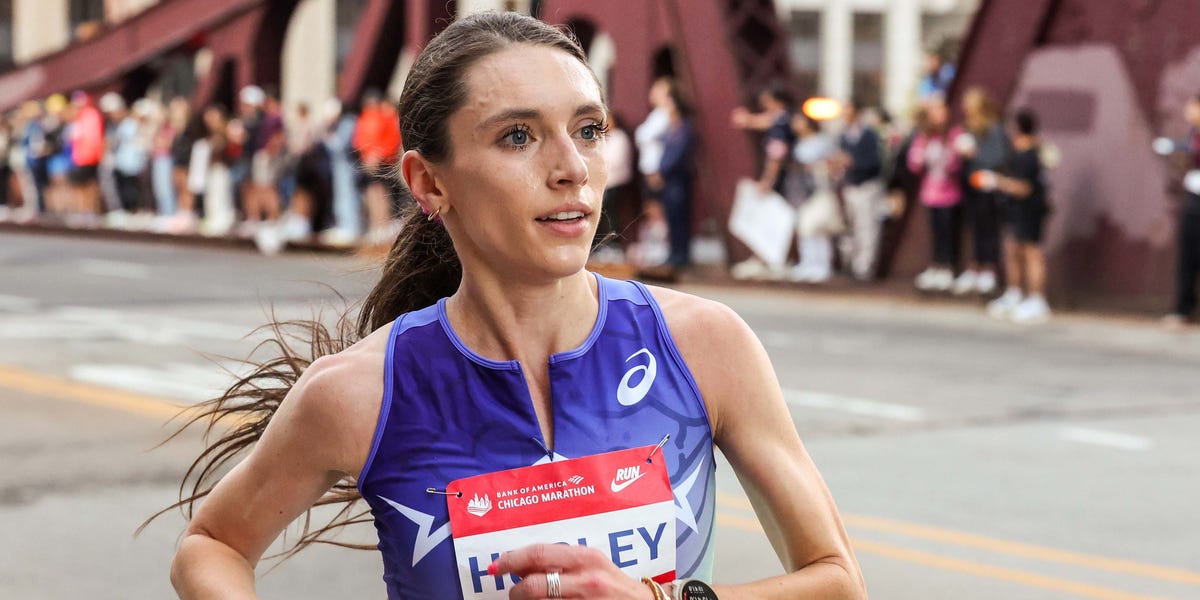
Pro runner Emma Grace Hurley had a few doubts and questions heading into last weekend’s Chicago Marathon, her first 26.2-mile race.Would she and her pacer, Caleb Kerr, end up on separate sides of the road at the race start? How would she manage to grab a bottle from an aid-station table on a crowded course? And how fatigued, exactly, would her legs feel after mile 20?Despite the unknowns—and the significant media attention focused on her marathon debut—Hurley was far more excited and curious than nervous. That’s largely because she and her coach, Andrew Begley, built up to this moment slowly and methodically.Ever since the pair joined forces at the Atlanta Track Club in 2021, they knew she would eventually take on the marathon. But early on in her pro career, they decided her odds of long-term success would be higher if they didn’t rush the process. So, instead, they focused on taking small steps each year that would eventually put her in prime position to make the Olympic marathon team in 2028.On Sunday, their careful planning and long-term vision continued to pay off. Hurley ran her first marathon in 2:20:47, placing seventh overall for women and first American, smashing Fiona O’Keeffe’s American debut record of 2:22:10, and claiming sixth on the list of all-time fastest U.S. marathoners in the process. And, she enjoyed it, even when it got tough in the final miles: “I had fun the whole time,” she said at the post-race press conference.Even those of us not in contention for future Games could benefit from a long-term view of marathon success, Begley says. That might look like waiting to move up to the distance in the first place. Or if you’ve already tackled the marathon and want to improve, a stepwise approach—giving yourself a few races to reach your goal—can also produce better results.Here’s why, and what you can learn from Hurley’s example.You Can Translate Short-Distance Speed to Longer RunsHurley ran well in high school—she was a finalist at the prestigious Foot Locker Cross-Country Championships—and then attended Furman University. She was good but not a standout; her highest finish at the NCAA Cross-Country Championships was 51st, and she graduated with personal bests of 15:57 in the 5K and 36:48 in the 10K.Plug that 5K time into a race calculator, and it predicts around a 2:35 marathon—speedy, but not necessarily Olympic caliber.But Begley saw world-class potential in Hurley and decided to develop it by focusing first on shorter distances. “The more efficient you are, the better—and the only way to get more efficient is to get faster at the shorter events, so that you’re running at a lower percentage of your max when you’re running the marathon,” he says.Begley and his wife Amy, a 2008 Olympian who also coached at the Atlanta Track Club, kept Hurley’s mileage lower than a typical marathoner’s—closer to 70, rather than 100-plus—and her workouts intense. She did one session per week with 800- and 1500-meter runners like Allie Wilson and another with marathoners, and raced distances from the 1500 to the 10K for several years.When the Begleys moved to Indianapolis in 2023 so Amy could take a job with USA Track & Field (USATF), Hurley followed, with Andrew taking the lead in her training and continuing the plan.Now, Hurley’s PRs are 15:01 in the 5K and 31:00 in the 10K—a performance she’s reproduced several times in training, and which makes marathon pace seem far easier, Hurley says.Even now that she’s officially a marathoner, Begley and Hurley see value in continuing to dip down. Next year, Hurley plans to spend the spring targeting distances no longer than a half marathon—including nabbing her Olympic Trials qualifier for the 10K on the roads—before lining up for her second marathon in the fall.Your takeaway: Spend at least a few training blocks focused on the 5K or 10K before your first marathon. After you run 26.2, consider taking at least a cycle or two every year to focus on shorter distances.You Can Find the Best Shoes for YouIn college and in Atlanta, Hurley had a similar, frustrating experience: She’d train hard, feel her fitness peak, then get hurt. While some of that may have been due to her training or other factors, she also thinks she didn’t always have the best footwear for her needs.Furman University was a Nike school, and Atlanta Track Club was sponsored by Adidas. In early 2024, Hurley signed her first individual sponsorship deal with Asics—a brand she was excited about since trying on a pair in her mom’s closet in 2023. “For some reason, the Asics shoes work really well for me,” she says.Your takeaway: Shoe choice is highly individual. Start with a fitting at a specialty running-shoe store—or use our guide to choosing shoes—and experiment with several brands and models until you find the pair(s) that fit well and feel comfortable.You Don’t Have to Make Huge Mileage LeapsAnother potential factor in reducing Hurley’s injury risk: a slow, steady increase in weekly volume and the length of her long runs, rather than big jumps that could sap speed and put extra strain on her body. Before she started marathon training, she averaged around 75 to 80 miles per week.This year, she was usually closer to 90 miles, with five or six weeks above 100 miles. But she didn’t linger there.For marathoners, Begley believes in cycling mileage—touching the top of your range, then decreasing for a week or two before reaching your peak again. (He typically follows a three-week cycle, though Hurley’s racing schedule naturally allowed for deload weeks.) “The marathon is a one-time event that you’re probably going to do every three or four months,” he says. Cycling allows you the benefit of long runs and big workouts, but also affords recovery time, so you have “something left in your legs” on race day.Hurley’s long runs also didn’t have to get much longer when she did jump into her marathon build. She’d already been logging 18 to 20 miles regularly, with the occasional 22-miler thrown into her schedule. “The balance of 20 to 22 versus 18 was heavier on the 20 to 22,” she says. But she didn’t actually extend her longest run farther than that during the official buildup.Your takeaway: Build a solid base of mileage throughout the year and over the years, rather than ramping up rapidly over a single training cycle.You Just Might Feel Less Pressure“One of the things that has always scared me about the marathon is that it feels like everything’s so focused on that one day,” Hurley says, “and there’s, like, a million things that can go wrong.” When they do, it can feel like the weeks and months of hard training were in vain. Setting interim goals offers more opportunities to bounce back from bad races and celebrate good ones.Case in point: This year’s USATF Half Marathon Championships in Atlanta, a qualifying race for the World Athletics Road Running Championships in Copenhagen. Hurley and two other runners—Jess McClain and Ednah Kurgat—were led off course after the 12-mile mark. Hurley, poised to place second, wound up 12th.While officials sorted out a solution to the snafu, Hurley pivoted. She traveled to Chicago to set a new American 8K record of 24:29 at the Shamrock Shuffle in March. Then, she raced the USA 5K Road Running Championships in May, placing second to ensure she could still run in Copenhagen regardless.“My identity is not my results, but it is how I handle them,” Hurley says. “The natural next step was to say okay, well, the goal was to be on this team. What’s the other option?” (USATF and World Athletics eventually announced Hurley and the others who were misled would still be able to represent Team USA in the half marathon.)Hurley’s fifth-place finish and personal best of 1:06:23 in Copenhagen—which helped Team USA to a silver medal—showed Hurley could, indeed, compete with the best in the world, and also helped her breathe a little easier heading into her debut marathon three weeks later. “All these people are trying to talk big about Chicago, and I’m like, ‘Cool,’” she said between the two races. “But even if it goes sideways, I still did this.”Your takeaway: When you hit a setback or a goal race doesn’t go as planned, consider how you can reframe the experience or set a new goal. And remember that no single result, good or bad, defines you—instead, reflect on the joy and resilience running brings you—and all the hard work it took to simply get to the start.You Learn MoreThat’s not to say that Hurley didn’t have big goals heading into Chicago. Beforehand, she said she hoped to finish in the top 10. And on the day, she and Kerr took the first 5K at an aggressive pace—16:24, or 5:17 per mile—because she wanted a chance at a sub-2:20 finish, according to Begley.But her other major objective was to walk away with something to improve upon for next time. So when she attempted to pick up the pace, running a 5:15 mile from 19 to 20, and then faded a bit in the final 10K, she didn’t sweat it too much. “I think it’ll take some more processing,” she said post-race, of what she’d learned on the day. “But I think if anything, I learned to maybe just be two to four miles more patient.”Begley also says that while he believed a fast time and the debut record were entirely within Hurley’s capabilities, he wasn’t too hung up on the outcome. “The first time is just about learning the race and going back to the drawing board and getting it more right,” he says. “And between this race, a fall marathon next year, and the Trials, the goal is that by the third time, you have it down.”Your takeaway: Do a post-race analysis where you determine what went well and what you could improve for the future. Take that knowledge to the next starting line.You Build Confidence Over TimeIn college, Hurley never contemplated running professionally. When she met the Begleys, she appreciated their belief in her, but still wasn’t sure she could live up to their expectations. But year by year, she’s come to realize they just might be right.Part of it has come from her race results—she won the 2024 USATF Running Circuit, then ran 1:08:26 in her half marathon debut later that year. This year, she won both the USATF 10-Mile Championships at the Cherry Blossom 10-Miler and the USATF 25K Championships in Grand Rapids, MI. She’s also buoyed by how she feels in training, able to handle much more challenging sessions with less fatigue.Each step forward, at the time, felt doable. But when she reflects on how far she’s come, she realizes the progress she’s made. And when she looks to the future—2028 and even 2032—she’s still full of enthusiasm. “I was excited before today, and I’m even more excited after today,” she said post-race, when asked how she feels about her future in marathoning. “I can’t wait.”Your takeaway: Whether it’s making an Olympic team, qualifying for the Boston Marathon, or simply getting the most out of yourself over the course of 26.2 miles, big goals will always feel at least a little bit intimidating. Breaking them down into smaller steps over time can improve your sense of possibility and keep you excited and engaged as you strive for them.Cindy is a freelance health and fitness writer, author, and podcaster who’s contributed regularly to Runner’s World since 2013. She’s the coauthor of both Breakthrough Women’s Running: Dream Big and Train Smart and Rebound: Train Your Mind to Bounce Back Stronger from Sports Injuries, a book about the psychology of sports injury from Bloomsbury Sport. Cindy specializes in covering injury prevention and recovery, everyday athletes accomplishing extraordinary things, and the active community in her beloved Chicago, where winter forges deep bonds between those brave enough to train through it.
Emma Grace Hurley’s Marathon Debut Was Years in the Making. Here’s How to Mimic Her Training When Going for 26.2.
Full Article
Original Source
Read the full article at Runnersworld →KhanList aggregates and links to publicly available news content. We do not host full articles from third-party sources. Always verify important information with original sources.