
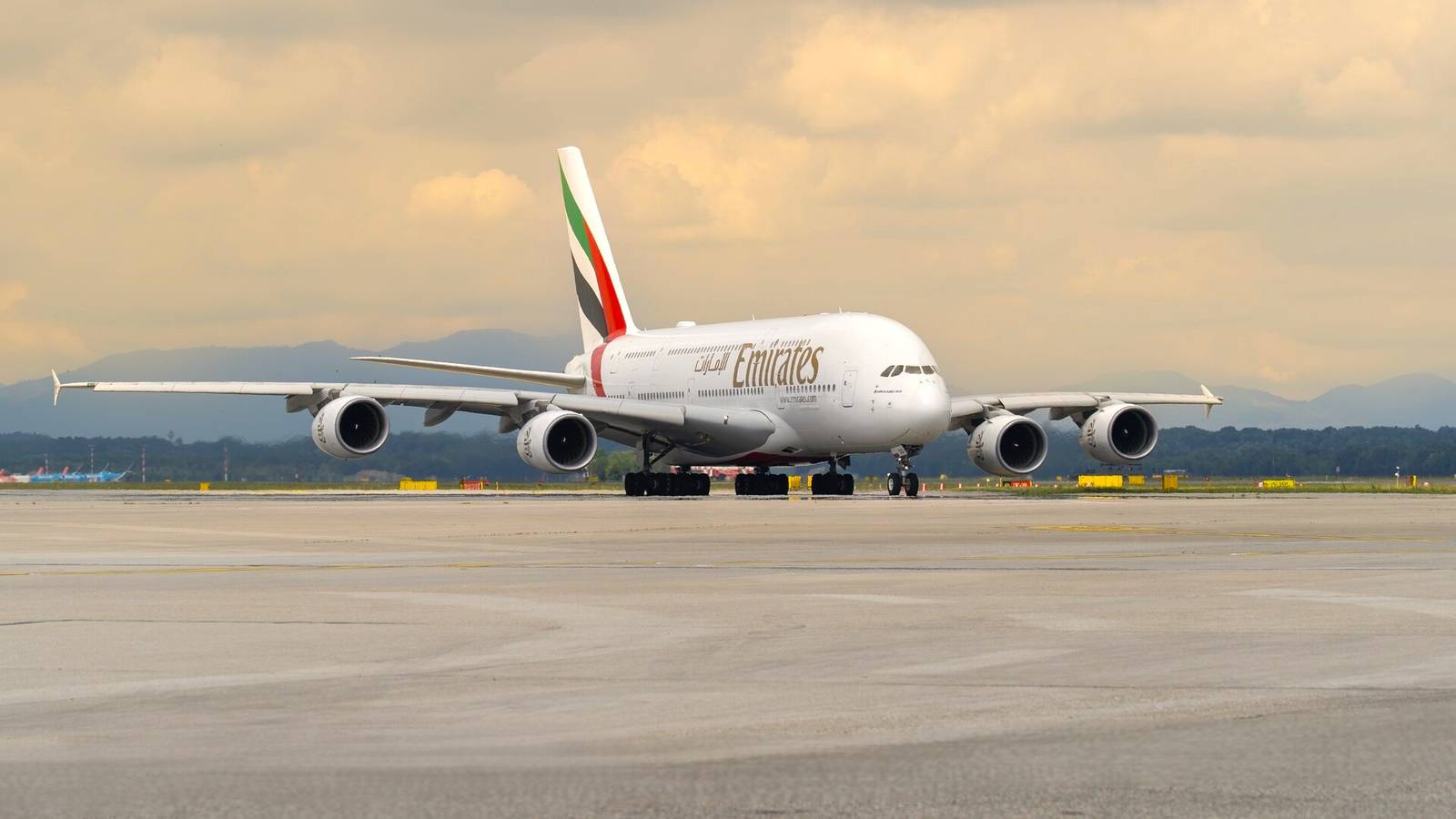
Credit: MC MEDIASTUDIO | Shutterstock Published Oct 7, 2026, 11:02 AM EDT Paul has had a career of 25+ years focused on the international technology sector, which has taken him to over 100 countries. Along the way, he developed a deep love for aviation, with a travel bucket list measured by aircraft types flown rather than destinations reached. Now he brings that avgeek passion, along with the journalism experience he accumulated early in his career, to write insightful pieces for Simple Flying. Sign in to your Simple Flying account Emirates is synonymous with the Airbus A380, operating more examples of the double-decker than any other airline. However, despite its continued dominance of global A380 operations, the Dubai-based carrier has withdrawn the aircraft from nine destinations that once featured regular or semi-regular services. These include major American cities, European destinations, and several important markets in the Middle East. The withdrawals have happened over several years rather than representing nine recent cancellations. Meanwhile, Emirates is increasingly concentrating its A380 capacity on major international routes while undertaking a $5 billion fleet modernization program. With scheduled A380 departures from Dubai falling substantially in 2026, the changes highlight how Emirates' strategy for its flagship aircraft continues to evolve. These Nine Destinations Have Lost Emirates Airbus A380 Service Credit: Michael Derrer Fuchs | Shutterstock Analysis of historical Emirates schedules identifies nine destinations that previously received meaningful A380 operations from Dubai International Airport (DXB), but are absent from the airline's planned network through July 2027. The figures represent historical A380 departures from Dubai, excluding the numerous airports that received only occasional or one-off visits. The withdrawals occurred at different times, reflecting changing commercial requirements, network adjustments, and external disruptions. Destination Historical A380 Departures From DXB Main Period Of A380 Operations Kuwait City (KWI) 1,535 Limited flights in 2011; regular 2014–2018 Hamburg (HAM) 743 Limited flights in 2011; regular 2018–2022 Riyadh (RUH) 532 Limited flights in 2011; regular 2018–2020; returned in 2024 Dallas/Fort Worth (DFW) 489 2014–2018 Muscat (MCT) 375 Limited flights in 2018; regular 2019–2020 Athens (ATH) 213 Limited flights in 2012/2013; regular 2018–2019; one-off in 2021 Boston (BOS) 185 Limited flights in 2017; regular 2019–2020 Doha (DOH) 116 2016–2017 Bahrain (BAH) 37 Semi-regular in 2021 Kuwait International Airport (KWI) comfortably leads the table of discontinued A380 routes, accounting for 1,535 departures, more than twice the total of Hamburg Airport (HAM) in second place. The KWI service now operates up to five times daily with a mix of Emirates' Boeing 777-300ERs and Airbus A350s, while HAM receives twice-daily service with the same aircraft types. When regular A380 operations began in July 2014, the Dubai–Kuwait route was the world's shortest scheduled A380 service, but Muscat International Airport (MCT) (also on the discontinued list) subsequently claimed that distinction in July 2019, when Emirates introduced twice-daily A380 flights covering just 211 miles (340 km). The withdrawal of Doha Hamad International Airport (DOH) was different, following the suspension of flights between the UAE and Qatar during the 2017 diplomatic crisis, and Emirates still does not fly to the Qatari capital. For American travelers, Dallas/Fort Worth International Airport (DFW) and Boston Logan International Airport (BOS) are particularly notable. Dallas welcomed Emirates' first scheduled A380 in October 2014, while Boston received the aircraft during peak travel periods beginning in June 2019. Both subsequently reverted to smaller aircraft, with Dallas now served by Emirates' small Boeing 777-200LR sub-fleet, while just five US cities retain Emirates A380 service. These Are Emirates' Ten Largest Airbus A380 Destinations Credit: KarlosWest | Shutterstock While nine destinations have disappeared from the A380 network, other airports continue receiving enormous amounts of capacity. London Heathrow Airport (LHR) dominates the planned schedule through to July next year, with 1,638 departures, equivalent to six daily A380 flights. Heathrow's constrained runway slots and strong premium demand make large aircraft particularly attractive, enabling Emirates to maximize passenger numbers without securing additional slots. As Emirates President Sir Tim Clark famously said when discussing Heathrow demand in 2022: “For those A380 flights, I could park a Boeing 777 next to it, and fill it up as well. Demand is that strong.” Rank Destination A380 Departures A380 Seats Average Daily A380 Departures 1 London Heathrow (LHR) 1,638 812,342 6.0 2 Bangkok (BKK) 1,062 564,754 3.9 =3 Cairo (CAI) 819 404,159 3.0 =3 Paris CDG (CDG) 819 405,508 3.0 =3 Jeddah (JED) 819 407,825 3.0 =3 Manchester (MAN) 819 428,743 3.0 =3 New York JFK (JFK) 819 392,847 3.0 =8 Sydney (SYD) 672 325,878 2.5 =8 Hong Kong (HKG) 672 327,458 2.5 =8 Singapore (SIN) 672 328,208 2.5 The long-haul destinations demonstrate the A380's importance to Emirates' global connecting network. Bangkok Suvarnabhumi Airport (BKK) ranks second, averaging almost four daily departures, while Paris, Manchester, New York, Sydney, Hong Kong, and Singapore combine substantial local traffic with passengers connecting through Dubai. Concentrating hundreds of seats into individual departures also supports the airline's hub-and-spoke model, particularly where demand is sufficiently consistent to fill large aircraft throughout the year. However, Cairo International Airport (CAI) and Jeddah Airport (JED) demonstrate that the A380 is not exclusively a long-haul aircraft. Cairo benefits from substantial business, leisure, and connecting demand, while Jeddah attracts considerable religious travel associated with Hajj and Umrah. These markets allow Emirates to deploy high-capacity aircraft on comparatively short sectors, demonstrating that passenger volume can be just as important as route length when determining where the A380 operates. Why Emirates' Airbus A380 Flying Has Fallen So Sharply In 2026 Credit: Markus Mainka | Shutterstock However, it is worth noting that Emirates' A380 operations have experienced a significant setback during 2026. Current full-year schedules indicate 24,300 departures from Dubai, a 15.4% reduction compared with last year. Available seats have fallen even faster, declining 17.4% to 12.29 million. Regional conflict has contributed to the disruption, primarily in the first half of the year, with Emirates grounding aircraft, temporarily replacing A380s with smaller aircraft, or reducing frequencies across multiple destinations. Year A380 Departures From DXB Available A380 Seats 2017 26,996 13,201,044 2018 28,760 14,063,640 2019 29,438 14,395,182 2020 7,690 3,763,551 2021 6,136 3,041,915 2022 17,439 8,890,953 2023 25,252 12,996,975 2024 27,794 14,297,892 2025 28,731 14,880,556 2026 24,300 12,294,851 Another significant consideration is Emirates' enormous retrofit program. The airline is investing $5 billion upgrading 219 aircraft, including 110 A380s and 109 Boeing 777s. By July of this year, it had completed 47 A380 refurbishments, with approximately 20 additional aircraft across both types expected to follow before year-end. The work introduces Premium Economy, redesigned cabins, upgraded entertainment, and connectivity improvements. However, each aircraft undergoing refurbishment must leave revenue service for approximately a month, creating additional fleet-planning constraints. Crucially, Emirates is also reducing capacity on its highest-density A380s. Its 15 two-class aircraft are being converted from 615 seats to 569, adding 56 Premium Economy seats while expanding Business Class from 58 to 76 seats. Across the wider fleet, average seats per scheduled A380 departure have declined from approximately 518 in 2025 to 506 in 2026, resulting in available seats dropping more sharply than departures. However, the net takeaway is that Emirates is modernizing rather than abandoning its flagship, showing a commitment to the type for years to come, and accepting temporary disruption to improve its long-term competitiveness.
Emirates Has Axed Airbus A380 Flights On 9 Major Routes: See List Now
Full Article
Original Source
Read the full article at Simpleflying →KhanList aggregates and links to publicly available news content. We do not host full articles from third-party sources. Always verify important information with original sources.