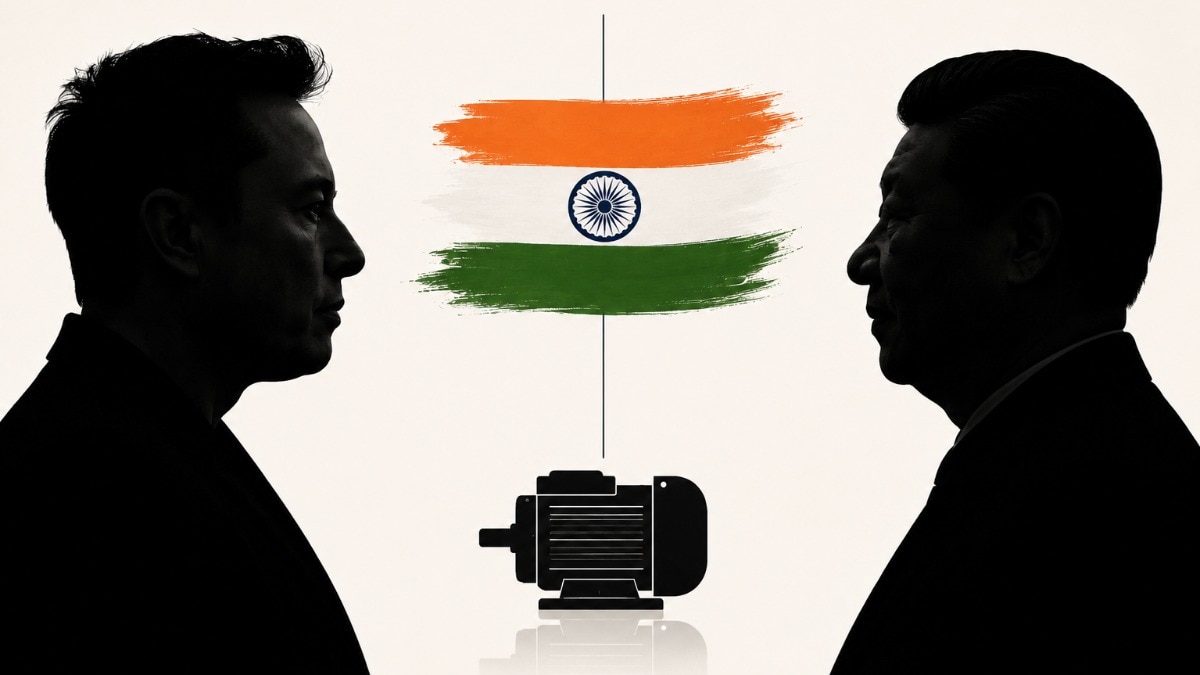
Tesla announced at its March 2023 Investor Day that its next-generation electric motors will contain zero rare earth materials. How and when, we do not know, to this day. As the world waits with bated breath for Tesla to reveal its next big electric vehicle (EV) breakthrough, an Indian startup called Vimag Labs has come out and beaten Elon Musk and Co. to the punch with its Virtual Magnet Synchronous Motor (VMSM) platform.Operating on a modest $5 million budget, Vimag—a Bengaluru-based deep-tech startup—claims to have cracked the code for alternative motor technology using just raw steel, copper coils, and software. “Think of our technology as generating a software-defined magnet inside the motor,” Manish Seth, CEO and co-founder of Vimag Labs, told India Today Tech in a recent interview. “We remove permanent magnets, replace them with copper coils, and then through software, we generate magnetic fields inside the motor. The trick is how to convert the copper inside the motor into magnets, and that we do through software and electronics.”A star is bornNo magnets. No rare earths. Those are the keywords here given how the solution—if successful—may hold the key to—eventually—breaking China's rare earth monopoly.“First, real credit to the team—this is exactly the kind of deep-tech problem-solving India needs more of, and doing it at home makes it more impressive,” says Gaurav Vangaal, Associate Director of Light Vehicle Production Forecasting at Mobility Global. “Motors that run without rare earth magnets already exist and are on the road today. What’s clever here is that Vimag is using software to do the job the magnet normally does. So, the real story isn’t ‘no magnets’—it’s the software trying to deliver the same power and efficiency a magnet would.” High-performance EV motors typically rely on permanent magnets. To give you some perspective, permanent magnets accounted for more than 80 percent of the global EV motor market as of 2022, according to IDTechEx research. Permanent Magnet Synchronous Motors (PMSM) do not require any external power source to stay magnetic, making them incredibly compact and efficient. This is why they are highly sought-after for commercial use.When you remove the magnets, you have to create the magnetic field artificially. Tesla used AC Induction Motors (ACIM) inside the original Model S and X for instance (before moving to a permanent magnet motor in future cars like the Model 3). Synchronous Reluctance Motors (SynRM) and Switch Reluctance Motors (SRM) are other alternatives. Ferrite-based magnet motors like the ones announced by Ola Electric can be an option as well. But each of them—induction motors included—presents its own set of challenges—related to size, efficiency, or all-round performance. Vimag Labs chose to go the other way, replacing rare earth magnets from the rotor with standard copper coils and steel, then using software to transfer power wirelessly inside the motor—manipulating the electromagnetic spectrum like a high-tech transformer.“Vimag has shown that a software-led approach can reduce dependency on rare earth and with time may completely eliminate it as well,” explains Anil Joshi, Managing Partner at Unicorn India Ventures. “From what we know so far, it appears that the innovation done by the company is a combination of hardware, software, and advanced control algorithms. We have been seeing this trend gather steam where software and AI algorithms are becoming a strong differentiating factor with a balanced hardware play.”The advantages are twofold. Vimag says its software-defined magnet motors can match or even exceed the performance of a conventional Permanent Magnet Synchronous Motor (PMSM). Plus, since it can dynamically adjust the magnetic field in real time, these motors can also—at least in theory—improve driving range, effectively reducing the number of battery cells an EV needs.“Imagine the possibilities if a software can replicate and, in some cases, surpass performance metrics without requiring rare earth magnets—now that's potentially game-changing. This can result in lower costs for manufacturers, greater design flexibility, and more resilient supply chains with short delivery time,” Joshi adds.The elephant in the room is, of course, China. For years, it has single-handedly dominated the rare earth supply chain, controlling roughly 90 percent of the world’s rare earth minerals and about 94 percent of the magnets used in high-power electric motors, per data from the International Energy Agency (IEA). When China restricted rare earth exports in 2011, neodymium prices spiked 750 percent, and dysprosium surged by 2,000 percent. China dominates the supply of rare-earth minerals globally. (Photo: Reuters) “The demand is real,” notes Vangaal. “Rare earth magnets can make up nearly a third of a motor’s cost, and most of the world’s supply is controlled by one country—so every carmaker wants a backup plan.”Rare earth mining also comes with grave environmental costs. India has vast deposits of rare earth minerals, but developing a refining ecosystem is a long, arduous 15-year project, Seth told India Today Tech. Given that timeline, it is no wonder nations worldwide are racing to secure resource sovereignty.“The recent disruption in rare earth magnet supplies has reminded the industry that technology choices are no longer driven only by performance,” Vijay Kumar, the Founder & CEO of Tsuyo Manufacturing Private Limited says. “They are also influenced by supply chain resilience. OEMs (Original Equipment Manufacturers) are now actively evaluating multiple motor technologies, including magnet-free solutions, ferrite-based motors, and optimised induction or reluctance motors.”This shift opens up a massive business opportunity. “The potential is substantial as the EV industry seeks to diversify technologies while reducing exposure to raw material price volatility and supply chain disruptions,” says Hitesh Garg, Vice President and India Managing Director at NXP Semiconductors.The trial by fireNaturally, you’d think if eliminating rare earth magnets is so important, why isn't every Tesla on the road already running on magnet-free software? The answer is, well, physics.“Every technology possesses its own merits and demerits,” Kumar notes. “Alternative technologies inevitably introduce complexities and necessitate advancements in hardware which cannot be overlooked or fully mitigated. Software can compensate for many aspects of motor control, but it cannot completely eliminate the underlying physics.”A permanent magnet stays mostly cool while doing its job. When you use software and advanced electronics to force a magnet-free rotor to create the same pull, the motor has to work significantly harder. As Vangaal points out, “This generates extra heat in the hardest part of the motor to cool. Managing that heat reliably, year after year, is the part still to be proven—in real driving, not just the lab.”Rare earth magnets can cram a large amount of magnetic force inside a very small space. Scraping them out usually means building a larger, heavier motor to be able to achieve the same level of horsepower. Samples of rare-earth minerals. (Photo: Reuters) Moreover, going magnet-free doesn't suddenly make you completely self-contained. “You swap a reliance on rare earth magnets for a reliance on chips and electronics, which come with their own supply worries,” warns Vangaal.If your motor relies entirely on algorithms to run smoothly, your software architecture must also be bulletproof. “Since we are talking about sophisticated control algorithms, the software should be able to perform safely under all conditions including hardware failure or environment extremism depending on the geography. The software should be fully secure and robust to continuously perform better and ensure safety of the man and the machine,” Joshi says.Needless to say, Vimag is entering a space where margins for error are incredibly thin.“This remains a very early-stage technology. It is attempting to address challenges that have traditionally been constrained by some fundamental trade-offs in motor physics,” Garg explains. “Extracting comparable performance will also require advanced power electronics, intelligent motor control software, and robust functional safety systems. The real innovation will ultimately be measured by how effectively these technologies perform under real-world automotive conditions at scale.”Breaking the chainsWhat makes India stand out is its unique market composition and deep software engineering talent pool. Unlike Western markets, which are dominated by heavy SUVs and long-range passenger cars, India’s EV revolution is playing out on two and three wheels. So, it is only befitting that Vimag, too, is currently focusing on electric two- and three-wheeler ecosystems.“The natural starting point is India’s electric two-wheelers, three-wheelers, and small commercial vehicles—affordable segments where local players are open to trying new things,” says Vangaal. These smaller, urban fleet vehicles operate on predictable duty cycles where power density is less critical than total cost of ownership and supply security. Passenger cars will take longer.Kumar agrees that this is where magnet-free tech can carve out its first major commercial stronghold: “For commercial vehicles, fleet applications, and certain two and three-wheeler segments, where cost, durability, and supply security are critical, magnet-free motors could become a viable alternative.” Vimag Labs' solution generates a software-defined magnet inside the motor. Furthermore, the Indian government is playing a highly strategic double game. It isn't putting all its chips on a single technological breakthrough. Instead, it is actively hedging its bets across the entire ecosystem.“It’s not either-or—and importantly, these are two separate bets,” Vangaal says. “India is spending Rs 7,280 crore under its REPM scheme to make rare-earth magnets at home, so it depends less on China for supply. The scheme doesn’t fund magnet-free tech, and that’s exactly the point: if magnets stay dominant, the scheme pays off; if magnet-free motors mature, the startups do. India is hedged either way.”This dual strategy ensures that as vehicles become increasingly software-defined, India can leverage its rapidly growing electronic ecosystem. “India is well positioned to support this transition through its rapidly expanding semiconductor ecosystem and automotive engineering capabilities,” Garg adds. He points out that the proposed Rs 1.25 lakh crore India Semiconductor Mission 2.0 (ISM 2.0) plan will be vital because “advanced semiconductors and intelligent control systems will be critical to delivering efficient, safe, and scalable electric mobility solutions tailored for both Indian and global markets.”That said, China isn't just a leader in mining rare earths. China is also a manufacturing juggernaut. Power electronics, batteries, classic automotive casting, you name it—China makes them all. Legacy manufacturers don’t buy patents. They buy validated components that have been stress-tested for hundreds of thousands of hours.“Developing deep tech products that haven't existed before should overcome the scalability challenge,” Joshi says. “At a prototyping stage, a tech can perform better, but at the same time it should be agile enough to be manufactured at scale for commercial roll-out and offer that same quality and efficiency that the end users expect and have been promised.”Vimag Labs has a long road ahead. Its motors are currently in testing, but scaling up to commercial deployment is an entirely different challenge. The startup plans to ship between 1,000 and 10,000 motors by the end of this year.“Customer adoption will be the key challenge for such new technologies,” Joshi continues. “Even at the testing stage, OEMs will test such a groundbreaking tech through a rigorous qualification and validation cycle, which means a longer waiting period for the deep tech company before seeing the revenues kick in.”Garg agrees, noting that a technology can only claim victory once it proves its mettle in the real world. “Alternative motor architectures must demonstrate competitive efficiency, thermal performance, durability, and lifecycle costs while being supported by a mature manufacturing ecosystem.”Permanent magnet motors aren’t going anywhere. Not yet anyway. This is especially true for high-performance, premium passenger cars that require absolute peak power density in a microscopic package. “Permanent magnet motors will continue to play an important role for the foreseeable future. Widespread adoption will ultimately depend on real-world validation rather than just technical demonstrations,” Kumar says.But if the goal is to break a monopoly, create an alternative supply architecture, and prove that Indian engineering can build world-class, deep-tech intellectual property, Vimag’s tech is a step in the right direction.“The exploration of new technologies is essential for developing a forward-looking technology roadmap,” Kumar says, steering the conversation toward long-term strategy rather than overnight disruption. “The goal is not simply to replace one motor with another. The goal is to ensure that India's EV industry remains globally competitive, technologically self-reliant, and resilient against future supply disruptions. We believe India's strength will come from engineering flexibility.”Vimag’s pursuit to build indigenous motors without permanent magnets is a sign that change is—finally—in the air. India is moving from localising Western influences toward a self-reliant future—one that the West would want to copy.“What I find most encouraging is the bigger picture—young Indian founders channeling their talent into solving the country’s own real problems, rather than chasing easier bets,” Vangaal concludes. “That’s the direction our startup ecosystem should be backing. If even one of these ventures scales, India moves from being a magnet importer to a genuine innovator. That’s the story worth watching.”- EndsPublished By: Armaan AgarwalPublished On: Jul 19, 2026 08:40 IST
Elon Musk promised it, this $5 million Indian startup built it. But can it beat China?
Full Article
📰 Original Source
Read full article at Indiatoday →KhanList aggregates and links to publicly available news content. We do not host full articles from third-party sources. Always verify important information with original sources.