
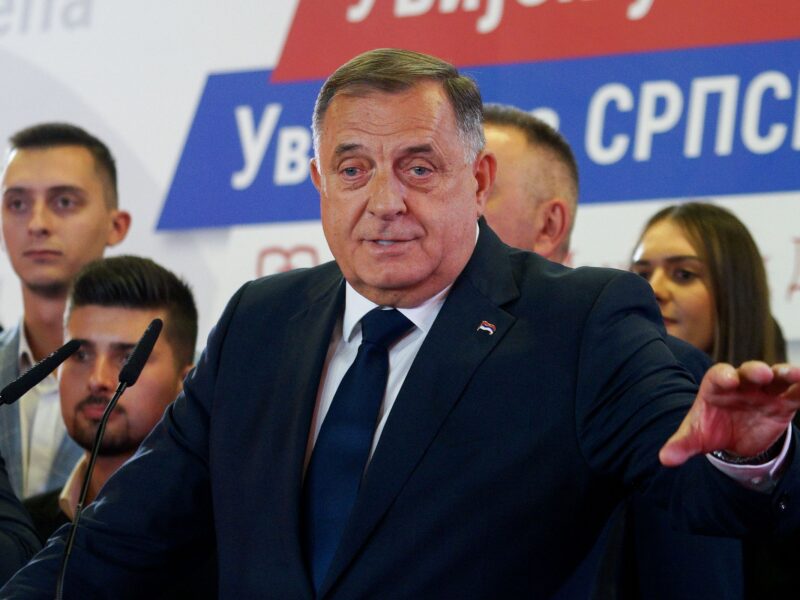
Milorad Dodik, a banned Bosnian Serb leader and secessionist, thanked Donald Trump and Vladimir Putin for his Serb nationalist party's strong showing.(CN) — Bosnia-Herzegovina, the small multiethnic Balkan nation haunted by war and riven by divisions, was left in a deeper state of paralysis after general elections Sunday solidified the power of Bosnian Serb secessionists.The result was a major setback for those hoping to see the country join the European Union any time soon. Bosnia-Herzegovina, like its neighbors in the Balkans, has long sought to become an EU member, but its internal divisions and deep corruption pose major obstacles.The election saw historically low turnout with only 42% of voters casting ballots, a reflection of the frustration many of the 3.4 million inhabitants feel after years of political deadlock and economic stagnation. Turnout dropped 9.5% from the previous nationwide elections in 2022.Sunday’s election reinforced the power of Serb nationalists in Republika Srpska, a semi-autonomous Serb-dominated part of the country, and brought Croat nationalists back into the country’s tripartite presidency for the first time in years. It was a combination analysts said posed new challenges to the country’s complex post-war constitutional order that was designed after the 1992-1995 Bosnian War to ease ethnic tensions and unify the country.For years, Bosnia-Herzegovina’s politics have been dominated — and poisoned — by the secessionist drive of its longtime leader, Milorad Dodik.In August 2025, Dodik, 67, was banned from public office and forced to resign because his secessionist policies were deemed a threat to the constitutional order and violation of the Dayton peace agreement.Pro-EU politicians in Sarajevo, the capital, and officials in Brussels and Washington hoped his ouster would tame the secessionist drive and help heal divisions.But that didn’t happen. Sunday’s election was a confirmation of Dodik’s enduring appeal and showed many Serbs in the Republika Srpska favor breaking away from Bosnia-Herzegovina and joining neighboring Serbia.Although he was not on the ballot due to his ban, Dodik’s Alliance of Independent Social Democrats won about 39% of the vote for Republika Srpska’s National Assembly. Dodik’s close ally, Savo Minić, was expected to become the next president of the semi-autonomous entity.Dodik credited U.S. President Donald Trump for his party’s win. Trump lifted sanctions the Biden administration imposed on Dodik and dozens of his allies.“If there had not been Trump’s magnificent victory, we would probably be politically dead today, but thanks to the new environment, we are now political winners,” Dodik told supporters Sunday night.Dodik also thanked Russian President Vladimir Putin for his party’s success. Dodik and Minić visited Putin in Moscow days before Sunday’s election.Željka Cvijanović, another Dodik ally, was expected to serve a second term as the Serb member of Bosnia’s tripartite presidency.The other two presidential posts were set to be filled by Denis Bećirović, an incumbent representing the Muslim Bosniak electorate, and Darijana Filipović of the Croatian Democratic Union for the Croat seat. Her party is considered a Croat nationalist force.The Dayton peace agreements that ended Bosnia’s war set up a complex system of government designed to represent the country’s three main ethnic groups through a multiethnic tripartite presidency, a central parliament and institutions for two semiautonomous entities — the Serb-run Republika Srpska and the Bosnia-Herzegovina federation.In the Bosnia-Herzegovina federation elections, the Party of Democratic Action, a Bosniak nationalist party, won 31.5% of the vote with the Social Democratic Party, a left-wing group, coming in second with 16.6%. A collection of smaller parties picked up the rest of the votes.Dodik and his party are pro-Russian and anti-NATO while the other major parties in the country are pro-EU and favor NATO.Courthouse News reporter Cain Burdeau is based in the European Union.Subscribe to our free newslettersOur weekly newsletter Closing Arguments offers the latest about ongoing trials, major litigation and rulings in courthouses around the U.S. and the world, while the monthly Under the Lights dishes the legal dirt from Hollywood, sports, Big Tech and the arts.Additional Reads
Elections leave Bosnia-Herzegovina mired in ethnic divisions, complicating EU path
Full Article
Original Source
Read the full article at Courthousenews →KhanList aggregates and links to publicly available news content. We do not host full articles from third-party sources. Always verify important information with original sources.