
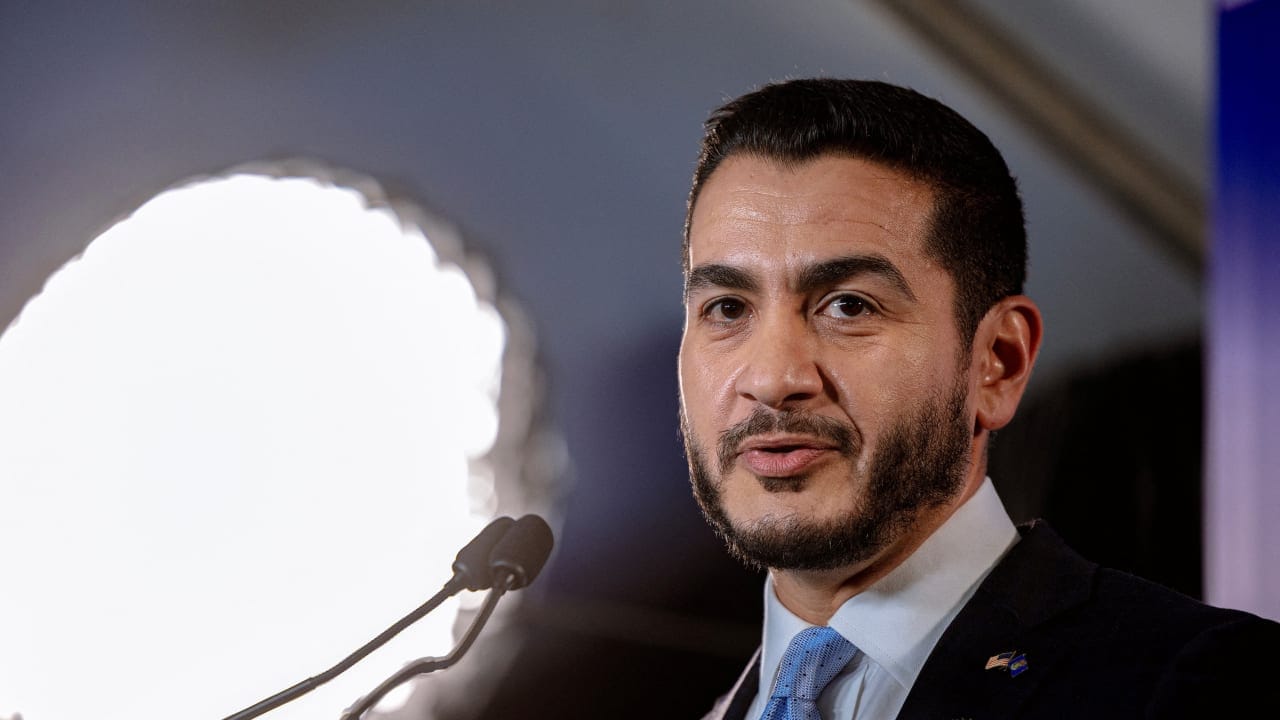
The appearance of Michigan Senate candidate Abdul El-Sayed at Greater Emmanuel Institutional Church of God in Christ (COGIC), alongside Congressman Jim Clyburn, raises serious questions that cannot simply be ignored.This was not an ordinary political appearance. It took place inside one of America's most significant black churches, within the largest predominantly black Pentecostal denomination in the United States, under the leadership of presiding Bishop J. Drew Sheard.When a church opens its doors to a political figure whose rhetoric about Israel has raised serious concerns within the Jewish community, its leadership has a responsibility to address those concerns. A church should never become a platform where rhetoric that fuels hostility toward the Jewish people goes unchallenged.El-Sayed has characterized Israel's military campaign in Gaza as genocide, described the Israeli government as being as evil as Hamas, and questioned Israel's future as a Jewish state. He has also repeatedly connected American support for Israel to Michigan's inability to provide affordable schools, healthcare, and childcare.The controversy over El-Sayed's position became even more pronounced on November 2, when he was directly asked during a CBS 60 Minutes interview whether Israel has a right to exist.Democratic US Senate nominee Abdul El-Sayed addresses supporters during a campaign rally in Detroit, Michigan, US October 24, 2026. (credit: REUTERS/REBECCA COOK)He answered yes, but qualified his response by saying that Israel's future should depend on an agreement between Israelis and Palestinians, whether through two states or one shared state.For the Jewish community, this is not an abstract political debate. It concerns the future of Israel as the Jewish homeland and the right of the Jewish people to determine their own future.These statements raise questions that extend beyond ordinary disagreements over foreign policy. They concern how Israel is portrayed, whether the Jewish people's right to self-determination is respected, and whether the Jewish state is being turned into a scapegoat for America's domestic problems.Consider the political advertisement released by Rebellion PAC supporting El-Sayed. It depicts a husband and wife shopping for groceries. The wife tells her husband they must put the eggs back because they have set aside seven dollars for killing Palestinians.The message is unmistakable: American families are struggling because America supports Israel. Blaming Israel for the financial struggles of American families echoes a deeply dangerous history of blaming Jews for society's economic problems.When Israel becomes the explanation for everything from grocery prices to healthcare costs, we must recognize the danger of allowing an entire people and their homeland to become a convenient scapegoat.Imagine reversing the situationImagine a political figure associated with the Ku Klux Klan being invited into one of America's most historic churches immediately after making statements blaming black Americans for destroying the country. Imagine that figure being given a platform and welcomed before the congregation without any public acknowledgment of the hateful rhetoric.The outrage would be immediate, and rightly so. The same principle of moral responsibility must apply when rhetoric targeting the Jewish people is given a platform in the Church. For many Jewish Americans, welcoming El-Sayed without addressing his statements about Israel sends a deeply troubling message.The Jewish people understand persecution. They understand what happens when hatred becomes acceptable, when accusations become normalized, and when those who should speak out decide that silence is more politically convenient.The black church understands these things, too.That shared history should make this moment an opportunity for solidarity, not division.I know the ugliness of racism firsthand. I grew up in a home where hatred was not hidden. My father hated both Jews and black people. He would say, “The blacks are ruining the country, and the Jews are running it.”I learned early what happens when hatred takes root in a person's heart. When I was 11 years old, I tried to defend my Jewish mother from my father's abuse. He responded by strangling me. I have never forgotten that moment.I know what it means to stand between hatred and its victims. I know that racism and antisemitism are not simply words or political talking points. They destroy lives, families, and communities. That is why I refuse to remain silent when I see rhetoric that threatens to normalize hatred against the Jewish people.A historic relationship must not be sacrificed for political convenienceFor generations, black and Jewish communities have stood together in the struggle for civil rights, religious freedom, and human dignity. Jewish Americans supported the Civil Rights Movement. Black pastors and Christian leaders have stood with the Jewish people and the nation of Israel through some of its darkest hours.That relationship is not merely political. It is deeply rooted in the biblical story.The God of Abraham, Isaac, and Jacob is not a God who changes His covenant according to the political climate. The Scriptures teach Christians to pray for the peace of Jerusalem. The Jewish people are woven into the very foundation of the Christian faith.Approximately 500 black pastors from the Church of God in Christ are in Israel this month, walking the land, experiencing its history, meeting its people, and strengthening relationships that transcend politics. Their presence is a powerful reminder of the deep relationship that exists between Black Christian leaders and the Jewish people.I have no doubt that the actions of one pastor do not represent the convictions of an entire denomination. The relationship that has been built between black Christian leaders and Israel is far too significant to allow one political appearance to define it.But precisely because that relationship matters, the denomination must speak.Leadership carries responsibilityBishop J. Drew Sheard is not simply another pastor. He is the presiding Bishop of the Church of God in Christ. His position carries enormous influence and spiritual responsibility.When a church opens its doors to a political candidate during an election campaign, it provides more than a physical location. It provides a platform, visibility, and an opportunity to reach people who trust its spiritual leadership.The November 1 gathering at Greater Emmanuel deserves an honest explanation. Bishop Sheard must ask himself a difficult question: Why was this candidate welcomed into his church, given a platform before his congregation, and permitted to address his people without a clear public response to the statements that have so deeply concerned the Jewish community?The responsibility of spiritual leadership extends beyond opening the church doors. It includes protecting the integrity of the message being communicated from its platform.Bishop Sheard and the leadership of COGIC should publicly affirm that antisemitism has no place in the Church of God in Christ. They should make clear that criticism of Israeli government policy must never become an excuse to demonize the Jewish people, deny their right to self-determination, or blame Israel for America's economic problems.This is not about demanding that every pastor agree on every political issue. It is about recognizing the difference between political disagreement and rhetoric that can reinforce historic hatred.Even within the Democratic Party, there were voices of concernCongresswoman Haley Stevens publicly challenged El-Sayed over the advertisement and his rhetoric about Israel. Stevens, whose fiancé is Jewish, raised concerns about the message being communicated and called for a clear condemnation.Her intervention demonstrates that concern about antisemitism is not confined to one political party. It is a matter of conscience that transcends partisan affiliation. When rhetoric reinforces historic antisemitic accusations, people of conscience have a responsibility to speak.Congressman Jim Clyburn's participation in the November 1 church appearance also deserves examination. His endorsement of El-Sayed and participation in an event intended to mobilize black voters brought additional political legitimacy to a candidate whose statements about Israel have generated serious controversy.Political leaders have a responsibility to consider not only the immediate electoral purpose of their appearances but also the broader messages communicated by the platforms they choose to share.When Jewish Americans express alarm, those concerns deserve to be heard rather than dismissed as political distractions.The responsibility to confront antisemitism does not belong to one political party. It belongs to every person and institution that claims to stand for justice.This is a defining moment for Christian leadershipWe are witnessing a dangerous convergence of political rhetoric, historical ignorance, and growing hostility toward the Jewish state. Antisemitism does not always arrive wearing a uniform. Sometimes it comes wrapped in political slogans. Sometimes it appears in campaign advertisements. Sometimes it enters through a church door under the banner of political unity.And sometimes it survives because good people refuse to confront it.What we are witnessing is not an isolated incident. When political leaders repeatedly portray Israel as the source of America's problems, campaign advertisements turn Jewish self-determination into an economic scapegoat, and influential churches provide platforms without challenging the rhetoric, an antisemitic fire is being fueled on a seismic scale.The danger is not simply what is being said today, but what future generations will come to believe if responsible leaders refuse to speak out.The Church of God in Christ has an extraordinary legacy. Its pastors have preached the Gospel, served communities, stood against injustice, and carried the message of Christ across generations. That legacy deserves to be protected.There are hundreds of black Christian leaders who have stood with Israel. The longstanding relationships between black pastors and Jewish leaders have been built on mutual respect, shared faith, and a common understanding of persecution.Those relationships must not be compromised by political expediency.I am not asking the Church of God in Christ to endorse a political party or candidate. I am asking it to uphold a biblical standard.Denounce antisemitism. Reject the demonization of Israel. Affirm the dignity and security of the Jewish people. And explain why a platform of such spiritual significance was extended without first addressing these concerns.The prophet Amos declared, "Let justice roll down like waters, and righteousness like a mighty stream" (Amos 5:24).Justice cannot be selective. We cannot condemn hatred when it is directed toward one people and excuse it when it is directed toward another.The black church has too much history, too much spiritual authority, and too much moral influence to remain silent.The Jewish people have known what happens when the world looks away. Christians should never become another voice looking away.Silence is not neutrality when hatred is given a platform.Dr. Mike Evans has written 120 books and is a #1 New York Times bestselling author. He is the founder of the Friends of Zion Museum in Jerusalem, the Ten Boom Museum in the Netherlands, and Churches United with Israel, one of the largest Christian Zionist networks in America, with more than thirty million followers.
El-Sayed’s church appearance raises questions about antisemitism, Israel - opinion
Full Article
Original Source
Read the full article at Jpost →KhanList aggregates and links to publicly available news content. We do not host full articles from third-party sources. Always verify important information with original sources.