
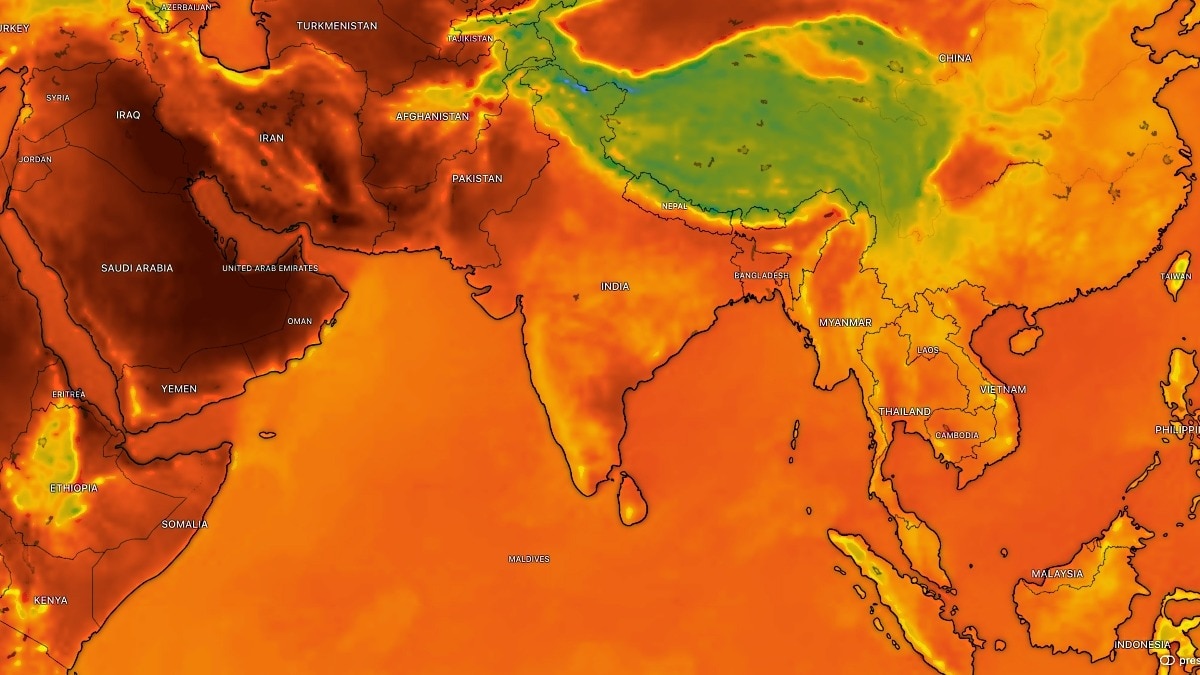
The El Nino taking shape over the Pacific is proving more than another turn in a climate cycle.El Nino events during the past 40 years have been nearly 40% stronger than those of the pre-industrial era, and stronger than any seen in the previous 1,000 years, a new study has found.CORAL REEFS REVEAL CLIMATE RECORDEl Nino is a recurring warming of the tropical Pacific that can shift winds, rainfall and temperatures far beyond the ocean where it begins. Its effects can include droughts as well as rain, floods, wildfires and food insecurity.Researchers behind the study examined cores from 13 modern and ancient corals in the Galapagos Islands and, as it turns out, their chemistry preserved clues about seawater temperature over several decades. You're looking live at El Nio going "full-tilt" to start meteorological fall. Once in a lifetime event.Three monster hurricanes in E. Pacific w/Hawaii splitting the uprights.Moisture from Hurricane Marie is going to inundate U.S. desert Southwest with major monsoon! pic.twitter.com/WN6G8gM2ra— Ryan Maue (@RyanWeather) September 1, 2026 The team found that strong El Ninos become especially prominent over the past four to five decades, while earlier events showed a “pretty consistent pattern of lower intensity."“We don't see a time in the past where El Ninos have been as strong as today, and we show that the strength of El Nino changes in parallel with the warming of global temperature,” said lead author Julia Cole of the University of Michigan.SHOULD INDIA BE WORRIED ABOUT EL NINO? India is sensitive to El Nino, which has been evident this year.Historically, the climate phenomenon has been linked to weaker monsoon rainfall, higher temperatures and longer dry spells. A farmer walks across a partially dried up paddy land. (Photo: PTI) In June, the India Meteorological Department (IMD) had confirmed El Nino and that it expected it to strengthen during the monsoon.Japan's Meteorological Agency declared it a day earlier.Although a possible positive Indian Ocean Dipole (IOD) offered some hope of cushioning its impact, India's June rainfall still ended nearly 40% below normal and has been deficient ever since.“The question is not whether the current El Nino is going to happen, but how bad is it going to be, and how bad will the impacts be?” Cole said.The most aggressive El Nio forecast currently belongs to Italy's CMCC model, which shows a remarkable +5.1°C in January.One clue: CMCC maintains strong westerly wind anomalies farther east than most models, ranking #1 in the eastern Pacific in November and #2 in December. pic.twitter.com/x9awsyEloP— Ben Noll (@BenNollWeather) August 12, 2026The researchers said that the bigger concern is not El Nino but El Nino playing out on a warmer planet.“This event is superimposed on global warming, and it's likely to supercharge the temperature increase that we would normally see from greenhouse gases,” Cole said.Forecasts cited in the study suggest temperatures could reach 1.7-1.8°C above pre-industrial levels.It's looking like a toasty start to September in the central and eastern U.S., with the potential for some record heatSimilar to September 2015, during the last super El Nio. pic.twitter.com/rSKuVMgYlT— Ben Noll (@BenNollWeather) August 27, 2026“We believe global warming is supercharging El Nino,” Cole said. “And if that's true, then we expect stronger climate extremes that will amplify ecological, infrastructural and human losses.”- EndsPublished On: Sep 1, 2026 10:20 IST
El Ninos in last 40 years have become stronger than they were 1,000 years ago
Full Article
Original Source
Read the full article at Indiatoday →KhanList aggregates and links to publicly available news content. We do not host full articles from third-party sources. Always verify important information with original sources.