
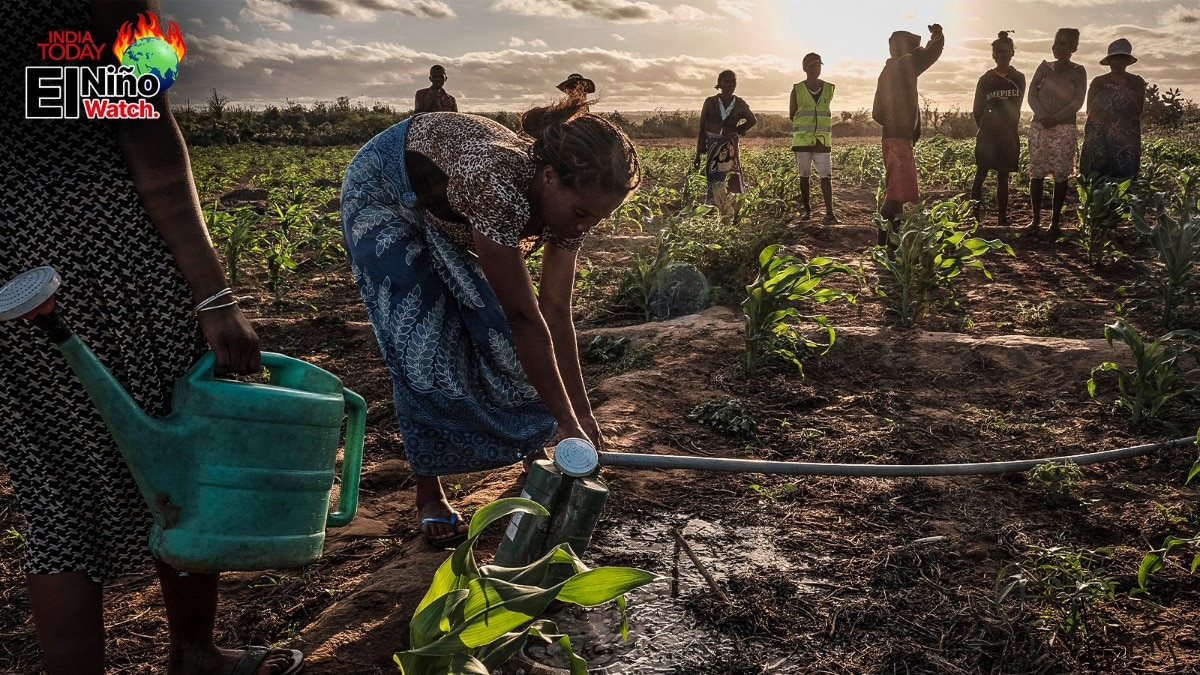
The world could be heading towards one of its strongest El Nino events on record, raising concerns over food production and the availability of staple crops as climate-related weather disruptions threaten agricultural regions.The latest advisory from the US National Oceanic and Atmospheric Administration, or Noaa, puts the chances of the developing El Nino becoming a historic event at around 60%, with strong-to-very-strong conditions likely to persist into early 2027.In its latest update, Noaa said temperatures in the central and eastern equatorial Pacific Ocean had risen significantly above normal.The temperature difference in the Nino 3.4 region, a key area used to monitor El Nino, reached 2.5 degrees Celsius above average. The agency also sees more than a 79% chance of strong-to-very-strong conditions continuing through January-March 2027. The growing concern, however, goes beyond rising ocean temperatures.The changing weather patterns associated with El Nino could threaten harvests, disrupt food supplies and deepen hunger in regions already struggling with food insecurity.HOW CAN EL NINO THREATEN FLOOD ON YOUR PLATE?El Nino is a natural climate phenomenon in which parts of the Pacific Ocean become warmer than usual, changing wind patterns and the movement of rain-bearing clouds around the world. Farmers tend to their farms ahead of El Nino rains in Kiambu County, Kenya. (Photo: AP) These changes can bring prolonged dry spells to some agricultural regions while causing excessive rainfall and flooding in others.Both can damage crops, disrupt planting and harvesting seasons, reduce water availability and affect livestock.The consequences are particularly concerning for farmers who depend on seasonal rainfall.A failed rainy season or prolonged drought can leave fields without enough water, while floods can destroy standing crops and damage agricultural land. Higher temperatures can also increase water demand and place additional stress on crops. People wait for food aid distributed by the World Food Program in Honduras, after El Nino induced drought. (Photo: AP) The Food and Agriculture Organisation (FAO), in its November 17 assessment, warned that the strengthening El Nino is increasing risks to staple crop production and food security across several regions.Countries already affected by conflict, displacement and high food prices face the greatest risks because communities have fewer resources to cope with another agricultural shock.MILLIONS COULD NEED SUPPORTThe scale of concern is reflected in preparations by the FAO and the World Food Programme (WFP). Kitchen utensils hang on a wall in a house of a person who received food aid. (Photo: AP) The two agencies have launched a $202 million anticipatory action appeal to protect nearly 9 million people across 22 high-risk countries from potential climate-related disruptions.The proposed support includes helping farmers access drought-resistant and flood-resistant seeds, protecting livestock, improving water storage and providing assistance before extreme weather damages livelihoods.The European Commission's Joint Research Centre has also highlighted risks to agricultural production in several regions.Through most of 2026, the sea surface temperatures of the equatorial Pacific Ocean have seen significant warming, greatly influenced by the presence of a very strong El Nio. This imagery from GOES-West over the past eight months observes this progression of the Pacific Ocean. https://t.co/sdrIQo17vR— CIRA (@CIRA_CSU) November 18, 2026In southern Africa, below-normal rainfall and above-normal temperatures could threaten maize production through March 2027.Parts of East Africa and Central America are also facing agricultural and food security concerns.WHY IS INDIA CLOSELY WATCHING EL NINO?India, the world's most populous country, and therefore, the largest number of people to feed, is closely monitoring the developing event.El Nino has historically been associated with weaker southwest monsoon rainfall, although its influence is not uniform and other ocean and atmospheric conditions can change the outcome.A weaker monsoon could affect rain-fed farming, water availability and agricultural production, particularly if rainfall deficits coincide with high temperatures. Andhra Pradesh CM N Chandrababu Naidu at a high-level review meeting on the state's preparedness for El Nino. (Photo: PTI) With the current event expected to remain strong into early 2027, its influence on India's June-September monsoon will be closely watched.This powerful and historic El Nino is set to extend well beyond the weather, reaching farms, food markets and households already struggling to afford necessities.- Ends
El Nino to become most powerful: Why food security is at risk in 2027
Full Article
Original Source
Read the full article at Indiatoday →KhanList aggregates and links to publicly available news content. We do not host full articles from third-party sources. Always verify important information with original sources.