
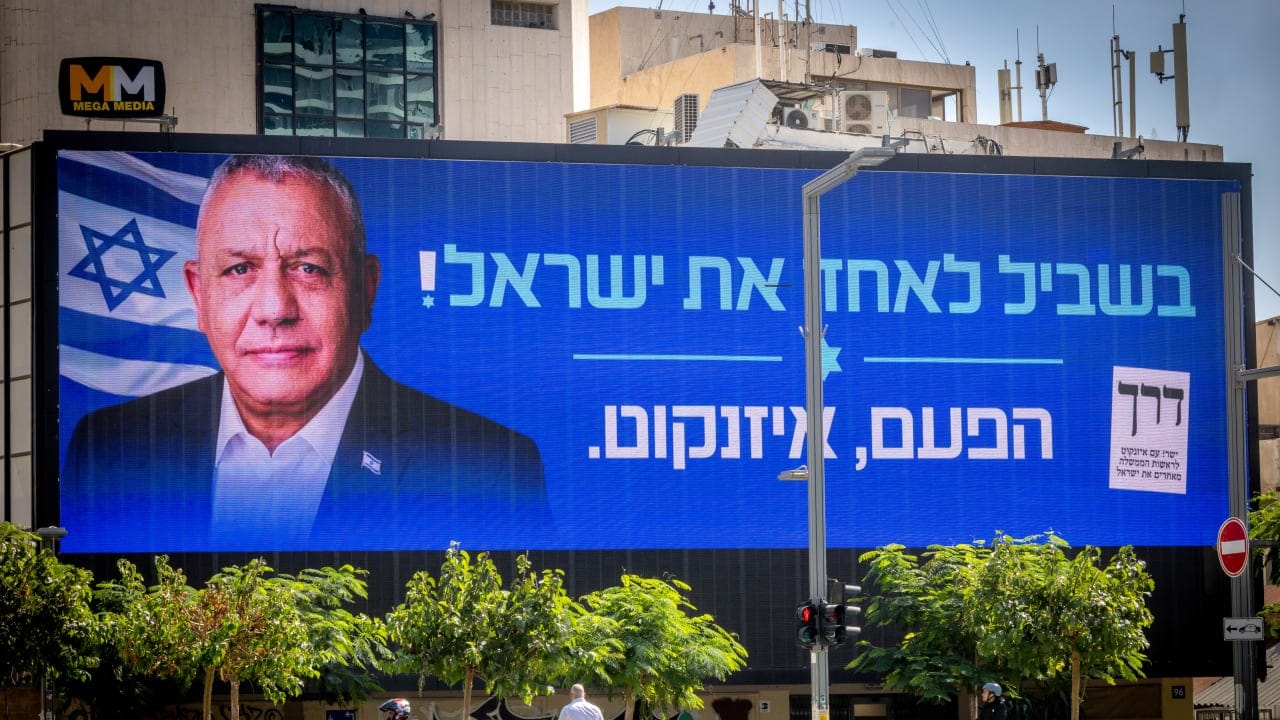
OCTOBER 22, 2026 06:04Updated: OCTOBER 22, 2026 06:10An N12 News poll published Wednesday evening ranked Gadi Eisenkot's Yashar party first with 23 seats, down one seat from the previous poll. A Channel 13 poll published at the same time also put Yashar in first place; however they only received 20 seats.In both polls, Prime Minister Benjamin Netanyahu's Likud party came in second, trailing Yashar and falling to 19 seats.Neither poll found that either of the political blocs would win a clear majority; however, the opposition bloc continued to lead Netanyahu's.N12 projected that the opposition bloc would win 55 seats and Netanyahu's bloc 51. By comparison, the Channel 13 poll showed Eisenkot's bloc gaining one seat to 52, while Netanyahu's bloc lost one seat to 49.Whether Ofer Winter's People of Israel party and Yoaz Hendel and Yaron Zelekha's Reservists-Economic party cross the 3.25% electoral threshold could affect the balance between the political blocs in the upcoming elections.Illustrative showing results of polls shared by N12 News and Channel 13 on October 21, 2026. (credit: ILLUSTRATIVE)Other party numbers remained similar to previous pollsFormer prime minister Naftali Bennett's B'Yachad party remained unchanged at 14 seats, while the Democrats, led by Yair Golan, gained one seat to reach 10, Channel 13 found. In N12, the Democrats remained at nine seats, while B'Yachad gained one seat to reach 15, its highest showing in a month and a half.In both, Avigdor Liberman's Yisrael Beytenu polled at eight seats and National Security Minister Itamar Ben-Gvir's Otzma Yehudit each received seven.Shas, led by Arye Deri, received eight seats in the N12 poll but seven on Channel 13, while United Torah Judaism, led by Yakov Asher, received seven in the N12 poll but eight on Channel 13.The Religious Zionist Party (RZP) and Zehut, led by Bezalel Smotrich and Moshe Feiglin, received six seats in the N12 poll, which rose to eight in the Channel 13 poll.The Joint List, comprising Hadash, Ta'al, and Balad and led by Yousef Jabareen, received nine seats in both polls; however, N12 found that Mansour Abbas's Ra'am was polling at five, while Channel 13 placed Ra'am at 6. In both polls, the Arab parties remained stable, earning the same number of seats as in the previous poll.People of Israel, Reservists-Economic parties teeter on the electoral thresholdIn the N12 poll, the People of Israel party won four seats, crossing the electoral threshold after falling below it in the previous two polls. However, the Reservists-Economic party remained below the electoral threshold with 2.8% of the vote.In contrast, the Channel 13 poll reversed the two. The Reservists-Economic party kept its four seats and remained above the electoral threshold. Meanwhile, the People of Israel party fell below the electoral threshold after receiving four seats in the previous poll.Shmuel Rosner, a pollster for The Madad and Channel 13 News, spoke with Ron Kofman and Aryeh Eldad on 103FM about the latest Channel 13 poll, explaining how the results of the two parties could affect the distribution of Knesset seats between the blocs.Which party will fail to cross the electoral threshold could be significantAddressing a scenario in which one or both parties fail to cross the electoral threshold, Rosner explained which bloc could benefit from the redistribution of seats."In terms of the balance between the blocs, if neither crosses the threshold, eight seats can be redistributed among other parties. However, one scenario is that one fails to cross the threshold and the other does, leaving four seats to be redistributed. Which party fails to cross the threshold could be significant. The side that would benefit more would be what we call the 'change bloc,' rather than the coalition bloc," he said, adding, "That is the conclusion we reached."Rosner also addressed where the two parties draw their support from and the differences between voters backing Winter and those supporting Hendel and Zelekha."People of Israel and the Reservists receive votes from both sides in almost equal measure. The question is when we start counting, whether we use the 2022 election as our starting point and ask where those votes were in the previous election," he explained."It is true that Hendel and Zelekha's votes come more evenly from both sides, while most of Winter's votes come from the coalition side. Nevertheless, Winter also took roughly one seat, out of the nearly four he has, from the opposition side, mainly from Liberman's party," Rosner added.Follow us on Google
Eisenkot's leads Netanyahu as Winter, Hendel, Zelekha may not cross electoral threshold - poll
Full Article
Original Source
Read the full article at Jpost →KhanList aggregates and links to publicly available news content. We do not host full articles from third-party sources. Always verify important information with original sources.