
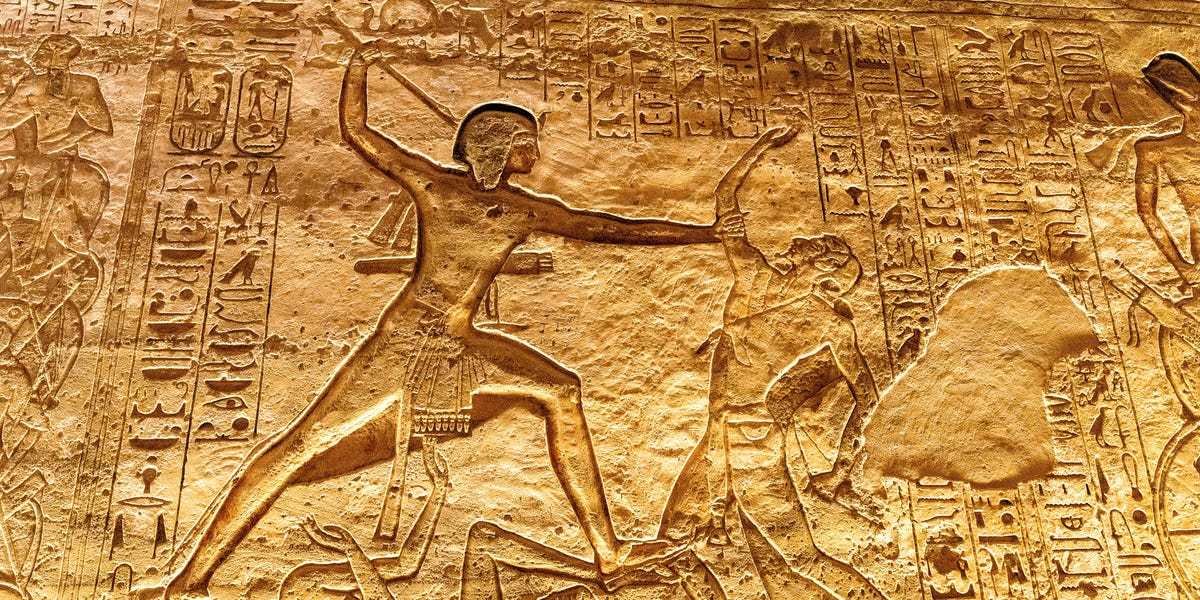
4 min readHere’s what you’ll learn when you read this story:In the 1920s, Egyptologist Flinders Petrie discovered an unsettling number of subsidiary burials surrounding royal tomb complexes, which probably meant there had been human sacrifices.How members of First Dynasty pharaohs’ courts were put to death is still a mystery, but new research has found evidence of sharp force trauma to the head in some individuals. Sacrifice vanished by the Second Dynasty and was later replaced with shabti, tiny faience figures that were buried with the deceased and meant to work for them in the afterlife. There was a time before mummies and pyramids, long before the gilded tombs that would make Egypt iconic in the ancient world, when a journey to the afterlife meant something darker. There was more reason to dread the death of the pharaoh than a shift in power. There had to be someone on the other side to tend to him and his every need, just as there had been in the realm of the living. That could only mean one thing. When the pharaoh died, most of his royal court would die with him.Egyptologist Flinders Petrie was excavating Old Kingdom ruins at Abydos in the 1920s when he came upon something unnerving. In the cemetery now known as Umm el-Qaab, a relic of a nascent Egypt whose northern and southern territories had barely been unified, Petrie unearthed hundreds of subsidiary burials surrounding royal funerary complexes. It seemed suspicious that so many individuals had met their demise at the same time as the king. This phenomenon began with First Dynasty ruler Hor-aha, son of Narmer and second pharaoh to ascend the Egyptian throne, and appeared to have faded by the dawn of the Second Dynasty. Roselyn Campbell, Egyptologist and bioarchaeologist at Purdue University, was intrigued by these findings. She decided to further investigate and analyze what was most likely a ritual of human sacrifice.“The general consensus among scholars has been that the occupants of these subsidiary burials were likely members of the royal retinue, court officials, and members of the king’s ‘harem,’” she said in a study recently published in Frontiers in Environmental Archaeology. “These individuals are generally grouped together as “retainers,” a general term for individuals associated with the royal household and court.”Petrie found rows of subsidiary burials dating back to about 5,000 years ago. Most of them were small chambers that sometimes included a few grave goods, such as an ivory comb. It seemed to be evidence of retainer sacrifice, a practice in which those closest to the ruler are killed to accompany and serve him in the afterlife. Whether these individuals chose to cross over to the land of Osiris with their pharaoh is unknown. Another mystery is why some skulls show obvious signs of lethal sharp force trauma, while there are no indications of violence on others. Petrie himself never reported signs of trauma. Instead, he preferred to interpret the cracks he saw as taphonomic damage sustained over thousands of years. Worse, his attempts to preserve the remains with paraffin wax concealed those very fractures from later researchers.When reexamining the remains that Petrie had either reburied or attempted to preserve, Campbell found linear cranial fractures consistent with sharp force trauma. There are many murals showing triumphant Egyptian pharaohs wielding a mace to smite enemies after defeating them in battle, but the blow of a mace would cause depressed fractures quite different from what was seen on the skulls Campbell examined. They were linear fractures, which are typically the work of a broad, flat object striking a wide area of the skull. Because the cranial vault is globular, the force of impact and resulting fractures spread across it instead of being confined to one region. They often radiate across the skull. Though injuries like these aren’t always fatal, they can be if not treated immediately, since they usually lead to unconsciousness, lesions, and internal bleeding.The fractures showed no sign of healing, which told Campbell they were perimortem: inflicted slightly before, at, or soon after the moment of death. So it’s likely that the blows were the cause of death. But the sharp force trauma hypothesis has a gap. A strike hard enough to crack a skull would likely have broken other bones too, but Petrie recorded none. Linear fractures are also far harder to read than depressed ones, which appear at the point of impact. Pinpointing where each skull was struck could reveal how these people were killed. It’s also possible that at least some of the king’s attendants went to the underworld in other ways. They might have been asphyxiated or given poison to drink, and a few may have died naturally and been buried before the pharaoh.“While Petrie's initial hypothesis regarding the occurrence of retainer sacrifice may be correct, we now have additional knowledge about how some of these individuals may have died,” Campbell said. “These advances in knowledge have also complicated our understanding.”As funerary practices evolved, Egyptians would spare the lives of those in the pharaoh’s court and instead create shabti, tiny faience figures that were buried with the deceased—often wrapped with them when they were mummified. Shabti were meant to take care of all the work that needed to be done in the afterlife so their master could luxuriate in the Field of Reeds without ever having to lift a finger. They were also mass-produced and accessible to most people who wanted freedom from labor after their earthly existence came to an end. It really was paradise.Watch Our Science VideosElizabeth Rayne is a creature who writes. Her work has appeared in Popular Mechanics, Ars Technica, SYFY WIRE, Space.com, Live Science, Den of Geek, Forbidden Futures and Collective Tales. She lurks right outside New York City with her parrot, Lestat. When not writing, she can be found drawing, playing the piano or shapeshifting.
Egypt’s First Pharaohs May Have Taken Their Entire Court to the Grave
Full Article
Original Source
Read the full article at Popularmechanics →KhanList aggregates and links to publicly available news content. We do not host full articles from third-party sources. Always verify important information with original sources.