
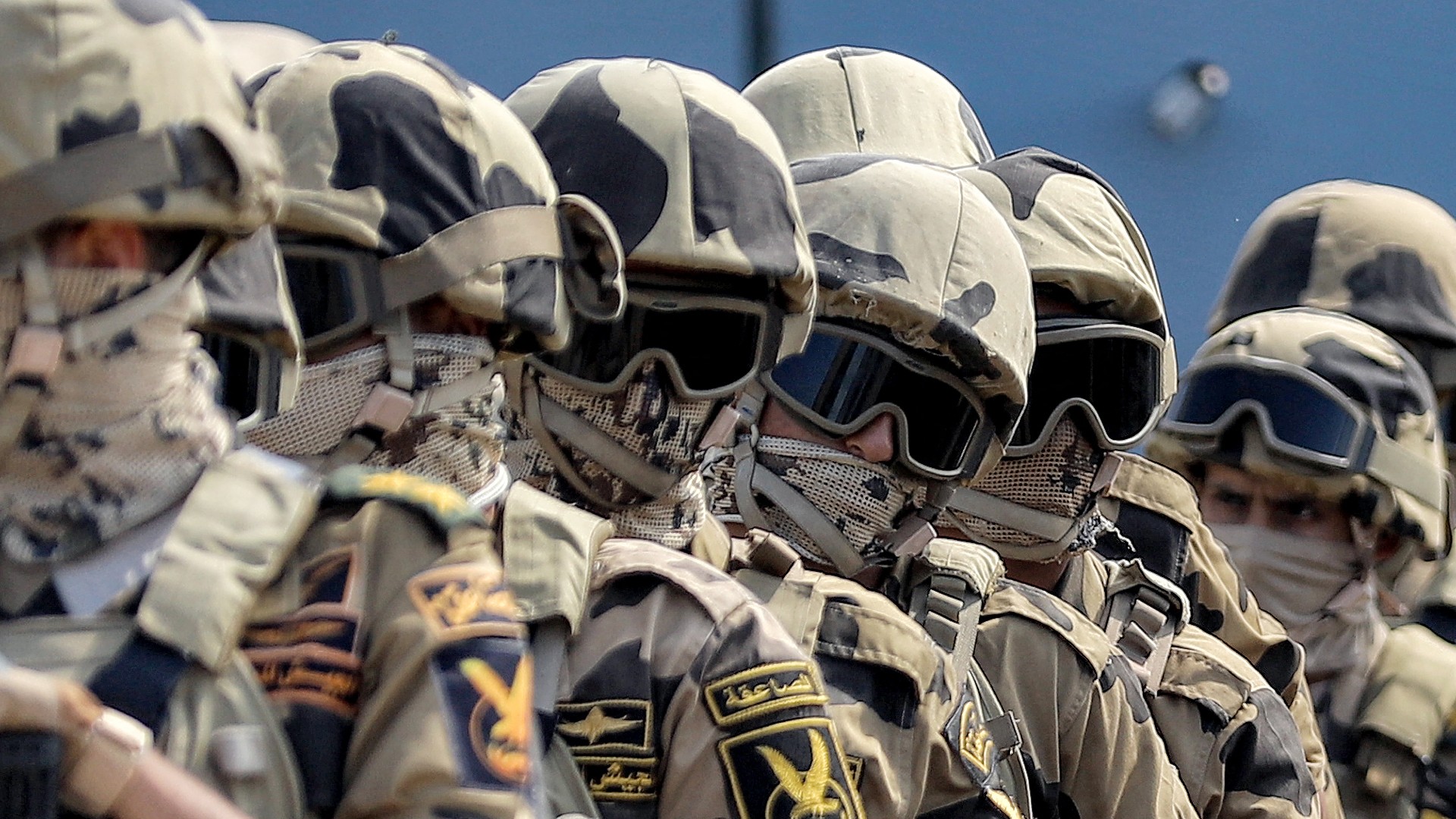
Egypt deployed forces and military aircraft to Saudi Arabia and moved air defence systems to strategic locations across the country long before President Abdel Fattah el-Sisi publicly pledged Cairo's support for Riyadh, Egyptian military sources have told Middle East Eye. The deployment included a squadron of Rafale fighter jets, eight helicopters and four large transport aircraft, an Egyptian military source said on condition of anonymity as he was not authorised to speak with the media. Egyptian naval warships had also moved towards the southern Red Sea, near the strategic Bab al-Mandab Strait, which connects the Red Sea to the Gulf of Aden, the source added. The reported naval movements came amid growing Egyptian concern over the security of Red Sea shipping lanes and the threat posed by Houthi attacks in Yemen. In August, Egypt reportedly increased its naval presence near the Bab al-Mandab Strait, with reports claiming that modern frigates and corvettes had been deployed towards the southern entrance of the Red Sea. New MEE newsletter: Jerusalem Dispatch Sign up to get the latest insights and analysis on Israel-Palestine, alongside Turkey Unpacked and other MEE newsletters Separately, Al Jazeera Arabic's open-source investigations unit reported last month that flight-tracking data had identified two Egyptian military C-130 Hercules transport aircraft operating in Saudi airspace. The aircraft, identified by their registration numbers SU-BAI and SU-BEW, were tracked over western Saudi Arabia before their signals disappeared. One was subsequently detected over northwestern Saudi Arabia, before its signal disappeared again while it was flying towards the Red Sea coast near Al Wajh. One of the military sources told MEE that Egypt had also repositioned several air defence systems, including Skyguard-Amoun batteries, to strategic locations in the east and south of the country. "Security discussions and exchanges between the two countries had been ongoing since the fighting began, with the aim of agreeing on how military intervention and support would be carried out," the source said. "While Egyptian-Saudi military cooperation had been agreed upon, the strategy, mechanisms and operational plans for intervention were still being discussed and coordinated to maintain Egypt's national security," he added. Abdelatty confirms deployment On Monday, hours after MEE sent Egypt's foreign ministry a request for comment, Foreign Minister Badr Abdelatty confirmed that the Egyptian military had been deployed to Saudi Arabia before Sisi obtained parliamentary approval. "Our presence there began a few months ago after the attacks and aggressions on Saudi Arabia during the escalation with Iran," Abdelatty told France 24, adding that Cairo was now in the process of "strengthening" that deployment. On 17 October, Sisi called for parliament to authorise the deployment of Egyptian forces to defend Saudi Arabia if requested. The following day, the National Defence Council, chaired by the president, announced that Egypt would provide all possible support to protect the kingdom's security and territorial integrity. 'Our presence there began a few months ago after the attacks and aggressions on Saudi Arabia during the escalation with Iran' - Egyptian Foreign Minister Badr Abdelatty Under Article 152 of Egypt's constitution, the president must consult the National Defence Council and obtain approval from two-thirds of the House of Representatives before sending the armed forces on a combat mission outside the country. Parliament held closed sessions on 18 and 19 October before reconvening on 26 October, when lawmakers approved Sisi's request by a two-thirds majority. The authorisation allows the president to take necessary measures, in coordination with the kingdom, to defend its territory against external aggression. The parliamentary approval, however, has not publicly clarified the precise nature or extent of Egypt's military commitment. The disclosures come as Saudi Arabia faces renewed missile and drone attacks by Yemen's Houthi movement, with the escalation increasingly drawing regional powers into discussions over the kingdom's defence. On Sunday, a building linked to Saudi state oil giant Aramco in Riyadh sustained minor damage after being struck by falling debris from an intercepted attack. No casualties were reported. The incident followed a series of Houthi attacks on Saudi territory, including strikes targeting strategic infrastructure, prompting Riyadh to seek additional military and diplomatic support from regional allies. The Saudis have escalated strikes against Houthi-controlled areas of Yemen, including the capital Sanaa, with dozens of casualties reported. Divisions over ground intervention A second senior Egyptian military official, also speaking on condition of anonymity, described sharp disagreements within the country's military leadership over the scope of any intervention, particularly whether Egyptian ground troops should participate in operations against the Houthis in northern Yemen. The official said meetings involving Sisi, commanders from different branches of the armed forces and members of the National Defence Council had been marked by disputes over the possibility of sending ground forces into Yemen. "The meetings witnessed arguments over the deployment of ground troops in operations planned to take place in northern Yemen against the Houthis," the official said. According to the source, Sisi pushed for Egypt to participate in Saudi military operations, arguing that further delays were difficult to justify as attacks on the kingdom continued to escalate. Yemen war: Why Egypt's vow to defend Saudi Arabia is a risky gamble Read More » "Saudi Arabia had officially requested Egyptian military support in the current war. It was in Egypt's security interests to take part in the operations to safeguard water security and protect the Red Sea and the Suez Canal," the source said. "Saudi economic support for Egypt is also part of the objectives behind the Egyptian move," the source added. The source also pointed to Cairo's financial relationship with Riyadh, which has become an important dimension of bilateral ties. On 30 October, Egyptian media outlets, citing banking sources, reported that Saudi Arabia had agreed to renew a $5.3bn deposit at the Central Bank of Egypt for another year, shortly before it was due to mature. The deposit forms part of Saudi Arabia's wider financial support for Egypt, which has faced persistent pressure on its foreign currency reserves and economy. The renewal came less than two weeks after Sisi publicly pledged to defend Saudi Arabia, although there has been no public evidence establishing a direct connection between the financial arrangement and Cairo's military decision. The debate over the possible deployment of Egyptian ground troops also reflects wider regional efforts to strengthen Saudi Arabia's defences. In August, Saudi Arabia, Turkey and Pakistan signed the Mecca Joint Defence Agreement, committing the three countries to treat an armed attack against any one of them as an attack against all. Turkey's parliament subsequently ratified the agreement in November, although this does not in itself establish that Turkish combat troops will be deployed to Yemen. The precise nature of any Turkish or Pakistani military contribution to Saudi Arabia has not been publicly established. Ground troops remain a red line For now, Egypt's publicly declared commitment is to support Saudi Arabia's defence. Whether this could eventually extend to Egyptian ground forces entering Yemen remains unclear. The first military source who disclosed the deployments to MEE did not rule out Egyptian troops joining the fighting in its final phase, after air and naval operations had weakened the Houthis' military capabilities. "Egyptian ground intervention could take place as part of a multinational ground force, rather than through Egyptian troops alone, along the lines of what happened during the 1991 Gulf War," the source said. He stressed, however, that "a ground war was not an option at present". "The current situation first required dealing with the Houthis' command and control centres, missile and drone launch platforms, and air defence systems before any ground engagement or even consideration of a ground war," he explained. Sisi's 2030 exit plan would keep Egypt in the army's hands Read More » Earlier this month, MEE reported that the Houthis had launched multiple cross-border raids targeting Saudi military positions over the previous month, marking the first such incursions into Saudi territory since the collapse of a ceasefire in Yemen. The small-scale raids targeted border posts in Saudi Arabia's rugged mountainous southwest, according to Arab and western officials. The first military source said a ground offensive could ultimately be avoided if air and naval operations succeeded in weakening the Houthis' military infrastructure. "If the air and naval operations achieved major successes, a ground offensive could instead be carried out by Yemeni forces supporting the country's internationally recognised government, without foreign ground troops," he said. He estimated that fighting could last between four and six months before its outcome became clear, although he cautioned that the conflict could continue for longer depending on the scale of the air and naval campaign, the targets struck and whether the forces involved managed to neutralise Houthi air defences. The second military official, however, offered a markedly different account of the discussions, saying commanders of the armed forces and members of the National Defence Council had agreed that Egypt should stay out of ground operations in Yemen. The disagreement is rooted partly in Egypt's own experience of military intervention in the country. Under former president Gamal Abdel Nasser, Egypt intervened in Yemen's civil war in 1962, deploying tens of thousands of troops to support republican forces fighting royalist forces backed by Saudi Arabia. The campaign became a costly and protracted military engagement for Cairo, with thousands of Egyptian soldiers killed before the withdrawal of its forces was completed in 1970.
Egypt deployed forces to Saudi Arabia before Sisi's public pledge of military support, sources say
Full Article
Original Source
Read the full article at Middleeasteye →KhanList aggregates and links to publicly available news content. We do not host full articles from third-party sources. Always verify important information with original sources.