
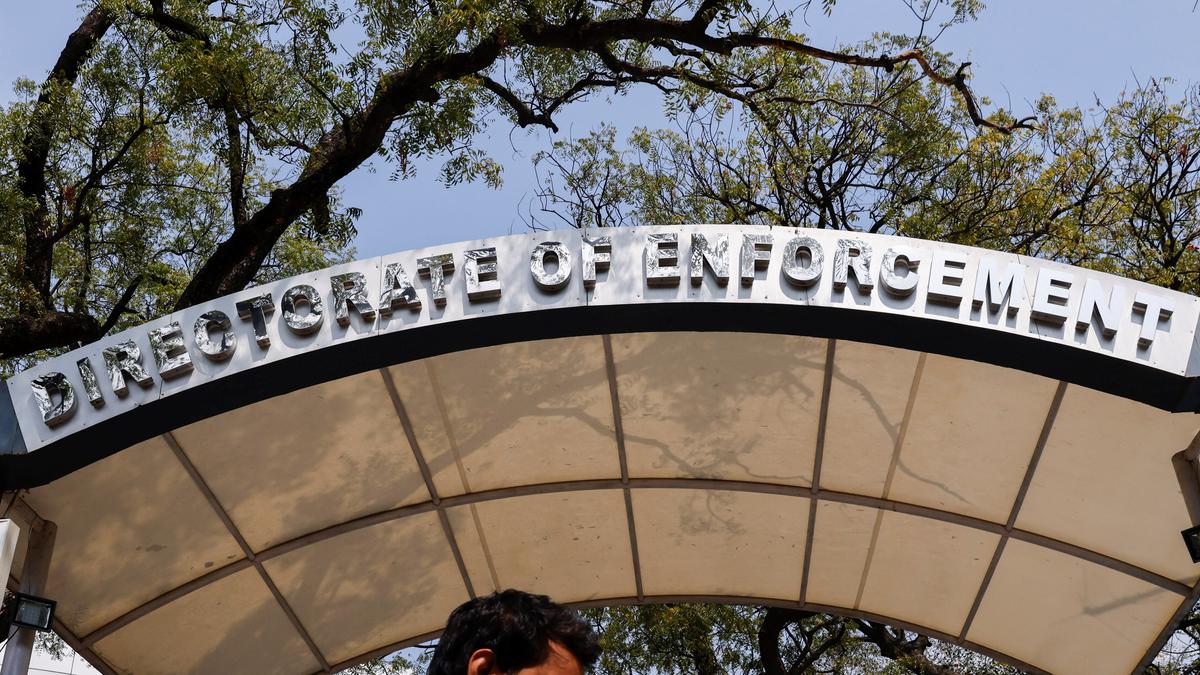
The story so far: The Enforcement Directorate (ED) has escalated scrutiny of alleged irregularities in proceedings under the Insolvency and Bankruptcy Code (IBC), instructing its zonal offices to examine cases involving disproportionately large haircuts through which promoters may have reacquired assets.At its 36th Quarterly Conference of Zonal Officers in Bengaluru on September 14 and 15, ED Director Rahul Navin told officials to re-examine such alleged collusive resolution cases. The agency identified possible circumvention of Section 29A of the IBC, inflation of related-party claims, manipulation of the Committee of Creditors (CoC), asset stripping and artificially large haircuts as areas requiring scrutiny.Officials have also been asked to analyse applications filed by resolution professionals, which involve preferential, undervalued, fraudulent and extortionate transactions, intervene before the National Company Law Tribunal (NCLT) where necessary, and initiate independent probe under the Prevention of Money Laundering Act (PMLA).What is the background?The latest direction builds on investigations that the agency had already undertaken over the past several months.Suspecting possible collusion during the Corporate Insolvency Resolution Process (CIRP) of the corporate debtor, in December 2025, the ED conducted searches in matters related to Angle Infrastructure Private Limited, its resolution professional and Nauseva Buildwell LLP and its partners. The agency said it had found evidence pertaining to an alleged undervalued sale of two-acre land for Rs.31 crore before CIRP, against a valuation of Rs.160 crore during the process. It also alleged attempts to pressure homebuyers to withdraw complaints.In February 2026, the agency arrested Arvind Kumar, who had served as resolution professional of Richa Industries Limited from December 2018 to June 2025. The ED alleged that he helped constitute a manipulated CoC that gave decisive voting power to former promoters. It said public-sector banks received Rs.40 crore against admitted claims of Rs.708 crore, resulting in a 94% haircut.The ED arrested Jitesh Gupta in the Best Foods money-laundering case in August. It alleged that, while acting as IRP/RP for Homestead Infrastructure Development and Golden Peacock Residence, he re-admitted claims that he had earlier rejected as spurious or fraudulent, thereby altering the CoC and facilitating a resolution plan allegedly linked to the former promoter.What is IBC?Enacted in 2016, the Code provides a time-bound framework for resolving insolvency and maximising the value of a distressed company’s assets. Once a corporate insolvency resolution process begins, the resolution professional takes charge, creditors’ claims are examined, a CoC is constituted and eligible resolution applicants submit plans. The CoC takes the principal commercial decisions, while the NCLT approves the resolution plan in accordance with the Code.How can the process allegedly be misused?The cases being examined by the ED point to several possible methods:Manipulating the CoC: Since voting power is linked to financial claims, allegedly inflated, fictitious, or related-party claims can potentially alter the composition of the committee.Undervaluing assets: Assets may allegedly be transferred before or during CIRP at prices significantly lower than their value, thus reducing recovery for creditors.Circumventing promoter restrictions: Section 29A bars certain specified persons from submitting resolution plans. Related entities may be used or other means adopted by defaulting promoters to regain control of assets.Promoter re-acquisition after a haircut: The ED’s focus is to ascertain whether there are any irregularities in cases where a steep reduction in creditors’ claims is accompanied by other linked indicators and the assets subsequently return to the promoter or connected entities.In the Alchemist Group matter, the NCLT recalled the CIRP finding the proceedings vitiated by fraud, collusion and malicious intent, after the ED alleged that the insolvency process had been misused and that the CoC was dominated by the Group entities. In Project Royal Rajvilas at Udaipur, the agency facilitated restoration of unsold inventory of 354 flats, 17 commercial units and two plots, with a stated market value of about Rs.175 crore, to the successful resolution applicant, benefiting 213 homebuyers.Which law does ED invoke?The ED’s intervention in IBC cases comes under the PMLA where the alleged conduct involves proceeds of crime. An IBC irregularity by itself does not automatically constitute money laundering. The agency has to establish the connection between the underlying offence, the proceeds of crime, and the alleged laundering activity. The PMLA empowers the agency to conduct searches and seizures, provisionally attach properties and arrest accused persons.
ED widens scrutiny of possible irregularities in IBC proceedings | Explained
Full Article
Original Source
Read the full article at Thehindu →KhanList aggregates and links to publicly available news content. We do not host full articles from third-party sources. Always verify important information with original sources.