
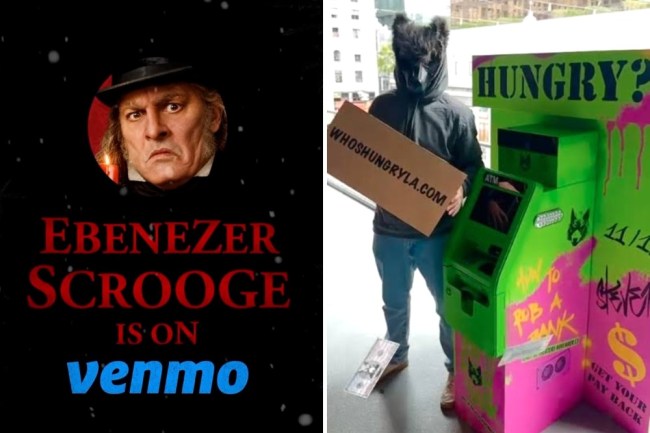
Clipfarming, influencer screenings, and meme-bait popcorn buckets: promoting a movie in the internet age is often a full-court offensive to get noticed. In that spirit, why not just get down to business and resort to modern civilization’s oldest method for seeking attention: dangling some money in people’s faces? That’s what the marketing teams behind Amazon MGM Studios‘ “How to Rob a Bank” and Skydance’s “Ebenezer” have tried in the weeks leading up to their shared November 13 release to North American theaters. For the former ensemble heist thriller, a branded ATM was moved between multiplexes throughout the Los Angeles area over the course of four days. Those who learned of the campaign on the film‘s social media channels could gain clues about the machine’s location and a specified PIN number, which would spark payouts of a single one-hundred-dollar bill to those who bothered to seek out (or stumble upon) it. “Ebenezer” took a more cheeky, trifling approach, promoting an official Venmo account for Johnny Depp’s Christmas crab apple that users could request funds from. Those who scrolled through the account’s transactions would see it shares the character’s penny-pinching spirit: the only completed transactions were those giving away one single cent. The Venmo account was only active for a few hours, though a Paramount Instagram post from last week teases followers to “check back” as “Ebenezer might be feeling generous on @venmo again.” Several film news aggregation accounts like Culture Crave and DiscussingFilm reported that the account “crashed” due an overwhelming amount of requests, though Paramount declined to comment on if such a description was accurate. Venmo did not respond to a request asking if the company partnered with the studio on the sponsorship. Both MrBeast-ian stunts are, at the very least, thematically appropriate. The “Ebenezer” Venmo explains itself to those familiar with the classic Dickens tale of a miser who catches the Christmas spirit. And “How to Rob a Bank” follows a group of thieves who teach online subscribers how to take back money from the financial institutions that screw them over. “Let’s make some content,” Nicholas Hoult’s Robin Hood hero says in a trailer stinger. Much like that line, there is also a tackiness du jour to both money-mindset stunts, especially in a world where awards shows, professional sports and geopolitical events can hardly be watched without outlets asking you to bet — erh, predict — on them. A video posted to Paramount’s socials opens with a Venmo request for $500, asking Scrooge to help pay off a user’s student loans. Not to mention the real inadvertent quirk: the account has been able to receive payments from users. Considering the scant number of one-cent payouts from the account and the number of influxes, it is almost certain that Paramount could have made money on the stunt, though an individual with knowledge of the account shared that all received funds were sent back to users via private transactions. Krystyna Ursta, a 27-year-old actress, video editor, and Depp fan in Los Angeles, shared that she gave about $30 to the account and received a full refund a few days later — plus an extra penny and an invitation to a special screening of the film in New York on Monday. She will be attending a local press screening instead. Ursta also posted a video of herself reacting to the account, one of many fan responses that flooded in on social media. “I kind of figured that they will probably return it,” Ursta wrote over text after being reached through her Instagram handle, which she included in her Venmo transactions. “I’m such a big fan. I was happy to support the film.” The rather gimmick-less gimmick of waving around money also helps capture the attention of people that aren’t necessarily interested in seeing the movie, but are going through the average modern experience of thinking about one’s financial situation. Aggregation accounts were quick to post graphics reporting on both stunts, with captions like “HOW TO ROB A BANK ATM’S ARE BEING SET UP AROUND LOS ANGELES AND GIVING PEOPLE FREE MONEY AND IT COULDN’T HAPPEN AT A BETTER TIME” and “EBENEZER SCROOGE WILL SEND YOU REAL MONEY ON VENMO BUT THERE’S A CATCH SWIPE FOR MORE.” There’s also people like Scott, a 35-year-old based out of Atlanta that couldn’t help but engage with the “Ebenezer” Venmo account after seeing it on X. He sent a penny, then received one in return. (A disclaimer: six Venmo users were reached for interview about their Ebenezer experience by sending them $0.01 with this reporter’s contact information in the caption; Scott was the only response that timed out before publication.) “Seeing Ebenezer is now on Venmo was too funny and stupid to not engage with,” he wrote over text. “There’s something very boring dystopia about it: the idea of a fictional character from a 200-year-old Christmas story being commercialized on Venmo just shows how dumb Hollywood can. … It’s like McDonald’s Monopoly: take our slop and we might give your money.” Also helpful for the studios is how little dangling the potential of money actually costs. Sans staffing fees, producing the “Ebenezer” Venmo account and its activity used a sum less than the coins between the couch cushions on the Paramount lot. Per the “How to Rob a Bank” promo’s website, each location’s prize pool gave away ten one-hundred-dollar bills and twenty twenty-dollar-bills ($1,400 total), plus some theater-supplied prizes like gift cards. An employee at the Regal Sherman Oaks that worked on the day of the on-site promotion said the ATM seemed to deal out the rewards in a random order, as opposed to $100 dollar bills for the first finders. Amazon MGM declined to comment, while Stellar Agency Inc., which sponsored and administered the promotion, did not respond to a request. Both had much smaller overheads than a “Now You See Me: Now You Don’t” promotion than ran in April 2025. To launch the magician threequel’s first trailer, Lionsgate reportedly gave away roughly $250,000 to those that texted a mysterious phone number displaying in Times Square in the hours up to the drop. Like “Ebenezer” and “How to Rob a Bank,” it was a promotion that sparked a viral moment with plenty of user-generated content, each sharing the widely desired fantasy of receiving free money. Neon handed out basic resources for an “I Love Boosters” promotion in May, where stars KeKe Palmer and LaKeith Stanfield took over a Shell gas station in West Pico to give out complimentary refills to the first 70 cars that arrived. The stunt played on then-peaking fuel prices, which had skyrocketed in the wake of the U.S.’ initial bombing of Iran in February and the subsequent blockade of the Strait of Hormuz. In the months since, President Trump has promised $5,000 checks to every adult U.S. citizen if the Republican Party retains control of Congress in Tuesday’s midterm elections. Trump announced the idea, his approval rating was at a dismal 35 percent, per a CNN aggregate of various polls. Though the offer is unprecedented and dubious on its face, it has been covered extensively — and it cost nothing to float it.
Ebenezer’s Venmo and ‘How to Rob a Bank’ ATMs: Studios Are Now Promoting Movies by Just Giving Away Money
Full Article
Original Source
Read the full article at Indiewire →KhanList aggregates and links to publicly available news content. We do not host full articles from third-party sources. Always verify important information with original sources.