
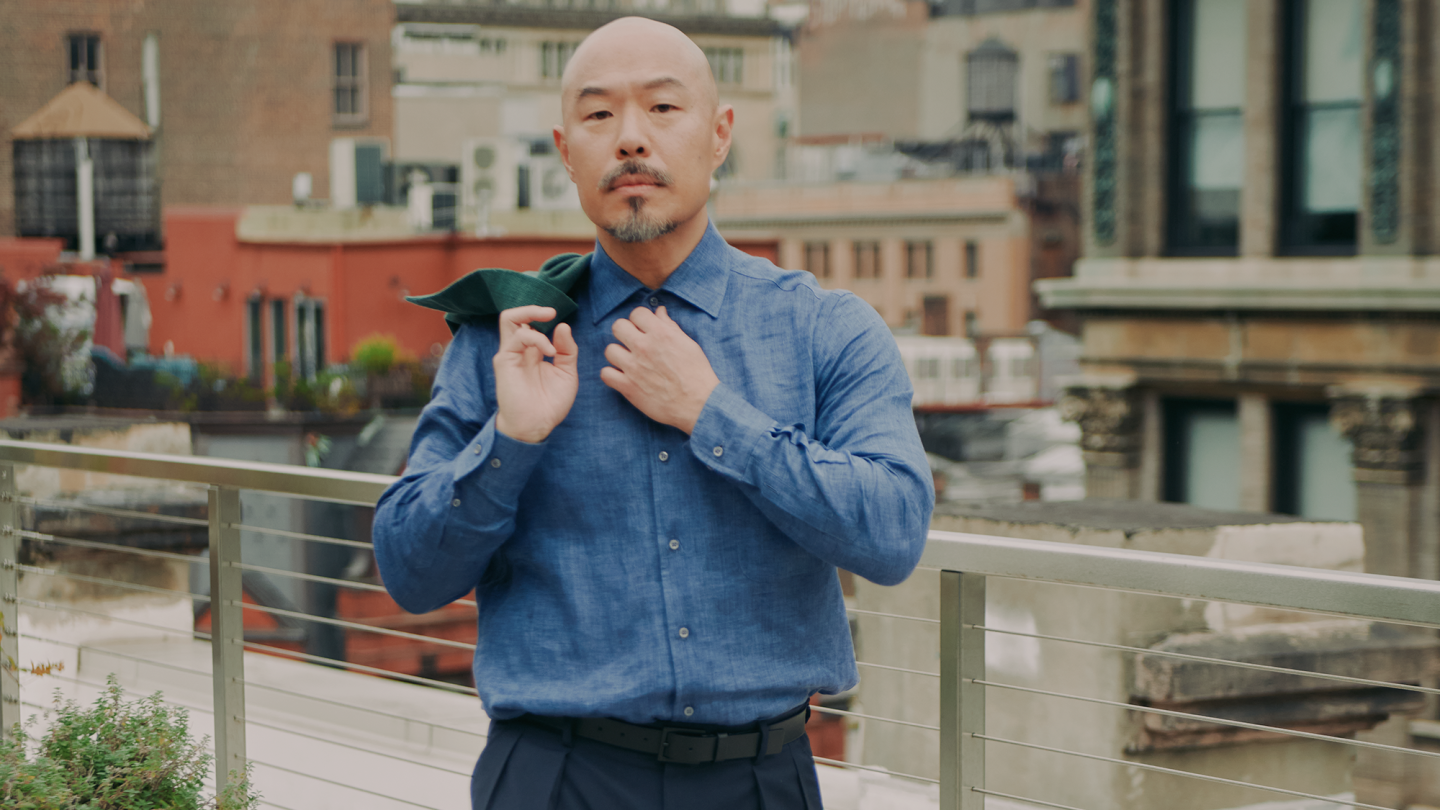
“It’s a huge relief,” says Hoon Lee of the reaction to East of Eden. “With any production, people work very hard. But I think this one in particular, there was the weight of expectation and wanting to honor the source material that adds a slightly different dimension.” The actor stars as Lee in Zoe Kazan’s adaptation of the classic John Steinbeck novel, released last month. The Florence Pugh-fronted series was quickly met with praise. “It almost would’ve been worse if it came out with a sort of indifference, like met with a wave of shrugging,” he tells The Hollywood Reporter. “To be well received the way the project has is obviously the best possible outcome and it’s very, very gratifying.” The series is very much aligned with the novel, but one of the most significant changes came in the form of the expansion of Lee’s character. He’d been given a head’s up, but he wasn’t sure just how in-depth the story would go until he received the scripts. All he knew was that Kazan and writer Alexander Chee had written a standalone episode for the character, the footage for which ended up being woven into other episodes. The actor was delighted to see what Kazan had to add and challenges anyone that questions just what the writer knows about the material. “That’s a huge risk for Zoe and the production but that actually speaks a lot to the boldness of her interpretation. There’s a lot of courage there, not only to put that forth, but to do it for the right reasons,” he says. “I don’t think anyone in the world knows this text better than Zoe. Every move she’s made, there is a reason for it, and there’s a justification in the text,” he continues. “She’s not somebody that is wildly going off script and going off the range to do what she’s doing. It’s a 600- to 800-page book. The idea that any of us who have just read it have all of the detail at our fingertips … But Zoe kind of does. She’s gone to that level.” Lee on the show’s positive reaction: “It’s very, very gratifying.” Shane McCauley The series, much like the novel, is quite heavy. It’s clear from moment one that show isn’t holding any punches. It might not be the easiest to watch in one go. “There should be a dosage that’s recommended,” he says somewhat cheekily. “It is intense.” Below, the actor speaks with THR about expanding upon the character of Lee, Kazan’s understanding of the material and how much he loves the character. What did you think about the decision to add more to Lee as a character? [Zoe’s] interpretation is deeply founded in the text, and it is expanded upon. But that choice, to me, speaks to the central ideas of the book itself, the sort of deep wells of humanism that Steinbeck brings. This idea that if we are going to use this book and talk about the thematics of this book — about what it means to be human and to have agency and to have choice — then it’s a totally viable thing to me. To make more human the people that at that time would’ve been somewhat marginalized or reduced — women, people of color. It’s certainly bold, but I think it’s in keeping with what she wanted to do for the entire production. It seems like you’ve gained a real respect for this material. Was there any anxiety about bringing this to life? There’s always the normal anxiety, which just revolves around variables and questions that you just don’t have visibility to at the time. We all could have shown up in New Zealand and hated each other, or we could have realized that we had six dollars to make seven episodes. Those sorts of things. But the added responsibility of the text, that’s a challenge I want. I want to have to do a good job because it’s important to you and because it’s important to other people. Where I knew we would encounter some friction is the more that people love any artwork, anything that’s important to them, whether that’s novels or movies or people or friendships, the more they protect it and the more they want their self-actualized canonical version to remain. There’s certainly a pressure there, but that’s just not how I view this situation. I can’t convince people to view it my way if they’re not inclined to. But I just feel that on its face, the idea of even attempting to create a one-to-one analog from novel to film or novel to television series is just flatly impossible. That’s true for any story. For any story. They’re just so wildly different in how they work, and how we participate with those mediums. We create the world in a novel. We not only create every detail of the world based on our own assumptions or preferences, we also create a hierarchy of importance. We create the hierarchy of attention to things. If you resonate with a character, that character looms larger in the story even with nothing changed in the words on the page. A film or a television show are exactly the opposite. It’s one collective production’s view on what is important and what you have to pay attention to, down to controlling what your eye focuses on. When you think about that level of control, there’s no way these things can match up. It’s not a task worth pursuing, which is part of the reason why I never watched the ’50s movie with James Dean. I knew that Lee was not included in that iteration. The actor on playing Lee: “It’s an honor. I love this character.” Shane McCauley What do you think about that? Certainly, that’s an omission. I have skin in that game literally. But I also think, well, what an interesting time capsule because in making that choice, Elia Kazan is saying, this is what I think is essential in the story. We have that reading, we have that perspective. In contrast, Zoe is doing the same thing. She’s saying, “This is what I think is important in this story and how I feel it, and when I read it, what I took from it.” That’s what we’re supposed to do. There’s an illusion that’s created, particularly in modern film and TV, that the details of the production, including the people who make it, are larger than the story or larger than the characters. In a book like this, that’s not the case. It’s much more like theater in that way. But you and I, we could do our own versions of Hamlet. We would be participants in a long lineage of people that have done Hamlet, and the role lives above us. We step into that river and step out. In film and TV, it feels to people like a character and an actor are fused, and that prevents people from reexamining it that easily. We should reexamine it. We should reinterpret, especially important stories and deeply felt stories. We should periodically reinterpret them because that’s their value to us, is to re-lens the same issues that we wrestle with in a new context, in our context, in our modern context, and remind us of things that we already feel deeply. What a wonderful lens to at it. Lee is a character that’s an essential to the story, in my reading of it. It seems Zoe agrees and you do as well. Well, it’s nice to have peaked now. There’s a lot of clarity. Better now than when I was 28, and it’s a long slide down the hill. It’s an honor. I love this character. I think the character is just a phenomenally realized human being at a time when I did not anticipate that, which perhaps speaks more to my own lack of awareness and shortsightedness, honestly. It’s also a good reminder that we broadly generalize, we coarse grain so many things and that in the detail there’s openings to a better understanding of the actual complexity that we’re wrestling with all the time and have wrestled with throughout our history. It’s easy for me as a person of color to … it’s an easy trap to paint with a very broad brush about opportunities I feel like haven’t been given, things like that. I was just talking about this, but when Lee says there’s a beauty in the truth, even if it’s a dreadful beauty — we are in a time and a place where we have a very difficult relationship with the idea of truth, partially because some people have been betrayed by that and partially because some people think truth is weaponized against them in some way and partially because the truth in and of itself is often difficult to confront. Without creating a foundation based upon the truth, how do we build anything with any integrity? How do we move forward? To bring it down to the most trivial levels, if I look at my own work somewhere and I just pat myself on the back for it, it’ll be very difficult for me to get better. There’s something very, very beautiful about this idea that in looking at this story and in looking at how Steinbeck was able to humanize his character, it prevents me from having the easy out of saying, “Well, everyone at a certain time period felt a certain way and everyone was… There were just amazing people with incredibly broad understandings of humanity at every point.” That’s something to remind ourselves that. If you’re someone that feels like you’re marginalized and struggling, you had allies at every point and maybe they weren’t given voice and maybe there weren’t many of them, but it doesn’t help us to feel like the monolith is out there and could come back at any time. I just don’t think that that’s fair, and I don’t think it’s accurate.
‘East of Eden’ Star Hoon Lee on the “Honor” of Playing Lee and Why It Made Sense to Expand on the Character
Full Article
Original Source
Read the full article at Hollywoodreporter →KhanList aggregates and links to publicly available news content. We do not host full articles from third-party sources. Always verify important information with original sources.