
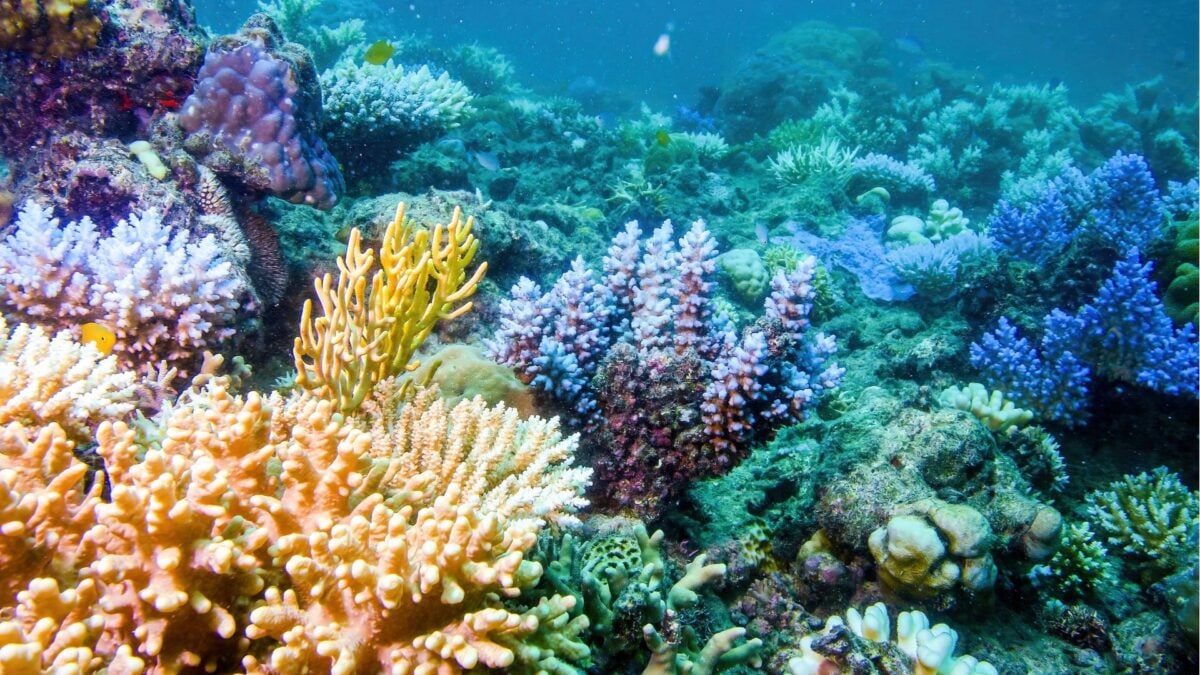
Few ecological crises capture the severity of climate change like the loss of Earth’s coral reefs. Global coverage of living corals has already declined 50% since the 1950s, largely due to rising ocean temperatures and worsening marine heatwaves. A new report shows just how dire this situation will become if global warming continues unabated. Scientists with the International Union for the Conservation of Nature’s Red List of Ecosystems have assessed the world’s shallow coral reefs for the first time, and the findings are stunning. The analysis—spanning 127 reef ecosystems across more than 80 countries and territories—shows that 96% are now critically endangered and face an extremely high risk of collapse in the next 50 years. “Corals carry a deep evolutionary record of coping with environmental change, yet the reef ecosystems we see today are remarkably young, shaped over only the last 5,000 to 7,000 years of stable climate,” Marcos Valderrábano, program manager for IUCN’s Red List of Ecosystems, said in a statement. “Ocean warming is now outpacing anything in their history, and recurring heatwaves are causing mass bleaching faster than reefs can recover or adapt.” Reaching a boiling point Since the late 1990s, Earth has experienced four mass coral bleaching events. The most recent lasted from early 2023 to late 2025, and during that period roughly 84% of the world’s reef area was subjected to bleaching-level heat stress. Bleaching occurs when stressed corals expel their zooxanthellae—symbiotic algae that supply them with nutrients and give them their signature bright colors. Bleached corals aren’t immediately killed, but they are starving. While recovery is possible if stressful environmental conditions subside, it’s becoming far less likely in a warming world. According to the IUCN Red List analysis, marine heat waves currently pose the biggest threat to coral reefs. As the ocean warms, these events are occurring more frequently and lasting longer, which means it’s much harder for corals to bounce back before the next heat wave arrives. Heat stress over the past 50 years already threatens 77% of the world’s coral reef ecosystems, the report states. That figure is hardly surprising. An analysis published last year found that the world’s warm water coral reefs have already become the first Earth system to cross its thermal tipping point. Without urgent global action to cut fossil fuel emissions, the world’s oceans will continue to rapidly warm. Over the next 50 years, heat stress alone could critically endanger 95% of the reefs assessed by the IUCN. Local pressures such as overfishing and pollution will only add to that strain by further destabilizing coral ecosystems. In 63% of the reefs evaluated, the delicate balance between corals, algae, and fish was already disrupted. What’s more, the IUCN found that 45% of reefs were so small or isolated that a single cyclone, bleaching event, or disease outbreak could wipe them out entirely. A quarter of the reefs assessed have already lost much of their living corals. The findings boil down to one stark truth: These critical ecosystems are in dire trouble. Coral reefs are vital to biodiversity, supporting about 25% of all marine fish species as well as numerous invertebrates. The food, income, and coastal protection of hundreds of millions of people also depend on coral reefs. There are reasons to be hopeful, however. Scientists working to help corals become more resilient have made some breakthroughs in recent years. Just last week, a study showed that bleached corals can rapidly recover from bleaching when touched by healthy, genetically identical corals. In lab experiments, dying corals regained their color and fully recovered within just seven weeks, and as little as five days of contact was enough to start the healing process. Still, the fate of the world’s coral reefs will depend on humanity’s ability to cut planet-warming emissions and slow the pace of global warming.
Earth’s Shallow Coral Reefs May Have Just 50 Years Left
Full Article
Original Source
Read the full article at Gizmodo →KhanList aggregates and links to publicly available news content. We do not host full articles from third-party sources. Always verify important information with original sources.