
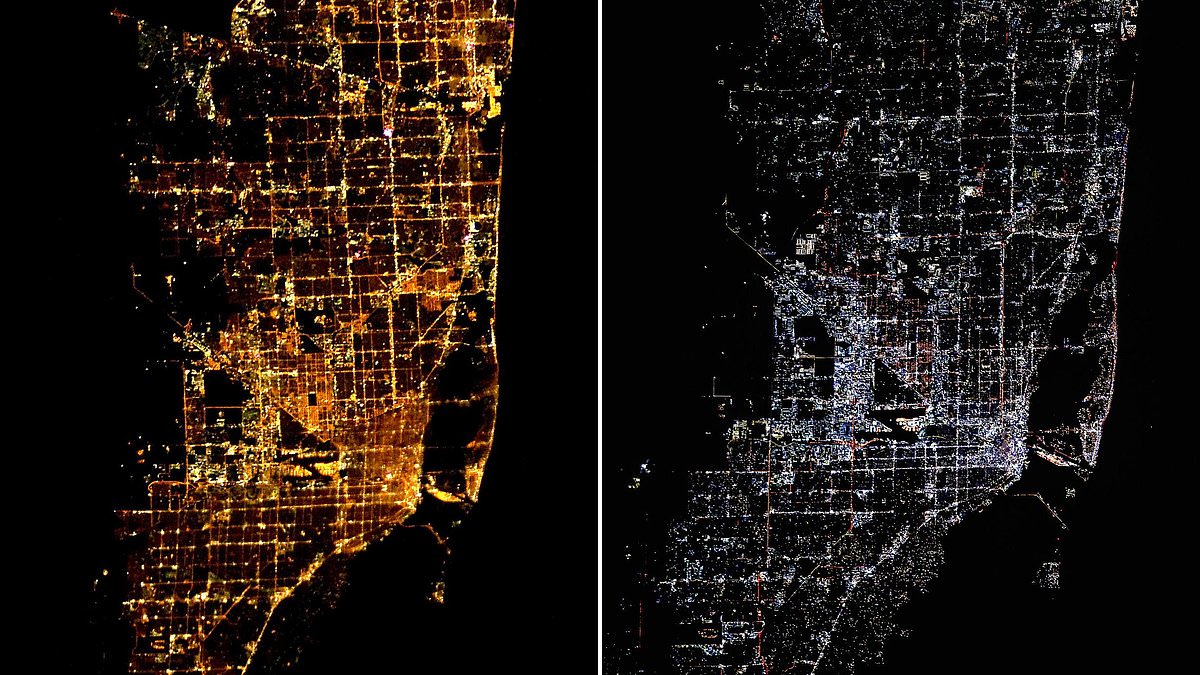
Incredible photos taken from space reveal how street lights have changed colour across the globe, morphing from yellow to white.NASA astronaut Don Pettit has spent almost 600 days in space over the last 23 years, painstakingly documenting Earth's changing nightscape.Across four missions on the International Space Station, Mr Pettit has photographed every major city on Earth.His stunning dataset, shared in a post on X, shows the gradual replacement of warm yellow sodium vapour lamps with bright white Light Emitting Diode (LED) street lights.In as little as 13 years, cities like Las Vegas and Miami have utterly transformed their nighttime glow.Mr Pettit says: 'The warmer, yellow-orange of gas discharge lamps has been phased out worldwide to multi-colored LEDs, citing energy savings and environmental reasons.'Widespread adoption has markedly changed the way our cities look from orbit, and as many have pointed out, how they feel to those on the ground!'Incredible photos taken from space reveal how street lights have changed from yellow to white across the globe. Pictured: Miami in 2012 (left) and 2024 (right)Las Vegas' transformation can also be seen from space, including the addition of the Vegas Sphere, which appears as a large dot in the centre. Pictured: Las Vegas in 2012 (left) and in 2025 (right)NASA photographer Don Pettit captured these images over four missions spanning almost 600 days in space. Pictured: Chicago seen in 2003 (left) and 2024 (right)Before the start of the 21st Century, the vast majority of cities were mostly lit by sodium vapour lamps.These old-fashioned lighting systems use electricity to excite atoms in vaporised sodium metal, to produce a warm yellowish glow.However, in 1993, the invention of the blue LED meant that energy-efficient white street lighting was suddenly commercially viable.LED lights are cheaper to produce, last significantly longer without needing replacement, and use far less electricity to produce more light.Due to environmental and financial concerns, cities started to phase out their old sodium vapour lights in favour of these more sustainable alternatives.In 2012 alone, researchers estimated that switching to LEDs in the UK led to energy savings of 30 to 40 per cent.However, as Mr Pettit's stunning pictures show, this also transformed the ways cities lit up at night.These changes are especially clear in the US, where cities' characteristic grid structures emphasise the change in colour intensity.In Mexico City, images from space reveal how dark areas of nature reserves have been left in place despite the city replacing old sodium vapour lamps with white LEDs. Pictured: Mexico City in 2003 (left) and in 2025 (right) Seoul has transformed from a bright orange glow to a very clean white grid in the last 14 years. Pictured: Seoul in 2011 (left) and in 2025 (right) These images show Monterrey, Mexico as it was seen from space in 2003 (left) and again in 2024 (right) In one set of pictures, Mr Pettit compares Miami as it was in 2012 to a photo taken from space in 2024, a little over 12 years later.He says: 'Famous for its bright streets, it was only recently that Miami's many colors could be distinguished from orbit because the vast yellow glow of sodium vapor overwhelmed all others.'Another dramatic change can be seen comparing Las Vegas in 2012 to how it appeared 12 years later in 2025.'Perhaps the brightest city on Earth, Vegas has continued its spectacle with new LED sources such as the Vegas Sphere, seen as the large purple spot at center,' Mr Pettit explained.Pictures show similarly massive transformations in Chicago, Sao Paulo, Brazil, and Seoul, South Korea.However, these photos also show how the LED revolution hasn't affected every city the same way.In Mexico City, although LEDs have replaced almost all of the city's older street lighting, large dark areas still show where nature reserves have remained unchanged.Meanwhile, in Hong Kong, a photo taken in 2025 shows how the island city kept much of its old lighting while nearby Shenzhen on the Chinese mainland is lit up in multicoloured LEDs.Mr Pettit wrote: 'A unique visual of the differences between the special administrative region and the Chinese mainland.'Likewise, NASA research recently showed that some parts of the world are actually getting dimmer, even as other cities glow brighter than ever before. Sao Paulo, Brazil, has been transformed by the arrival of LED lights. Here you can also see the introduction of warmer, red LEDs in some areas. Pictured: Sao Paulo in 2003 (left) and in 2025 (right) While Hong Kong has kept much of its older street lighting, nearby Shenzhen can be seen glowing with multicoloured LEDs. Pictured: Hong Kong and Shenzhen in 2003 (left) and in 2025 (right) Some cities, like Buenos Aires in Argentina (pictured), have started using significantly warmer LEDs. These can be seen as the red areas in this photograph Researchers have shown that the transition to LED lights has led to an increase in light pollution, especially in the blue part of the spectrum, increasing the risk of harmful impacts on ecosystems. Pictured: A colour map of Europe's night lights for 2014 to 2020Between 2014 and 2022, the UK has grown 22 per cent darker at night, making it the second fastest dimming country behind France - where evenings are now 33 per cent darker. NASA says that this trend is mainly being driven by widespread technological shifts, such as the move towards energy-efficient LED lights. While LED street lighting was meant to reduce cities' night-time energy consumption, researchers are concerned that the transition may have brought unintended consequences.In a recent study, researchers from the University of Exeter suggest the existence of a so-called 'rebound effect'.Their idea is that as the cost of lighting plummeted, demand for street lights increased, leading to an overall increase in energy consumption and light pollution.The researchers found that this has led to a significant increase in nighttime brightness in the blue part of the visible light spectrum.While some cities, like Buenos Aires in Argentina, have started using significantly warmer LEDs, this hasn't balanced out the massive increase in white LEDs. They warn that this has increased the risk of harmful effects on ecosystems, interfering with animals' circadian rhythms, navigation, and ability to hunt at night.In their paper, published in Science Advances, the researchers write: 'The net effect has nonetheless been a pronounced whitening of the artificial light that is eroding natural nighttime cycles across the continent.'LIGHT POLLUTION IS ARTIFICIAL LIGHT THAT IS EXCESSIVE, OBTRUSIVE AND WASTEFULLight pollution, also known as photopollution, is the presence of anthropogenic light in the night environment. Artificial light that’s excessive, obtrusive and ultimately wasteful is called light pollution, and it directly influences how bright our night skies appear. With more than nine million streetlamps and 27 million offices, factories, warehouses and homes in the UK, the quantity of light we cast into the sky is vast. While some light escapes into space, the rest is scattered by molecules in the atmosphere making it difficult to see the stars against the night sky. What you see instead is ‘Skyglow’.The increasing number of people living on earth and the corresponding increase in inappropriate and unshielded outdoor lighting has resulted in light pollution—a brightening night sky that has obliterated the stars for much of the world’s population. Most people must travel far from home, away from the glow of artificial lighting, to experience the awe-inspiring expanse of the Milky Way as our ancestors once knew it. Light pollution is excessive and inappropriate artificial light. While some light escapes into space, the rest is scattered by molecules in the atmosphere making it difficult to see the stars against the night sky. What you see instead is ‘Skyglow’The negative effects of the loss of this inspirational natural resource might seem intangible. But a growing body of evidence links the brightening night sky directly to measurable negative impacts on human health and immune function, on adverse behavioural changes in insect and animal populations, and on a decrease of both ambient quality and safety in our nighttime environment.Astronomers were among the first to record the negative impacts of wasted lighting on scientific research, but for all of us, the adverse economic and environmental impacts of wasted energy are apparent in everything from the monthly electric bill to global warming.
Earth's cities are changing COLOUR: Astronaut photos taken just 13 years apart reveal how night lights have morphed from yellow to white across the globe
Full Article
Original Source
Read the full article at Dailymail →KhanList aggregates and links to publicly available news content. We do not host full articles from third-party sources. Always verify important information with original sources.