
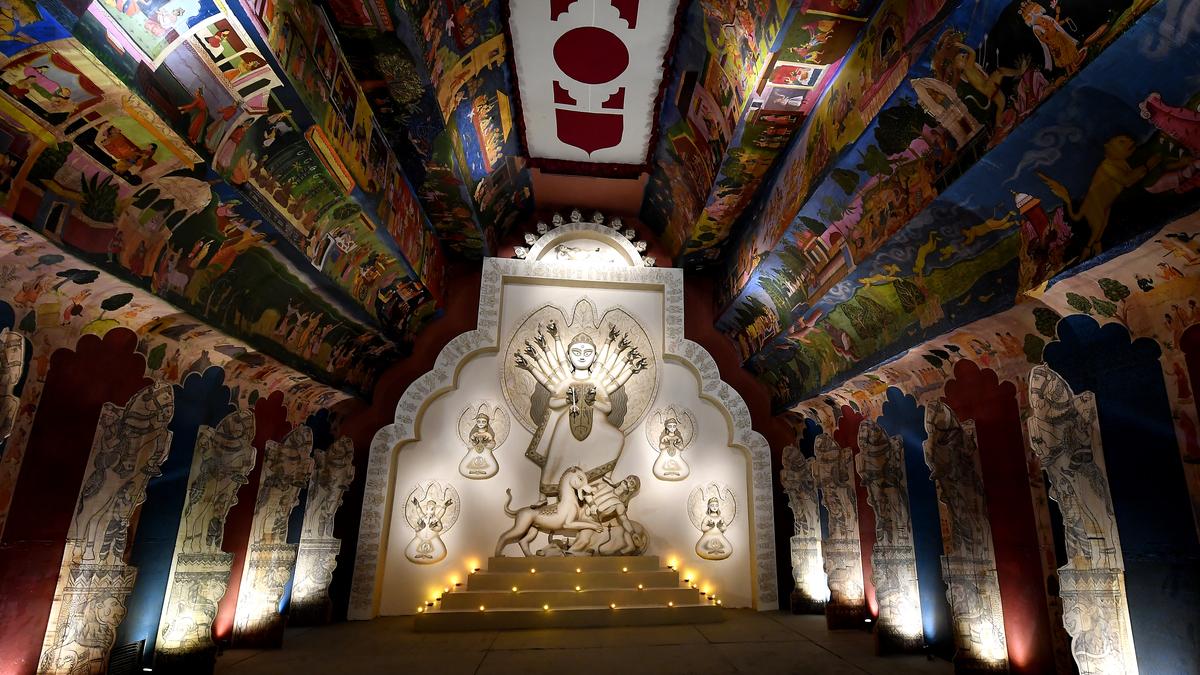
Three years ago, I added pandal hopping in Kolkata to my calendar and since then it has become an annual art pilgrimage. Every year, during Durga Puja, the city amazes me with the sheer number and creative variety of the massive installations that spring up across its length and breadth. The first year, I remember thinking Kolkata could rival the Venice Biennale during these five days of October. My second year, I was impressed by how pandals became important platforms for social and political activism. But this year, I was moved by how the installations are an ode to the spirit of collaboration. A Durga idol in Kolkata | Photo Credit: Getty Images Each pandal can employ anywhere from 50 people to a few hundreds. And the work, I’m told, often takes an entire year to complete. The main artist conceptualises it, coming up with topical, message-driven themes. He then commissions its various elements to different artisans and designers — from paintings and sculptures to the main deity, the soundscape, the lighting, the performances and so much more. It is nothing short of a spectacle, and the talent and ideas behind these productions can put major international art biennales in the shade.The showstoppersThis year, the pujo atmosphere is visible from the sky, the city’s illuminations bright as my flight readies to land. On the ground, wending my way through Kolkata’s busy streets for a preview of 10 pandals, the artists’ labour becomes immediately apparent. A drone display depicting goddess Durga at Eden Gardens | Photo Credit: Getty Images At S.B. Park Sarbojanin in Thakurpukur, artist Raju Sarkar designed the Colliery, taking inspiration from the Raniganj Coalfield. Crafted as a subterranean mine, the pavilion captures the dark, suffocating atmosphere of the mines and the struggles that miners face every day. I am struck by the simplicity of the sculptures and photographs, which, combined with its lighting and sound installations, create a sombre, dramatic mood that is unforgettable. Sculptures at Raju Sarkar’s Colliery | Photo Credit: Amit Moulick ‘The simplicity of the sculptures and photographs, combined with the lighting and sound installations, create a dramatic mood’ | Photo Credit: Amit Moulick Goddess Durga wielding a pickaxe at SB Park Sarbojanin | Photo Credit: Amit Moulick Artist Anirban Das has created four major pandals across the city, each with sharp messaging. His Ramayana pavilion at Alipore Sarbojanin is a grand spectacle, painted in parts, and with metal cutouts dotting the rest — a combination of folk-scroll and wood-cut styles translated onto metal panels. Performance art is an important element, too. A combination of Chhau and other forms, it follows the story of the sleeping Kumbhakarna, drawing parallels with present-day politics and how many Indian citizens are oblivious to what’s going on. Anirban Das’ Ramayana pavilion at Alipore Sarbojanin is a grand spectacle | Photo Credit: Amit Moulick Another of Das’s pandals, at Naktala Udayan Sangha, is drama in black and white. Based on the Bengali Almanac, the installation has a roofscape that reminds me of the sacred five-peaked Mount Meru set against the stars in the night sky. Laid out like a horoscope chart, it has a gripping performance, accompanied by Baul singers, where Shiva and Parvati traces the form of almanac as a metaphor for the cosmos (as a science) controlling destiny. At Naktala Udayan Sangha, Das’ pandal is drama in black and white | Photo Credit: Amit Moulick Another favourite is at Telipukur Yuba Sangha, where well-known artist Bhabatosh Sutar’s pandal deals with the politics of water, ecology, and the fact that the ponds that once fed the land are fast disappearing. The combination of mixed-media film projected on the ceiling and monumental drawings on the walls, along with sound installations and music, makes you linger, almost expecting a water creature to leap out of the large pond next to a beautiful young girl, the avatar of the goddess in the pandal. Bhabatosh Sutar’s pandal deals with the politics of water | Photo Credit: Amit Moulick A beautiful young girl is the avatar of the goddess in this pandal | Photo Credit: Amit Moulick Spirit of co-workingThe pandals are experiential; photographs don’t do them justice. Imagine spaces the size of two football fields! This year also focused a lot on technology such as projections and soundscapes, and traditional performances.Each pavilion is presented like a major museum show: from the planning, the techniques used, the mixed disciplines, and the strong storylines. And at a time when I have stepped away from my comfort zone of running a gallery to coordinate the visual component of the upcoming India Biennale in New Delhi (set to debut on December 4), the artists have shown me a side of art where success lies in team spirit and generosity.The writer is the founder of Apparao Galleries.
Durga Puja 2026 | Lessons from the pandal
Full Article
Original Source
Read the full article at Thehindu →KhanList aggregates and links to publicly available news content. We do not host full articles from third-party sources. Always verify important information with original sources.