
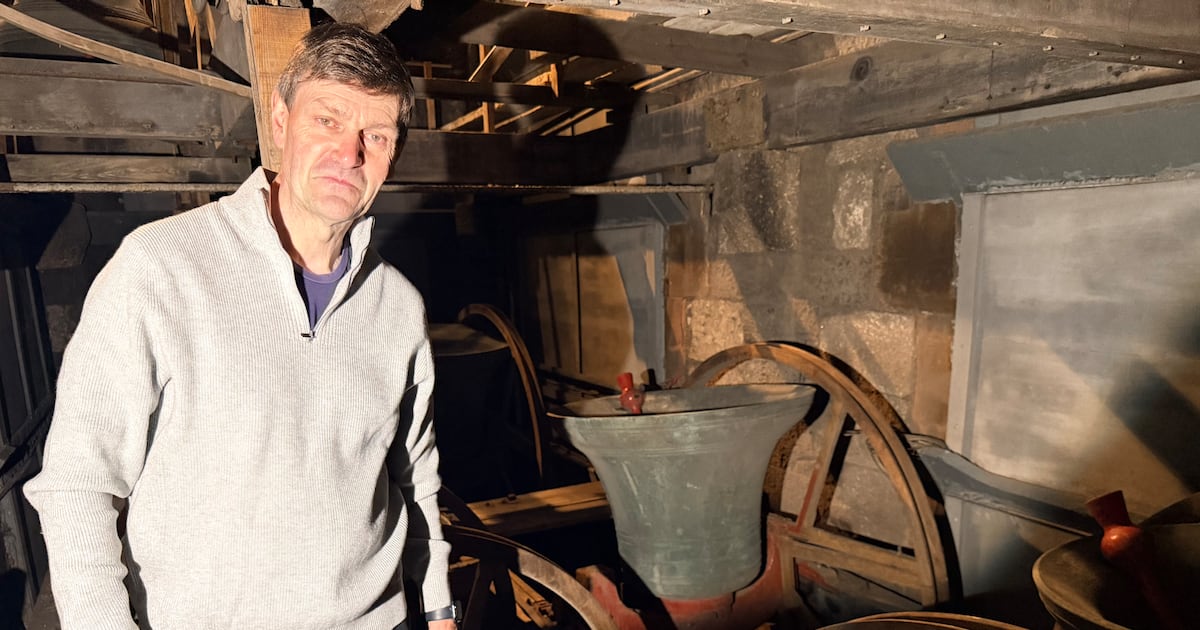
The Liberties bells have started calling Catholics to prayer again after ringers from the other Dublin church towers cleaned up the belfry of the St Augustine and St John Church on Thomas Street after it spent more than 20 years silently gathering dust.So alarmed and confused were some locals when they heard the practice peals from half a dozen campanologists last week that they raced into the church to tell the priests they feared the bells were about to come crashing to earth.Far from falling down, they were springing into life again following a revival project led by Michael Ryan, a man who was first drawn to bell ringing while serving as an altar boy in the church, known as John’s Lane, more than 50 years ago. While sitting on the altar in the early 1970s, his eye would often be drawn to the small spiral staircase at the back of the church that seemed to reach towards the heavens. READ MOREEventually curiosity got the better of him and he climbed the stairs where he met the bell ringers. “They told me they didn’t get many people up in the tower and showed me around,” he says. “They took me on to the roof where I saw views of Dublin that I’d never seen before.”They also taught him the ropes – literally – and he has been ringing bells in churches around Dublin – and further afield – ever since.While the bells have tolled occasionally for funerals and other major church events, they fell silent for routine prayer services in the 1990s. “Some of the bell ringers died and there was no one to take over. I had moved away by that point,” Ryan explains. Michael Ryan wants to encourage more people to consider taking up the art of campanology But although he had left John’s Lane, it never really left him and when the prior of the church, Fr Pat Gayer, gave him the chance to lead a restoration project earlier this year he jumped at the opportunity. The church, which was built in the 1860s, has the tallest spire in Dublin, and while it doesn’t quite tower over the twin cathedrals of Christ Church and St Patrick’s, and St Audoen’s, nearby, it can lay claim to being taller than all of them. Michael Ryan first began bell ringing when he was an altar server 50 years ago The Catholics of Dublin 8 didn’t exactly lord this over their Protestant neighbours but it was definitely something they wore as a badge of honour for donkey’s years, Ryan says.On Sunday morning last, he and a team of six others climbed the vertiginous spiral staircase which snakes past the stained glass of a large Harry Clarke window and into the belfry before the 11:30am mass. The team ran through a reading from the book of numbers, the bell ringer’s bible which contains the sequences needed to get specific sounds. Michael Ryan and bell ringers at St Augustine and St John's Church on Thomas Street “They are called methods but I call them tunes,” he says. “It’s not musical, it sounds musical because all the bells are differently tuned, but it’s just moving numbers around in your head.”One of the reasons he wants to shout about the restoration project from the rafters is to encourage more people to consider taking up the art of campanology.He stresses that a religious affiliation of any kind is not a requirement – like other bell ringers he moves seamlessly between Protestant and Catholic churches and is entirely agnostic as to where he goes as long as there are bells that need pealing. In all his years bell-ringing, no one has ever asked him his religion or even if he has one, he says.Ultimately, he suggests, it is about community. It is also, he says, “a mild form of exercise and it is great for your brain. You don’t have to be musical and it is not complicated; you just need to do simple things well”.
Dublin’s Liberties bells ring after 20 years’ silence following revival project
Full Article
Original Source
Read the full article at Irishtimes →KhanList aggregates and links to publicly available news content. We do not host full articles from third-party sources. Always verify important information with original sources.