
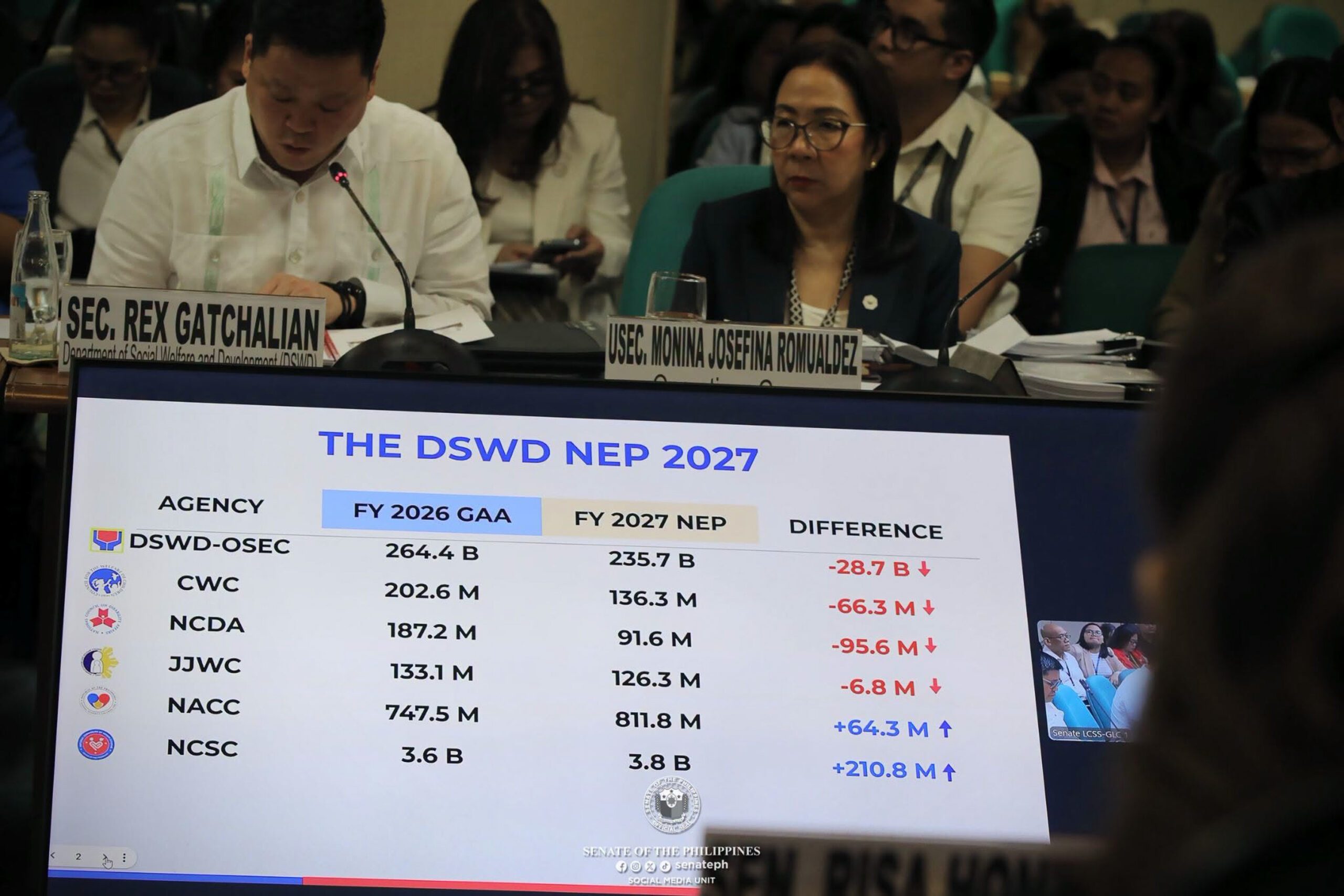
BUDGET BRIEFING. Social Welfare Secretary Rex Gatchalian appears before the Senate as his department's proposed 2027 budget is tackled on October 21, 2026. Senate Social Media Unit The Department of Social Welfare and Development says AICS will be used to support those affected by El Niño and the Middle East conflict. But there are still concerns about the program. The Department of Social Welfare and Development is requesting at least P63.9 billion for the Assistance to Individuals in Crisis Situations program in 2027. Concerns were raised about the potential misuse of AICS for political patronage, and about deficiencies flagged by state auditors. This is AI-generated. Read the article for full context. Report any errors. MANILA, Philippines – The Department of Social Welfare and Development (DSWD) appealed to senators to allocate at least P63.9 billion for the Assistance to Individuals in Crisis Situations (AICS) program in 2027. “We are looking at the barrel of the gun with El Niño, with inflation, and then our regular payout for those who come into our offices,” Social Welfare Secretary Rex Gatchalian said in a mix of English and Filipino during the budget deliberations of the Senate finance subcommittee E on Wednesday, October 21. Under the 2027 National Expenditure Program, AICS was allocated P33.29 billion. The House of Representatives’ version of the budget bill added P25 billion. The current amount is still lower than the P63.9 billion provided under the 2026 national budget. (READ: P241-billion budget proposed for DSWD in 2027 is below 2026 level) “Kahit nga ‘yon (P63.9 billion) very tight na eh. Pero kung talagang tight fiscal space, maibalik man lang doon, palagay ko kakayanin natin nang konti po,” Gatchalian said. (Even the P63.9-billion level is already very tight. But if there’s really tight fiscal space, I think we would somehow manage if that level is restored.) He added that it can be supported by the agency’s quick response fund next year. AICS provides financial assistance for medical needs, burial, transportation, education, food, and other support services or needs of a person or family. According to Gatchalian, this year has already been “quite challenging” for the DSWD as AICS was used to help sugarcane farmers affected by insect infestation and agricultural workers impacted by droughts. The transportation sector also received financial aid amid high oil prices triggered by the Middle East conflict. Citing a survey, Gatchalian said majority of public utility vehicle drivers used the money to continue their livelihood and buy food for their families. Meanwhile, the Department of Agriculture (DA) estimated there may be up to 4.6 million affected farmers and fisherfolk in a worst-case El Niño scenario, with potential agricultural losses reaching over P20 billion. In the Senate’s deliberations for the DA’s proposed budget also on Wednesday, Agriculture Secretary Francisco Tiu Laurel Jr. said possible volume loss may be up to a million metric tons, covering 350,000 hectares of agricultural land. This could threaten food security next year, and lead to high prices of goods. Worries: Political patronage, COA-flagged deficiencies During the budget briefing, Senator JV Ejercito, the chairman of the Senate finance committee, raised the issue of AICS potentially being weaponized for political patronage, especially with the upcoming 2028 elections. Gatchalian assured Ejercito that while the DSWD receives many referrals for the aid program, their social workers are licensed professionals. “At the end of the day, the social worker does the intake ho eh. Nobody can dictate [to] them kung qualified or not qualified at kung magkano ang ibibigay…. We know for a fact that they can withstand ‘yong mga pressures,” the DSWD chief said. (At the end of the day, the social worker does the intake. Nobody can dictate to them whether applicants are qualified or not, and how much they can receive. We know for a fact that they can withstand any pressure.) Ejercito’s concern stemmed from issues found by the Commission on Audit. In its 2025 annual audit report, COA flagged the DSWD’s lapses in the implementation of AICS, including “duplicate, multiple, and overlapping payments” amounting to P397.45 million. The overlapping payments were made to AICS and Ayuda para sa Kapos ang Kita Program (AKAP) beneficiaries. State auditors reported discrepancies in beneficiary records, the referral-based beneficiary selection, inconsistent documentation, inadequate monitoring, and deficiencies in beneficiary validation, deduplication, and accountability controls. “As long as it’s not the same item that they availed of, then that should be allowed in our guidelines,” Gatchalian said, noting that separate DSWD and COA validation processes are set to be finished by December. AKAP, the controversial pet project of former House speaker Martin Romualdez, emerged in the 2024 budget. It was defunded in 2026 and in the 2027 budget proposal. A bill institutionalizing AICS remains pending in the bicameral conference committee over an “anti-epal” provision, or a provision that would prohibit politicians from participating in cash aid distribution or making it appear that the program is theirs. This clause is absent in the version of the House bill. – Rappler.com How does this make you feel? Loading
DSWD’s budget appeal: Give AICS at least P63 billion in 2027
Full Article
Original Source
Read the full article at Rappler →KhanList aggregates and links to publicly available news content. We do not host full articles from third-party sources. Always verify important information with original sources.