
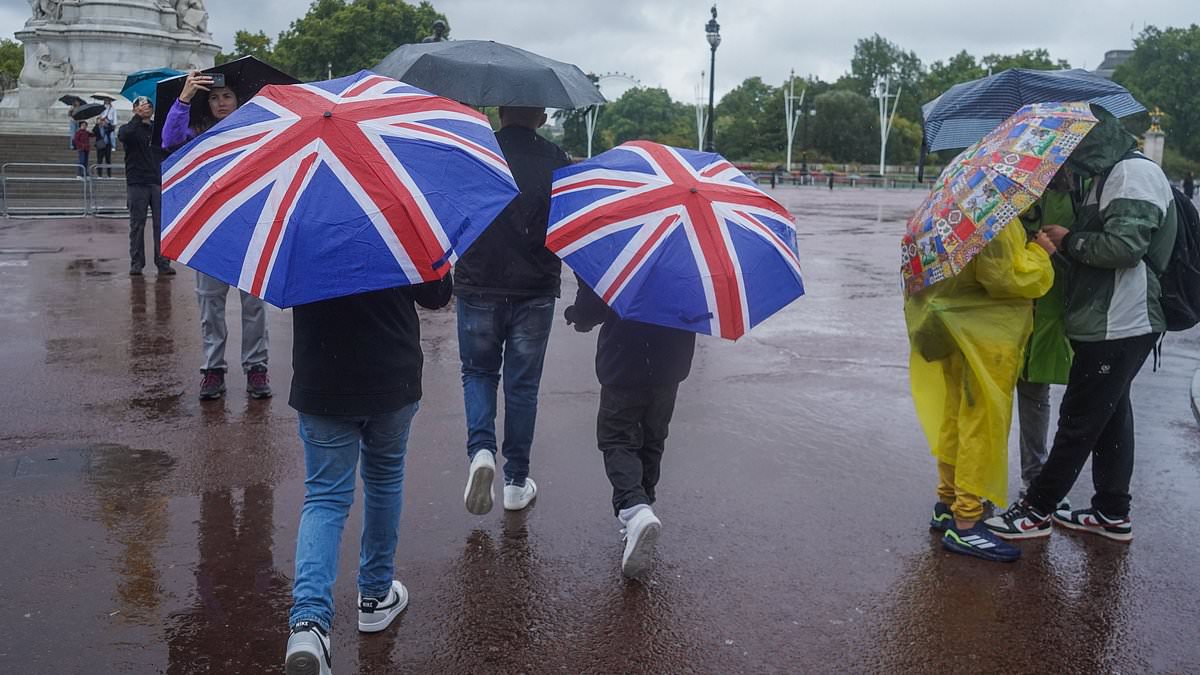
England endured further heavy rain today after the wettest week in seven months – despite the country remaining in drought with hosepipe bans still in force.The Met Office said southern England had a 'very wet morning' today ahead of more showers this afternoon; while the North experiences rain, strong winds and thunder.Further unsettled weather is expected from Thursday evening, with this week's daytime high temperatures around the average for the time of year at about 21C.Forecasters expect a 'day-to-day swing between settled and unsettled conditions', as low pressure systems followed by ridges of high pressure create a varied week. But the rainfall is not expected to change the situation for the three-quarters of England and all of Wales in drought, or the 28million people under hosepipe bans.August 28 to September 3 had the most rain of any week since early February, with totals ranging from 26mm (1.0in) in the south-east to 48mm (1.9in) in central areas.The Environment Agency (EA) has welcomed the recent rainfall for 'improving river flows, soil moisture deficits and environmental conditions' for much of England.But reservoir storage continued to fall for several water firms, with officials warning drought conditions will continue until there is 'sustained rainfall across the country'.The public body also cautioned that a 'few days or even weeks of wetter weather cannot reverse the impacts of several months of exceptionally dry conditions'.It follows the hottest summer on record – with parched landscapes still a common sight as England and Wales endured their driest July since records began in 1836. Tourists take cover under umbrellas outside Buckingham Palace on a rainy day in London today Pedestrians walk in the rain in Westminster this morning as heavy downpours hit the capital People brave the rain for a wet-weather punt tour along the River Cam in Cambridge today A pedestrian in the rain outside Westminster station across from Big Ben in London today People take in the view from Garret Hostel Bridge over the River Cam in Cambridge today Tourists shelter with umbrellas outside Buckingham Palace on a rainy day in London todayThis was followed by a lack of rain at the start of August – meaning some areas of Hampshire, Surrey and West Sussex went more than 60 days without a downpour.About 71 per cent of England has been experiencing 'flash drought', which develops very quickly because of a combination of very low rainfall and high temperatures.Heavy winter rainfall meant reservoirs and groundwater were replenished earlier this year, meaning the country made it through a dry spring without any major impacts. How drought and hosepipe bans are still affecting England AREAS IN DROUGHTEast AngliaHertfordshire and North LondonThamesDevon, Cornwall and Isles of ScillyWest MidlandsWessexKent and South LondonSolent and South DownsEast MidlandsLincolnshire and NorthamptonshireHOSEPIPE BANSAffinity Water – Central and East regions, covering Bedfordshire, Berkshire, Buckinghamshire, Hertfordshire, Surrey, and parts of London and EssexAnglian Water – whole area, excluding HartlepoolBristol Water – whole areaCambridge Water – whole areaEssex and Suffolk Water – whole areaSouthern Water – Hampshire and the Isle of WightSouth East Water – whole areaSouth West Water – whole area, excluding BournemouthThames Water – whole areaWessex Water – whole area But the hot and dry summer brought the third drought in the past five years – the other two being in 2022, when the UK's hottest ever day was recorded, and 2025.The exceptional summer was the first to see three days where temperatures exceeded 37C as parts of the country sweltered through five major heatwaves.August 28 to September 3 was the wettest week for England since early February, according to EA figures.But the agency said: 'Further significant rainfall is needed to return to normal water resource conditions for many water companies.'Reservoir storage fell to 58 per cent nationally in data for the week ending September 1, remaining significantly below average, with 11 reservoirs less than half full.The EA said farmers 'face challenging conditions due to hard soil, especially where some abstraction restrictions remain that limit the availability of water to soften ground'.River flows increased at many sites monitored by the agency at the start of the month, however some low flows continued in parts of the east and south-west England.Some ten areas of England were in drought status at the start of this month: East Anglia; Hertfordshire and North London; Thames; Devon, Cornwall and Isles of Scilly; West Midlands; Wessex; Kent and South London; Solent and South Downs; East Midlands; Lincolnshire and Northamptonshire.The remaining areas were in 'prolonged dry weather status', according to the EA.Rainfall across August reached 78 per cent of the long-term average nationally, although south-east England received only 54 per cent.The Met Office said autumn had marked a 'significant change of weather type from summer, which was dominated by dry conditions'.It added that the first week of autumn had seen 18mm (0.7in) of rain fall across the UK, with more heavy rain forecast this week, especially in western areas. EA chief executive Philip Duffy said: 'A few days or even weeks of wetter weather cannot reverse the impacts of several months of exceptionally dry conditions. 'Drought conditions will continue until we receive sustained rainfall across the country and we still all have a role to play in conserving precious water supplies.'We ask people to carry on following the restrictions, where in place, and continue to save water such as by turning off taps when brushing teeth and using an eco-setting on household appliances.'Small steps will leave more in the environment for our wildlife, our local rivers, and our farmers who are still struggling with the drought impacts.'Met Office spokesman Grahame Madge said: 'Autumn has marked a significant change of weather type from summer which was dominated by dry conditions, especially in the south.'Now the weather patterns are dominated by the Atlantic which in autumn usually means an increase in wet and unsettled conditions.'The first week of autumn has seen 18mm of rain fall across the UK, and we have more rain in the forecast for the coming week; some of this rain is likely to be heavy, especially in western areas.'This week's forecast is dominated by a regular drumbeat of clearer periods interspersed with wetter spells.'
Drought and hosepipe bans remain in force despite Britain's wettest week in seven months as heavy rain falls today
Full Article
Original Source
Read the full article at Dailymail →KhanList aggregates and links to publicly available news content. We do not host full articles from third-party sources. Always verify important information with original sources.