
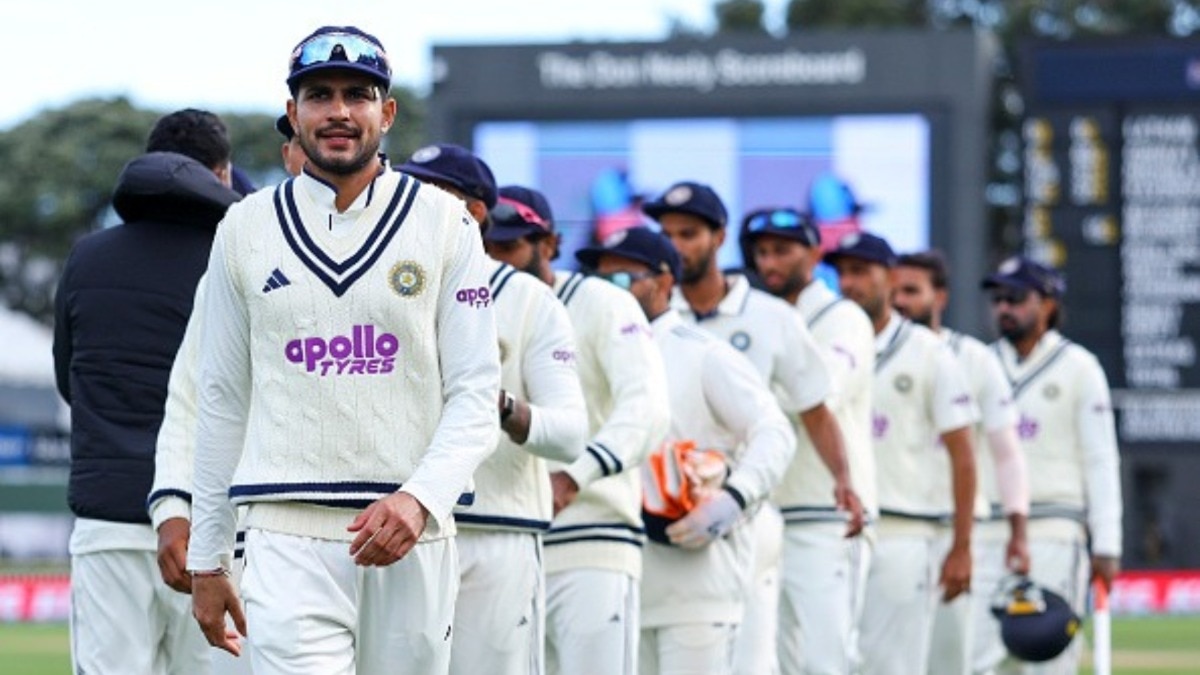
India had scored 720, taken a 352-run lead and given themselves four sessions to bowl New Zealand out. Yet, with 15 overs still left in the final day's play, Shubman Gill's side shook hands for a draw, five wickets short of victory. SCORECARDThe decision to shake hands with 15 overs still remaining sparked debate over whether India should have persisted for a result. The draw also marked their second in succession, following the stalemate against Sri Lanka earlier this year, adding to the frustration.India had reduced New Zealand to 70 for five in the first innings before Henry Nicholls and Glenn Phillips struck centuries to take the hosts to 368. Their resistance continued in the final innings, with Daryl Mitchell and Phillips adding an unbeaten 63 for the sixth wicket to guide New Zealand to 239 for five.With India's World Test Championship campaign under pressure, the early handshake has reopened a larger debate: could Gill and his team have done more to force a result? COULD INDIA HAVE FOUGHT LONGER?Senior Managing Editor and Head of Sports Tak, Vikrant Gupta, was among those who questioned India's decision to shake hands with time still left in the day. He felt the visitors had given up on the possibility of a win too early."India shook hands, offered New Zealand a draw with 15 overs left. Because they thought it was impossible to win from here. "But what was the harm in at least trying - in fact they stopped fighting at least an hour before the handshake."Vikrant invoked the infamous Sydney Test of 2008, when Australia captain Ricky Ponting turned to part-time spinner Michael Clarke with India seven wickets down and the match nearing its end. Clarke took three wickets in five balls in the penultimate over, helping Australia secure a 122-run win with eight minutes of playing time remaining. Screengrab from X Gill, however, said the decision was based on the condition of the pitch and the workload on his fast bowlers. He felt the attack had already put in a demanding shift and that another spell was unlikely to change the outcome."Honestly, not really. All our fast bowlers had bowled close to 50 overs in the match. Giving them 4 or 5 overs more... if there was anything on the pitch, and if the bowlers felt they could get the batters out, we tried all the plans we thought of. They executed it as well. There wasn't enough on the wicket."We thought those extra 10 or 15 overs were not going to do anything."UNFIT PITCH FOR TEST?The condition of the Basin Reserve surface was central to the debate. The pitch looked green on the opening morning, but the assistance expected by the fast bowlers did not last. As the match progressed, the surface became slower and flatter, making it increasingly difficult to create chances.Such pitches are not what visiting teams have come to expect in New Zealand, a country known for welcoming touring sides with green tops.Former New Zealand captain Jeremy Coney described it as the flattest surface he had seen at the venue in a long time."In a long time, a long, long time," he told PTI when asked whether it was the flattest pitch he had witnessed at the Basin Reserve."This is a new group of groundsmen for this particular pitch. Apparently, they haven't had the best conditions after the last groundsman left. He left it in a pretty average kind of state, so they have had to work very hard to get this pitch ready. That's why they are telling me it is as bland as it is."Former New Zealand all-rounder Scott Styris was equally critical of the surface, saying it had failed to provide a fair contest between bat and ball."I'm with you - the pitch wasn't good enough for Test cricket. I think we can stick our hand up and say that. We want a good even contest between bat and ball. We didn't get that," Styris said."I thought that first morning did plenty, however, it didn't last very long, and that was the problem."Gill shared that assessment, saying the pitch became flatter as the match progressed."When we started playing the Test match, we thought there would be a lot more in the wicket. I think on day three, four, and five, it just went flatter and flatter. There was no impact of the overs being bowled on the wicket, or even the days being played. The wicket just got slower.""Not a great Test wicket, if you want results," he added.Sunil Gavaskar, meanwhile, said he had initially expected the match to finish inside four days, given the appearance of the pitch on the first morning and the threat posed by Jasprit Bumrah. However, the surface did not offer sustained assistance to the bowlers as the Test progressed.POOR QUALITY OF THE BALL?The condition of the ball was another concern raised by the Indian captain. Gill said it became soft after just 25-30 overs, making it harder for the fast bowlers to extract movement, particularly on a pitch that was already offering little assistance."The ball definitely plays a big role. The first ball we used, it went soft after 25-30 overs. Even New Zealand complained about this. We experienced a similar thing in England last year. I don't know if the quality of the ball is going down."He also questioned why the use of saliva remained prohibited, more than six years after the Covid-19 pandemic began."And we are way past Covid times, why are we still not allowed to use saliva? This is also a big factor when it comes to managing the ball."New Zealand captain Tom Latham agreed with Gill's assessment."Yeah, I think he's spot on in terms of the ball. Apart from day one, where the wicket had probably a little bit more in it, as you saw throughout the game, the ball tended to get soft," he said."You get through those first few overs, first 10 overs with a new ball and things look slightly different. Whereas I think the usual characteristics of grounds in New Zealand, the ball tends to stay a bit harder and obviously carries through a little bit more and probably swings for a little bit longer."MORE AGGRESSION FROM GILL?The pitch and the quality of the ball were not the only factor under scrutiny. Questions were also raised about Gill's field placements and whether India could have been more attacking in the final innings, particularly given that they had a substantial lead and did not need to worry about conceding runs.Styris praised the Indian captain's handling of the bowling attack but felt his field settings could have been more aggressive."It's the one area I was disappointed with Shubman Gill's captaincy. The rotation of the bowlers, mixing and matching, changing ends to create something out of nothing, I thought he was first class. But the fielding positions weren't aggressive enough. When you have so many runs in the bag, boundaries don't matter. I thought Gill was a bit reactive at times. I feel like it was a missed opportunity. He is still a young captain, I think he will learn from this."There were moments when India came close to breaking the partnership. Mitchell survived a run-out opportunity following a misfield by Akash Deep, while a chance off his glove fell short of the area where a short-leg fielder could have been stationed.India also went without a second slip or a short leg for a period after taking the second new ball. Gavaskar, however, noted that even the second new ball failed to provide India with the breakthrough they needed, despite Bumrah being handed the ball."The second new ball did not turn out productive at all," he said.Another question put to Gill was whether India could have declared earlier to give themselves more time to bowl New Zealand out. The captain was quick to dismiss the suggestion, arguing that an earlier declaration would only have increased the workload on his bowlers without necessarily improving their chances of forcing a result."We declared with four sessions and around 140 overs left. And we couldn't bowl them out in that. What was the point of declaring earlier? The game would have extended and we would have had to bowl more. We have our next Test in three days and one of those days will be to travel. It's frustrating," he said.SELECTION UNDER SCRUTINYThe decision to leave out Mohammed Siraj and Ravindra Jadeja also came under scrutiny, particularly after New Zealand recovered from 70 for five in the first innings. Former India captain Sourav Ganguly questioned the absence of a specialist spinner, arguing that India needed a frontline wicket-taking option as the pitch flattened.Gill, meanwhile, defended the decision to leave Siraj out, saying selection was based on form and the bowling combination the team wanted. He also acknowledged that dropping a close friend was difficult.For India, the draw came at a cost in the WTC race. They entered the match needing all 12 points and left with four, with their points percentage dropping from 51.52 to 50.00. Gill acknowledged the frustration but pointed out that the emphasis on results in the WTC had changed how teams viewed drawn Tests."There is definitely a bit of frustration. We did not get the desired result. But this is also part of the game. In the last six-seven years, there have not been a lot of draws. That's why we are feeling more frustrated."Whatever the shortcomings, India had fought hard to put themselves in a position to win the Test. They dominated large parts of the contest, but could not find a way to prise out the final five wickets. The pitch, the ball and the workload on the bowlers offer some explanation. But could India have done more, tactically and in their approach, to close out the game? That is the question the Wellington draw leaves behind.- EndsTune In
Draw or missed opportunity: Did Gill and Gambhir miss a trick in Wellington Test?
Full Article
Original Source
Read the full article at Indiatoday →KhanList aggregates and links to publicly available news content. We do not host full articles from third-party sources. Always verify important information with original sources.