
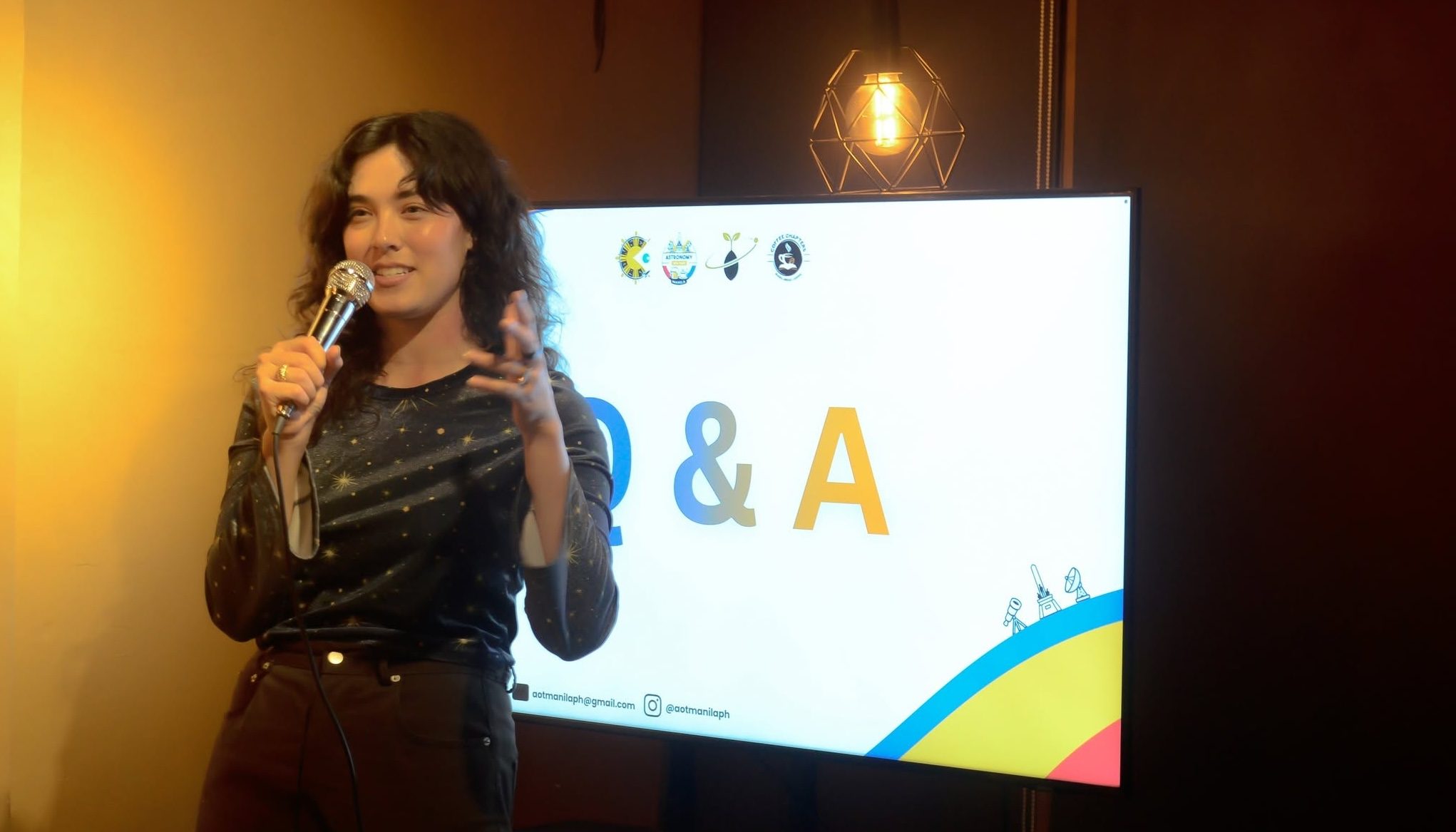
MENTOR. Dr. Sabrina Berger-Marcelo answers questions during her astronomy talk in Manila. Astronomy on Tap Manila Facebook page ‘There's actually a huge history of indigenous Filipinos doing astronomy, and we just don't talk about it,’ says Fil-Am astrophysicist Dr. Sabrina Berger-Marcelo Dr. Sabrina Berger-Marcelo, a Filipino-American astrophysicist, connects her Filipino heritage with her work in astronomy, emphasizing the importance of community and mentorship. She aims to diversify the field of astrophysics in the Philippines and is committed to addressing social issues like poverty and education while promoting science. Berger-Marcelo's journey includes a strong academic background, a passion for teaching, and a desire to inspire future scientists, particularly in her mother's home province of Palawan. This is AI-generated. Read the article for full context. Report any errors. Ever heard someone explain the formation of black holes by comparing it to the classic Filipino sinigang recipe? This is something only Dr. Sabrina Berger-Marcelo could pull off. Almost instantly, the Filipino-American astrophysicist caught the attention of her listeners during a talk on astronomy in Manila. For someone who grew up in the US, Berger-Marcelo still makes sure that her teachings reflect her Filipino roots. “My mom was born in Palawan and immigrated when she was in her teens. Growing up, I was confused about my background,” Berger-Marcelo shared. “My mom had a lot of trauma here as a child — that was one of the reasons why she left, so she’s never wanted to come back. Not because of the Philippines, but because of her family life here. It was really hard to connect to my culture.” “My family on my dad’s side is just my grandma, so I basically just grew up with my Filipino family. I think, actually, it’s helped me in astrophysics because I just learned this word: kapwa. My grandma and my mom know how to build community.” Dr. Sabrina Berger-Marcelo hopes to inspire young Filipino students to pursue science. At 30 years old, Berger-Marcelo visited the Philippines for the first time, accompanied by her 84-year-old grandmother, whom she’s very close with. “Growing up in the US, there were a lot of opportunities to get involved and do research. That’s one of the reasons why I wanted to come to Manila: to meet Filipino astrophysicists, help diversify astronomy, and find out what people are doing here,” she said. Berger-Marcelo is a PhD candidate in physics at the University of Melbourne, Australia. Her interests in astronomy, astrophysics, instrumentation, cosmology, and other branches of science have led her to various paths, including indigenous Filipino astronomy. “There’s actually a huge history of indigenous Filipinos doing astronomy, and we just don’t talk about it. It’s in your blood,” she said. “In Australia, there are big programs dedicated to indigenous Australian astronomy, so it’s slowly evolving.” Berger-Marcelo graduated with a bachelor’s degree in astrophysics at UC Berkeley in 2018, then took her masters in physics at McGill University in 2022, before becoming a PhD candidate at the University of Melbourne. In 2019, she worked as a data science intern at NASA Ames, a major research center of the National Aeronautics and Space Administration in California, then later took some time off to travel. Music dreams Like many Filipinos, Berger-Marcelo also loves singing. “I actually grew up wanting to be a musician. I loved singing. I wanted to be like Olivia Rodrigo. In college, they made me choose between music and astronomy, and so I said, ‘Okay, I’ll do astronomy instead,’ because I always knew I was interested in it,” she shared. “I love it because the problems that I get to work on, I feel like, are some of the most interesting ever. They’re so cool. I just gave a talk on black holes; it doesn’t affect anything we do on Earth, but it’s still really interesting.” During her talk in Manila, Berger-Marcelo shared why she enjoys teaching. “In astrophysics, it tends to be very individual — everyone for themselves, a very self-absorbed, narcissistic field,” she said. “I think that’s been one of the greatest things I’ve learned from being Filipino: connecting with people and trying to do it as a group rather than just being on my own. I want to bring other people up with me.” Berger-Marcelo was a lecturer at the Hackbright Academy and also conducted workshops and private tutoring. So it’s no surprise that she wanted to do the same in her mother’s home province. “That’s one of the things I want to do in Palawan, at Palawan State University. There’s no astrophysics program in Palawan,” she said. But then, Berger-Marcelo understands the many gut issues Filipinos have to face. “Coming here, I think, ‘wow, how can I be studying astrophysics when there are all these people that can barely get to work because of flooding?’ There are so many major political issues and poverty,” she said. “It’s really hard to reconcile, and I don’t think I have an answer for it yet.” Access to astronomy Still, Berger-Marcelo noted the importance of pursuing science. “Everyone should have the opportunity, but simultaneously, we need to work on ways to do astrophysics while also addressing problems like climate change or poverty in the Philippines,” she said. “First, you need to make sure that kids can get to school and have enough food to study. Kids need to be emotionally and physically healthy to then be able to study.” “There’s so much potential, there are so many amazing astrophysics students [here],” she added. “They deserve to have access to astronomy just like the rest of the world.” For now, Berger-Marcelo hopes to continue using her voice and knowledge to inspire future scientists. “I’m really proud of my mentorship and how I’ve given back to science through science communication and mentoring,” she said. “I care a lot about that — that’s the whole reason I’m here.” – Rappler.com Angel Camille Dio is a Rappler intern studying BA Journalism at Polytechnic University of the Philippines. How does this make you feel? Loading
Dr. Sabrina Berger-Marcelo brings Filipino flavor to space science
Full Article
Original Source
Read the full article at Rappler →KhanList aggregates and links to publicly available news content. We do not host full articles from third-party sources. Always verify important information with original sources.