
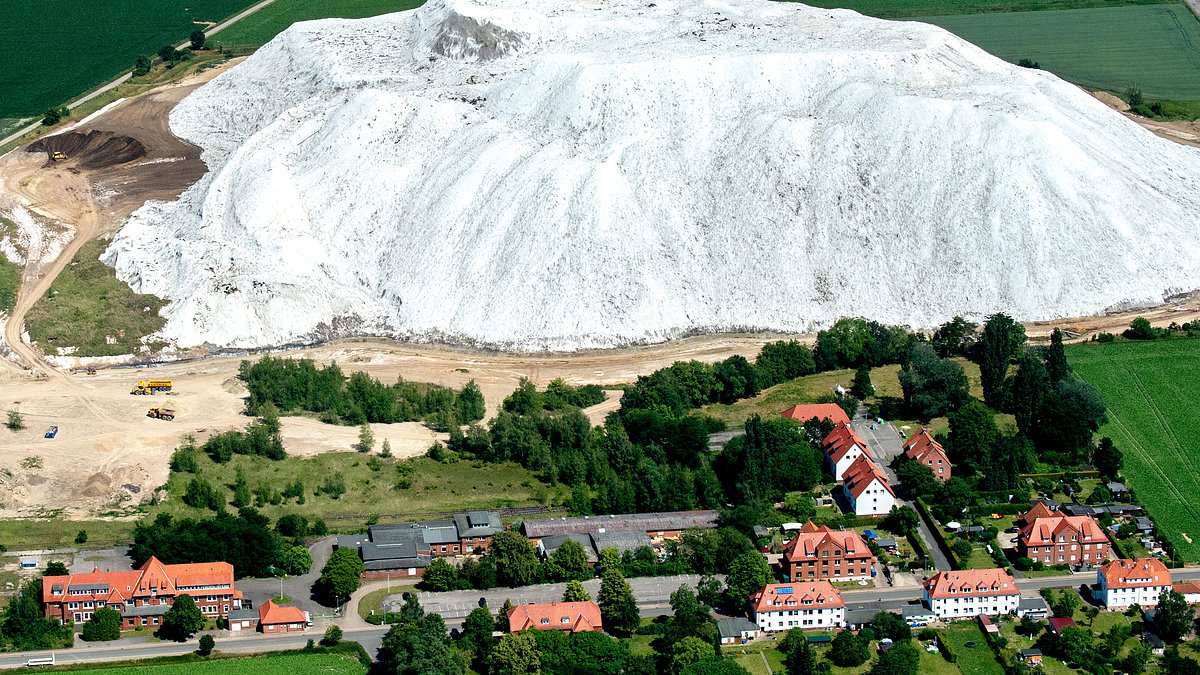
A vast white mountain looms above the German village of Widdershausen. Rising more than 700ft into the sky, the steep-sided peak with its flat summit looks almost natural, except it is entirely man-made.The colossal mound is made up of salt waste produced by potash mining operations run by K+S, a German mining company and one of the world's largest salt producers, in the state of Hesse.Over the weekend, it emerged that the German company supplies rock salt used in the production of Maldon Sea Salt, despite the Essex firm's longstanding claims that its famous flakes were made solely from seawater drawn from the Blackwater estuary.Mining firm K+S is renowned in Germany for potash, a salt rich in potassium extracted from crude salt and used in agricultural fertilisers.The solid salt waste left behind by mining has been piled into vast heaps, creating one like the man-made mountain nicknamed Monte Kali, or Kalimandscharo, that looms over Widdershausen and neighbouring village Heringen. The heaps have raised concerns among environmental activists, who fear increased salinity from the salt mounds is eroding nearby waterways. Last week, a newspaper investigation discovered that imported rock salt – mined in Germany – is used in the manufacture of the middle-class staple.But the firm claimed it used the rock salt as a filtration agent and to 'enrich the seawater' with minerals. The man-made mountain nicknamed Monte Kali, or Kalimandscharo, is pictured alongside the German village of Widdershausen Residential buildings stand in front of the potash mountain locals call Monte Kali and Kalimandscharo A pile of crude salt, used to make potash, magnesium and sulfate for speciality fertilizers, is pictured underground before heading to a 'crushing machine' at the Hattorf mine, part of the Werra potash site operated by K+S AG in Philippsthal, GermanyThis 'salt-on-salt' technique is a traditional method which uses additional salt to strengthen the salinity of the water, reducing the energy required to evaporate the water and extract the salt crystals.Maldon Salt admitted it used rock salt in the production of its sea salt, updating its website to include it had always used a 'long-established salt-on-salt process, in which natural, ancient sea salt forms part of the brine-making, to enrich the seawater with natural minerals'.This came after the Observer spent days monitoring Maldon's Longwick Farm production facility in Essex after being tipped off by residents who spotted lorries arriving at the plant. The investigation uncovered that Maldon Salt now predominantly comprises imported salt from K+S.The mining firm extracts rock salt from mines in German states such as Saxony-Anhalt and Lower Saxony. According to the company, this process creates no salt waste, and there is no indication that producing the rock salt used by Maldon Salt causes German water pollution. Just 30 per cent of mined crude salt can be used for potash production, with the remainder discarded, creating vast man-made mountains of waste salt.The piles have raised environmental concerns because rain can wash salt into nearby rivers, increasing salinity levels and potentially harming local ecosystems. Maldon Sea Salt is famed for its pyramid-shaped salt flakes Thomas Norgall, from the environmental group BUND, told The Times: 'The amount of salt washed off the salt heaps by rain now exceeds the amount of wastewater that K+S itself still produces.'K+S told the paper that around 6.6 million cubic metres of saline water were generated in 2024, including 2.5 million cubic metres from production processes and four million from erosion. Around four million cubic metres were discharged into the River Werra.The company has sought to curb erosion by covering its spoil heaps with sediment and tarpaulin-like sheeting. Dismantling the mountains of waste has been considered impractical.It is understood salt-saturated water has filtered into the River Werra for decades, affecting its ecosystem. K+S pumped salt water into the ground, where layers of sediment acted as a natural seal. But frequent reports were made of salt rising to the surface and destroying forests and flora. The firm stopped the practice in 2021. In the same year, the local government reduced the amount of water K+S could transfer to the River Werra.Plans by K+S to stop diverting wastewater into the River Werra by 2028 were scrapped after they were rejected by local authorities. It now plans to pump wastewater into the river until 2039. Earlier this year Maldon Salt, which was founded in 1882, announced plans to expand Longwick Farm due to increased demand, particularly from export markets.Essex trading standards, supported by the Food Standards Agency, investigated the site in 2019 and 2020 and concluded there were no failures in regulation, with no legal definition to differentiate one grade of salt from another.But in Canada, labelling requirements prohibit labelling mined salt as 'sea salt' and some of the description on packets of Maldon Sea Salt in the country has been changed to Maldon Salt.Maldon Salt previously denied consumers were being misled.K+S and Maldon Salt have been contacted for comment. READ MORE: British favourite Maldon Sea Salt uses German rock salt despite claims it's 100 per cent from Essex
Don't get salty... but this is the white mountain created by Maldon Sea Salt's German supplier
Full Article
Original Source
Read the full article at Dailymail →KhanList aggregates and links to publicly available news content. We do not host full articles from third-party sources. Always verify important information with original sources.