
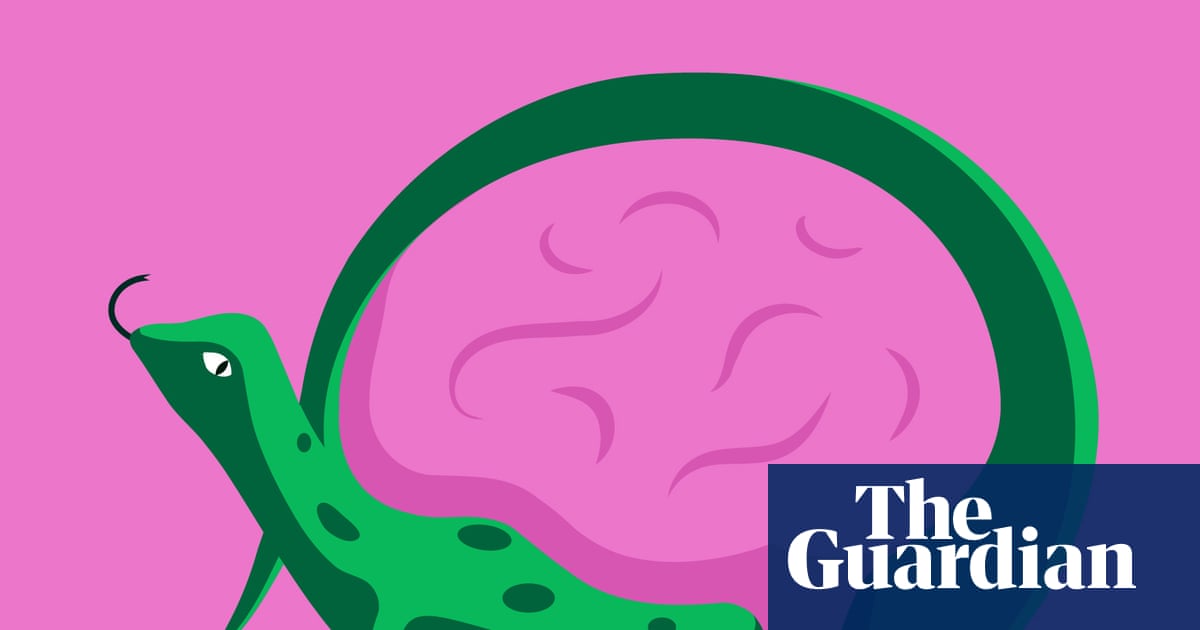
Humans have a cognitive quirk for the number three. Think of the many stories that use it, from The Three Little Pigs to Goldilocks and the Three Bears and The Three Musketeers. Public information and political campaigns use it for impact and ease of recall (“Stop, look and listen”; “See it. Say it. Sorted”; “Reduce, reuse, recycle”). And then there are psychological or philosophical frameworks: Freud with his id, ego and superego; Plato’s three parts of the human soul; the Holy Trinity.Well, it turns out neuroscience isn’t immune from tri-mania. In 1959 Paul D MacLean set out a new way of thinking about the evolution and function of the brain, which he christened the “triune” – three-in-one – model. It quickly became one of best known and most enduring concepts in human biology. His idea was that a trio of distinct brains are layered inside our skulls, one on top of the other, all fighting to generate our feelings and thoughts.Deep inside, at the centre, lurks the primitive lizard brain, retained from an ancestor we share with reptiles. This contains ancient regions responsible for survival, helping us to hunt and forage, and driving our sexual impulses so that we reproduce. A second layer sits wrapped around the first, the so-called mammalian brain. It contains the limbic system, deemed to be the seat of our emotions. It enabled mammals to play, care for and nurse their young and communicate in some crude way.The third and final layer, sheathing all of this and making humans in particular a cut above, is the “neomammalian” brain: the eminently rational cortex. This, it was proposed, provides us with our superior intellect, capacity for language and ability to reason. According to MacLean, it helped to keep in check our primitive, lizard-like impulses and rudimentary emotional reactions.Human behaviour was thought to be a result of interactions between all three layers of the triune brain. Frayed tempers, impulsive acts and short termism were signs of the lizard brain winning out. The notion of reptilian impulses “breaking through” proved so popular it found its way into the worlds of pop psychology, business and self-help, and has proved remarkably tenacious. A mini-industry of books, talks and training grew up around the idea that you could draw on the power of the neomammalian brain to keep basic, unhelpful or destructive emotions in check.The underpinning analogy – of an onion-like brain made up of different strata – is now considered deeply misleading by neurobiologists. It’s easy to grasp, sure, and tells a compelling story. But evolution just doesn’t bolt-on neatly divisible mental capacities in this way.MacLean conducted dissections of living creatures to try to prove his theory, but the results, and his interpretations of them, have since been largely discredited. For example, it’s now accepted that many reptiles do actually possess the “mammalian” limbic system, while all mammals exhibit “neomammalian” features previously thought to be unique to “higher” ones like us. Alongside these anatomical observations, there’s the behavioural data too, with many “lower” animals good at problem solving, responding and learning via emotion, and communicating in complex ways.As Guy Leschziner, consultant neurologist at London’s Guy’s and St Thomas’ hospital put it to me: “the concept of different parts of the brain having different functions is extremely well established. However, to portray humans as having different brain layers, for example a ‘lizard brain’ underlying basic physiological functions, is not borne out by evolutionary or physiological evidence. For a start, mammals and reptiles split early in evolutionary terms. Whilst it is true that more primitive functions in our brains evolved earlier in the course of life on Earth, this view of three separate brain systems driving our basic instincts, emotions and logic respectively does not stack up.”Lisa Feldman Barrett, professor of psychology at Northeastern University is another contemporary voice actively debunking the lizard brain myth. In her view, rather than operating as a battleground between ancient instinct, raw emotion and sophisticated logic, the brain is a dynamic, integrated system, whose aim is to keep us alive by predicting and budgeting our energy requirements.Neuroanatomically and behaviourally, if not yet in the popular consciousness, the idea that we all have a lizard brain has been thoroughly discredited. Yet despite the mounting evidence, and the success of more recent frameworks, the triune brain endures. Shockingly, it is still being widely taught in introductory psychology textbooks (as one journal article mischievously titled “Your Brain Is Not an Onion With a Tiny Reptile Inside” showed). The study also highlighted some of the pitfalls of allowing the hypothesis to go unchallenged, which include giving students a false sense of how evolution unfolds, and promoting the idea that human beings have a monopoly on “rational” actions such as deferring gratification – sacrificing a short-term reward for a longer-term gain.skip past newsletter promotionafter newsletter promotionSo, what is it about MacLean’s model that we just can’t seem to let go of? Well, as we’ve seen, people really do seem to love threes. But perhaps there’s more to it than that. The triune brain tells us an ego-stroking story about our place in the world: that we really are the pinnacle of evolution, standing apart from other species. It reaffirms heady ideas about our sovereignty over nature, and tells a reassuring story about our logical, orderly, almost computational abilities. We are storytelling creatures, of course, but this is a story that needs updating – to one about how much in common we have with other animals, and how simplistic assumptions about the way our minds work are almost never true. Dr Hannah Critchlow is a neuroscientist and author of The 21st Century Brain (Torva).Further readingSeven Deadly Sins by Guy Leschziner (William Collins,£20)How Emotions are Made by Lisa Feldman Barrett (Pan, £12.99)Our Brains, Our Selves by Masud Husain (Canongate, £20)
Do humans really have a ‘lizard brain’ lurking beneath our rational minds?
Full Article
Original Source
Read the full article at Theguardian →KhanList aggregates and links to publicly available news content. We do not host full articles from third-party sources. Always verify important information with original sources.