
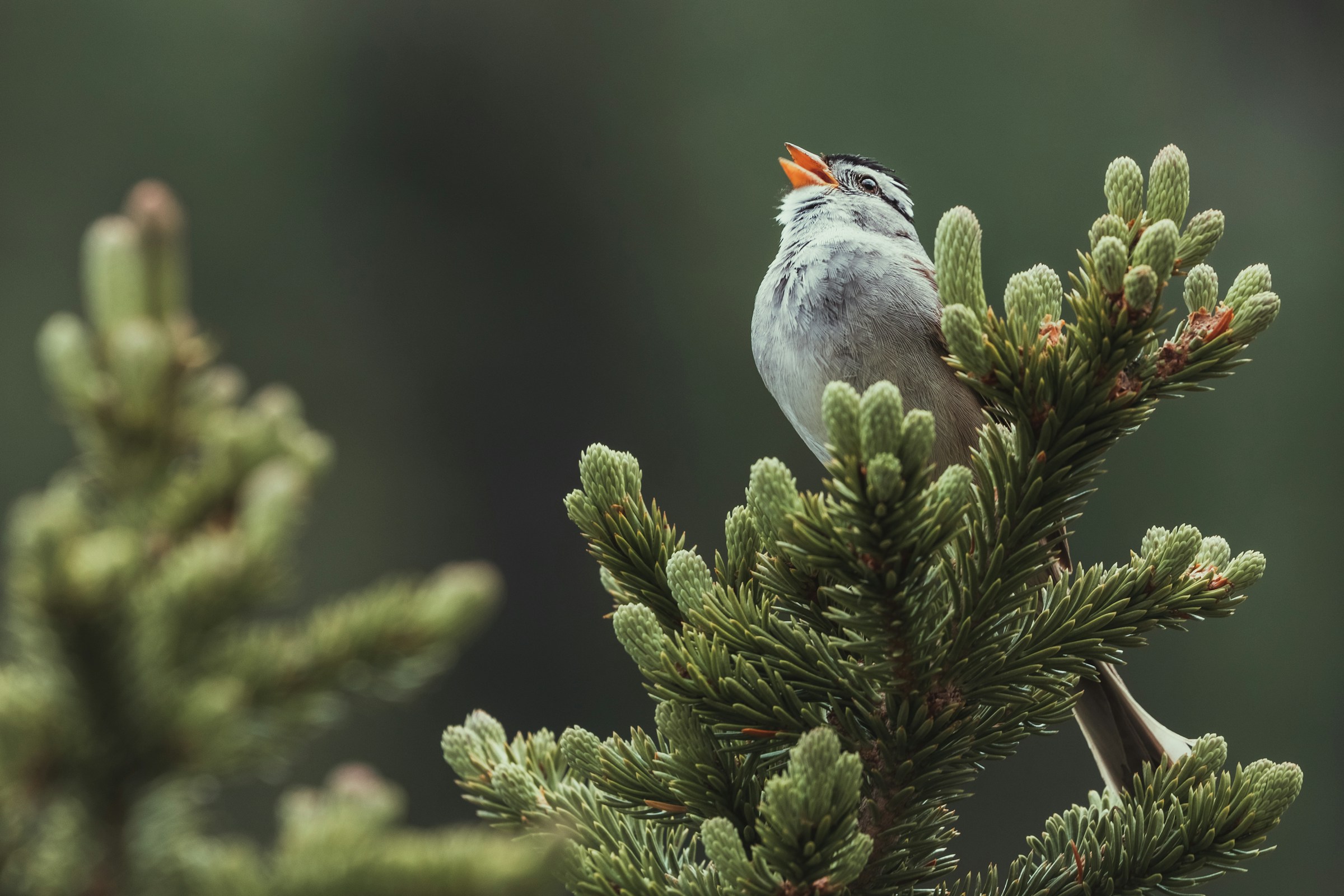
A new study used data from U.S. forests to analyze whether diversity in tree species helped forests weather compound climate extremes, such as drought and high temperatures occurring at the same time.The study found that diversity did have a protective effect: More diverse forests were more resilient during compound climate events, and recovered more effectively afterwards.However, the study also found that the protective effect of diversity wasn’t equally strong across all types of climate events, and that other factors — like rainfall, soil health and day-to-day temperatures — also played a role in how well these forests handled climate stress.Researchers say that the study’s findings give forest managers a good place to start when planning adaptation strategies for the climate extremes that lie ahead. Forests around the world face mounting pressures as the climate changes. In order to understand how they will fare, new research suggests looking at the forest for the trees — more specifically, the different types of trees within. The study, published in July in Nature Communications, examined thousands of acres of U.S. woodlands. It found that the higher diversity of tree species in a forest, the better equipped it will be to handle the compound climate extremes that result from global warming, such as when extreme heat occurs at the same time as drought or unusually high rainfall. Previous research had already shown that diversity among tree species, broadly, made forests stronger. But most of this research had been smaller in scale, or on human-planted experimental plots. Confirming that diversity does indeed have a positive effect on the vast, complicated systems of natural forests somewhat surprised the paper’s lead author, Xuetao Qiao. “Before completing the analyses, we were genuinely uncertain whether we would be able to detect this relationship in real forests,” wrote Qiao, a postdoctoral researcher in ecology at Peking University in China, in an email to Mongabay. A mixture of five tree species at the Sardinilla plot in Panama, planted as part of the Tree Diversity Network. The plot reached 25 years in 2026, making it the oldest tropical tree diversity experiment, according to researchers. Image by Florian Schnabel. Additionally, most research into forests’ climate resilience has focused on how they weather single events, such as heat waves. The reality of a shifting climate, however, will be one of intersecting extremes. With this in mind, the study’s authors decided to investigate the effect of these compound events using one of the largest and most comprehensive forest datasets that exists: The U.S. Forest Inventory and Analysis program, for which Forest Service researchers have been repeatedly measuring trunk width and cataloging species in forest plots across the continental U.S. since 1990. From this dataset, the researchers involved in the most recent study selected 88,116 forest plots across the continental U.S. that had no record of human disturbance or events like fire. They then checked on these plots from above by using satellite data collected during identified climate extremes to determine the plots’ “greenness,” which can be used to estimate how much the trees are photosynthesizing. Because trees often slow or stop photosynthesis when they’re stressed, this is one way to check on a forest’s status from afar. The team then calculated the plots’ resistance — how greenness during climate extremes compared to greenness in a normal year — and their recovery, defined as how photosynthesis in the year after the disturbance compared to a normal year. Across the board, the analysis found that compound climate extremes were much more stressful to forests, producing more dramatic changes in photosynthesis than if you added up the effects of separate events. It also showed that heat and drought were the most taxing combination, affecting forest resilience and recovery more dramatically than heat and excess rainfall. However, the analysis also had good news: Forests with more diverse tree species amongst their ranks were better equipped to handle both single climate events and these coupled extremes. This data also showed that tree diversity had a more protective effect during the more stressful combination of heat and drought than during heat and high rainfall —though diverse forests better weathered both types of events, and recovered faster, than forests with fewer species. The authors noted that species diversity isn’t the only factor playing a role here: They also saw that the soil properties, elevation and age of the trees played a role in how forests did, and that the average temperature throughout the year may have a larger impact on a forest’s durability than the diversity in its ranks. “So the main message is not that biodiversity is the only or the strongest control of forest stability. Rather, biodiversity provides a consistent contribution to stability within a much more complex environmental system,” Qiao said. The Southern Appalachian Mountains are home to the most tree-diverse forests in the U.S. Image by Ken Lund via Wikimedia Commons (CC BY-SA 2.0). Tree diversity can be an insurance policy Florian Schnabel, the chair of silviculture and a professor of forestry at the University of Freiburg in Belgium who was not involved in the study, said its results are an important addition to the growing body of evidence around how diversity supports forests — though he, too, was surprised at how consistently positive its effects were. Much of Schnabel’s research revolves around testing the effect of diversity in human-created forest plots through Ghent University’s Tree Diversity Network project, and results so far have been much more varied; Schnabel said that in these plots, he has seen tree diversity have both a neutral and negative effect as well as a positive one. The power of these experimental plots is that, since humans control their species makeup, they can help reveal why diversity can have these different effects. Schnabel said that much of it has to do with how trees’ different qualities may help them avoid — or may create — competition. “In a mixture you have species with different traits, different characteristics, that allow them to access different resource pools,” Schnabel told Mongabay during a Zoom interview. His research has so far uncovered two main examples in these strategies: Different rooting depths, which allow trees to draw water from different sources without stealing from their neighbors; and differences in how quickly they open or close their stomata, the pores on leaves from which trees “breathe” in CO2 and release oxygen, in response to stress. Trees that close their stomata quickly benefit from growing near trees that can survive longer with them open, as this helps the forest maintain humidity even in dry conditions. Boreal forests, such as this spruce-dominated forest in Quebec, Canada, have naturally little tree diversity. Image by peupleloup via Wikimedia Commons (CC BY-SA 2.0). However, Schnabel emphasized that there is a gap in understanding between how these effects translate from experimental plots to forests. There’s some evidence, for example, that older forests may see more benefits from diversity than younger forests — but the oldest experimental forests are only a few decades old. Additionally, these interactions look very different depending on local environmental conditions; diversity is going to work differently in tropical rainforests versus leafy European woodlands or spruce-dominated Arctic boreal forests, yet there’s not much information out there that forest managers can use to make decisions for a local context. In the future, Qiao hopes to study some of these factors to make sure that their results hold across different regions, and across the different types of climate extremes that are to come. “In the current study, we focused on isolated extreme years so that we could clearly separate the effects during an extreme event from recovery afterward. But in reality, a second extreme may occur before the forest has fully recovered from the first,” Qiao said. “Ultimately, we would like to understand not only how forests respond to individual climate extremes, but what gives some forests a greater capacity to absorb repeated climate shocks and continue functioning over the long term.” Even so, both Qiao and Schnabel agreed that the top message of this study — that diversity can benefit forests when they are at their most stressed — gives forest managers a good place to start. Qiao suggested managers working on the ground could begin monitoring tree stands that they already know are diverse, or trial planting new species together and monitor how they perform during the climate extremes that are coming. “That would help translate the broad pattern into advice for particular forests,” he said. Tropical rainforests have the highest levels of tree diversity, with the Amazon Rainforest containing around 16,000 species. Image by Rhett A. Butler/Mongabay. Overall, Schnabel sees diversity, even with all of its unknowns, as an insurance policy for forests, particularly knowing that the climate stress to come is going to bring forests into completely unknown territory. “What is important there for management in general is that our past experiential and empirical knowledge is not relevant for the future anymore,” he said. He added hypothetically that research could identify a particular species that is, for instance, really good at surviving drought in a monoculture, and then shifting conditions could bring in a beetle that kills them all. “It’s a lot about increasing resilience and depth of capacity,” Schnabel said. “And so, in my opinion, the single best strategy is diversification.” Banner image:A white-crowned sparrow (Zonotrichia leucophrys), native to North America, on a pine tree. Image by Andy Holmes via Unsplash. Citation: Qiao, X., Zscheischler, J., Loreau, M., Reich, P. B., Chen, Q., Bahn, M., … Wang, S. (2026). Biodiversity buffers forest ecosystems from compound climate extremes. Nature Communications. doi:10.1038/s41467-026-75370-5 FEEDBACK: Use this form to send a message to the editor of this post. If you want to post a public comment, you can do that at the bottom of the page. Credits Topics
Diverse forests can better withstand extreme weather events, study finds. Here’s why
Full Article
Original Source
Read the full article at News →KhanList aggregates and links to publicly available news content. We do not host full articles from third-party sources. Always verify important information with original sources.