
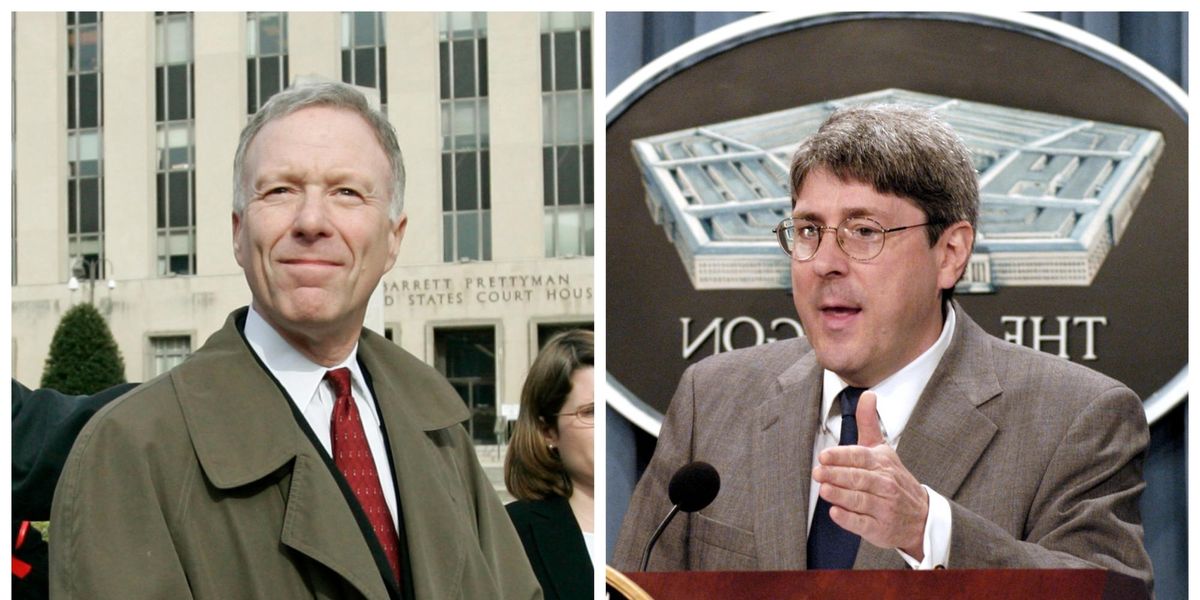
Apparently, it takes the prospect of ending the war on Iran to get the blood running hot in aging and otherwise reclusive neoconservatives — particularly those whose tenures as key architects of the 2003 Iraq invasion and subsequent occupation were both short-lived and disastrous.Douglas Feith, who served as undersecretary of defense for policy (2001-2005), and Lewis “Scooter” Libby, Vice President Dick Cheney’s powerful national security adviser and chief of staff (2001-2005), co-authored an op-ed published Monday by the Washington Post entitled “’Endless wars’ is a catchy phrase, not a reason to shift policy.” Evoking the wartime steadfastness demonstrated by Abraham Lincoln in the Civil War; Winston Churchill – naturally, these are neoconservatives, after all — against the Nazis, Dwight Eisenhower in Korea; and Ronald Reagan in concluding the Cold War, the duo urged America to steel itself for more war.“None of these leaders wanted endless sacrifice and risks, but none buckled for fear of them,” they wrote, suggesting a parallel with the current war on Iran. “Each understood that an enemy’s willingness to endure a long struggle does not make one’s own ‘endless’ resistance foolish.”In assessing the wisdom behind their words, some context may be in order.First, the authors, both proteges of the “Prince of Darkness,” Richard Perle, who served as chairman of the Defense Policy Board in the run-up to the 2003 Iraq invasion, are dyed-in-the-wool, hard-core neoconservatives in that they believe as much, or perhaps more, in Israel’s exceptionalism as they do in America’s. Their Middle East policy preferences have long paralleled those of Israeli Prime Minister Benjamin Netanyahu and his right-wing Likud Party.Their institutional associations since their departures from government in 2005 tend to confirm their Israel-centrism. Feith has been a senior fellow at the neoconservative Hudson Institute, while Libby, who was also based at Hudson for many years, is currently serving as a distinguished fellow at the Foundation of Defense of Democracies (FDD). A survey by RS of four commonly used AI programs in April found that both organizations were among the five think tanks that were “the most prominent in promoting military action” against Iran across mainstream and social media in the six months leading up to the current war that was launched by massive air strikes against key targets across Iran on February 28. FDD, whose original submission to the IRS when it was founded in 2001 described its mission as “enhance(ing) Israel’s image in North America…,” ranked number one in promoting military action in all four programs.Second, both Feith and Libby may be best known for their roles in shaping, manipulating, distorting, leaking, and promoting fabricated intelligence – often in close cooperation with Iraqi expatriate Ahmad Chalabi and his Iraqi National Congress — that would justify the invasion and occupation of Iraq and rally public opinion behind that enterprise. Feith created offices in the Pentagon whose missions were to collect and disseminate any information that suggested a cooperative relationship between Saddam Hussein’s regime and al-Qaida and major advances in Iraq’s alleged (but non-existent) nuclear-weapons program. As Cheney’s chief adviser and enforcer – “Dick Cheney’s Dick Cheney” – Libby provided a direct channel to the White House for the “intelligence” produced by Feith’s office and Chalabi’s purported “defectors,” much of which then appeared in speeches by the vice president and other top administration officials, without being vetted through the normal intelligence processes. Libby became notorious in the intelligence community for his frequent visits to CIA headquarters to question – some say harass – analysts about their work, culminating in a frantic, last-minute efforts to include a particularly dubious piece of intelligence linking Saddam to al-Qaida in Secretary of State Colin Powell’s infamous address to the U.N. General Assembly on the eve of the invasion.Third, both authors left their government service under a cloud, if not in disgrace. Libby’s was the most spectacular fall. In October 2005, he was indicted by a federal grand jury resulting from an investigation into the leak of the covert identity of a CIA operative, Valerie Plame, as part of an apparent effort by Libby and his boss to discredit her husband, a former U.S. ambassador who had publicly exposed the falsity of a key administration claim regarding Saddam’s alleged nuclear-weapons program. Libby resigned his positions immediately following his indictment, was subsequently convicted by a jury of making false statements and sentenced to 30 months in prison, which President George W. Bush later commuted. He received a full pardon from President Donald Trump in 2018.Feith — who, besides his collaboration with Chalabi, had overseen a number of other fiascoes during his tenure, including the disastrous de-Baathification program in Iraq — resigned in August 2005, by which time it had become clear that the occupation faced a serious insurgency. He may be best known, however, for the characterization applied to him by then-U.S. Central Command chief Gen. Tommy Franks, who led the invasions of both Afghanistan and Iraq, as “the f*cking stupidest guy on the planet.”Given that context, it’s no wonder that both men appear to have preferred the relative tranquility and obscurity of those Washington “think tanks” where their colleagues share the same or very similar world views, and “groupthink” rules the roost, much as it did during the heyday of neoconservative power during Bush’s first term. Perhaps somewhat chastened by their failures, they have seemingly been reluctant to engage in the public square in recent years. Indeed, over the past decade, Libby had published only one op-ed in any of the country’s three most influential national newspapers, and that was back in 2021 on the evils of China’s “Covid wrongdoing,” as the Wall Street Journal’s editorial page editors called it. As for Feith, he hadn’t published a single op-ed in the Journal, the Washington Post, or the New York Times since 2015.Until Trump launched the war against Iran on February 28, that is. That apparently got the old juices going, with Jeff Bezos’ recalibrated editorial pages of the Washington Post serving as willing host. On March 9, Feith broke his silence with the giddy title, “Trump is trying something new in Iran. Hold on tight.” Then, after Trump signed a dreaded ceasefire agreement, he evidently felt compelled to warn that “The Iran deal comes with a familiar false promise.” On September 10, he extolled his glory days in “The 9/11 response got the most important thing right.” Libby was not as prolific. But on September 18, he co-authored an op-ed in the Post calling, among other things, for the destruction of “Iran’s major oil production and export facilities, as the Allies did to Germany and Japan in World War II” and for “ground troops” to seize Iran’s “coastline or the regime’s enriched uranium stockpiles…” And now, on the very eve of Veterans/Armistice Day, these two strategic geniuses have taken once again to the Post’s op-ed page to earnestly warn us against listening to those who have grown weary of “endless wars.”It’s time to thank them for their service.
Disgraced neocons Feith & Libby: stop whining about 'forever wars'
Full Article
Original Source
Read the full article at Responsiblestatecraft →KhanList aggregates and links to publicly available news content. We do not host full articles from third-party sources. Always verify important information with original sources.