
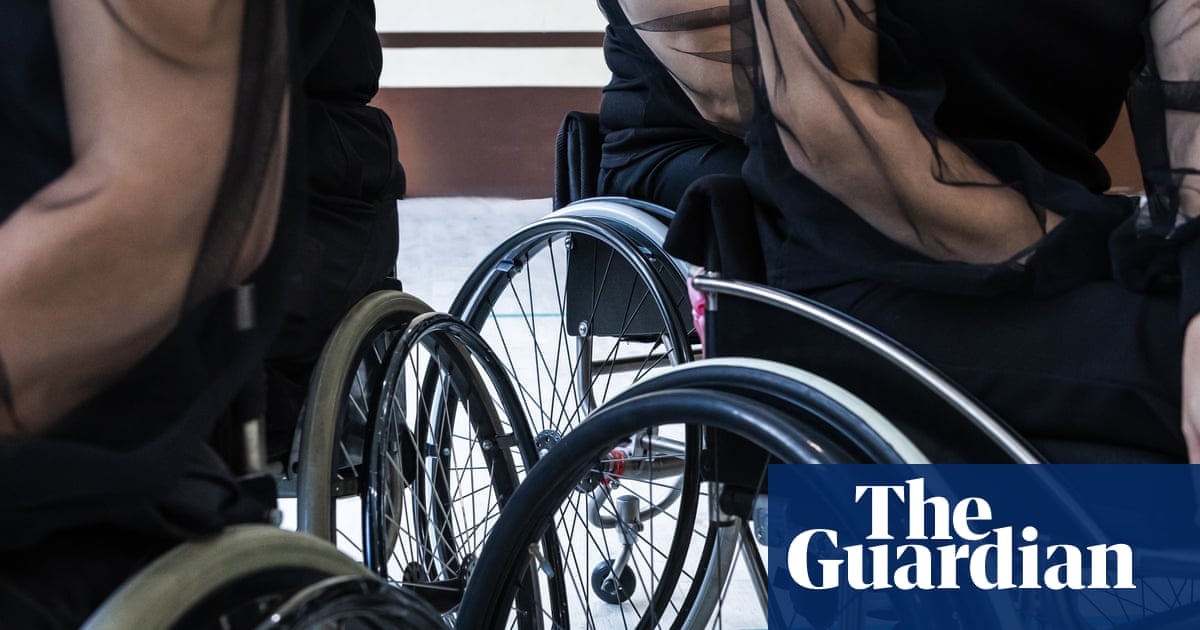
Disabled people are having to wait up to two years to get a wheelchair because of delays involving NHS bodies and private firms that make them.The situation is revealed in a report by the parliamentary and health service ombudsman for England, Paula Sussex, who said hold-ups were having profound consequences and limiting wheelchair users’ ability to lead independent lives.In one case a three-year-old boy with cerebral palsy was unable to start nursery at the same time as his twin brother because he had to wait seven months for a wheelchair. He hurt himself several times when he fell from an adapted buggy his parents were using while they waited.Sussex launched an investigation into NHS wheelchair provision after a sharp rise in complaints – from eight in 2020-21 to 110 in 2025-26.Four out of five relate to the handful of private firms that provide wheelchairs to at least half of all children and adults who need one to help them lead independent lives.Most are about people who need a wheelchair having to wait longer than the supposed 18-week maximum to receive either the device or parts for it.“For people who rely on a wheelchair, delays, unsuitable equipment or poor repairs can affect every part of their life”, said Sussex.“There can be profound consequences, from physical pain and emotional distress to limiting their ability to lead full lives.”Elliot Cruz Gardiyanoglu, now six, was three when he faced a seven-month wait for his wheelchair. That also meant that he was unable access education or specialist therapy.“We were never told there would be such a long wait for the wheelchair,” his mother, Jania Cruz, said. “If we had known we would have explored other ways to get it, especially so that Elliot did not miss out on starting nursery at the same time as his brother.“It was very hard for him to see his brother going to school while he couldn’t.”Rachel Perrin, the director of Newlife, a charity for disabled children, said Elliot’s experience showed how “the wrong wheelchair – or no wheelchair at all – can be dangerous, as well as keeping children and their families trapped at home and leaving them unable to attend school and take part in activities with siblings and friends”.Graham Woolner, a 68-year-old in Bishop’s Stortford who has spinal muscular atrophy, a degenerative condition, has needed a wheelchair for the last 15 years.He was meant to get a new one by August 2023 but it did not arrive until September 2024, and when it did, it failed to work properly. He did not get one in full working order until October 2025, 26 months past the 18-week deadline.skip past newsletter promotionafter newsletter promotion“After a year of waiting, the wheelchair they gave me broke on the first day. I only made it 100 yards before the batteries died,” Woolner said. “The battery issue was never resolved, so I couldn’t go anywhere for a year with any certainty that I would get there and back.“I like to be independent, go into town and take my dogs for a walk. But it got to the point where I wouldn’t go out without my son in case I needed him to push me home.“The wheelchair is effectively my legs. I need it to live my daily life.”Nick Goldup, the chief executive of the Wheelchair Alliance, said the report shone a light on the systemic problems wheelchair users faced.“Getting wheelchair provision right means giving people the freedom to live their lives and to enable them to contribute meaningfully to society,” he said.Sussex highlights a “regulatory gap” in wheelchair services such as assessment, fitting and repair. The Medicines and Healthcare products Regulatory Agency oversees the equipment, but the remit of the Care Quality Commission – the NHS care watchdog – does not cover the services wheelchair users receive because they are not supervised by a health professional.Integrated care boards (ICBs), NHS regional bodies that commission wheelchair services, have “unreliable information” about how many people locally need a wheelchair and are faced with “an uncompetitive wheelchair market” which is dominated by a handful of private providers. Nor are ICBs good at telling each other when they encounter problems with private firms that provide poor services.An NHS spokesperson said:“Long waits for wheelchairs are unacceptable, denying people the independence and quality of life they deserve.“That’s why our wheelchair quality framework, co-produced with wheelchair users, sets a clear expectation that 92% of people receive their equipment within 18 weeks, and requires commissioners to hold regular performance meetings with providers to identify and tackle delays.”
Disabled people in England ‘have to wait up to two years for wheelchairs’
Full Article
Original Source
Read the full article at Theguardian →KhanList aggregates and links to publicly available news content. We do not host full articles from third-party sources. Always verify important information with original sources.