
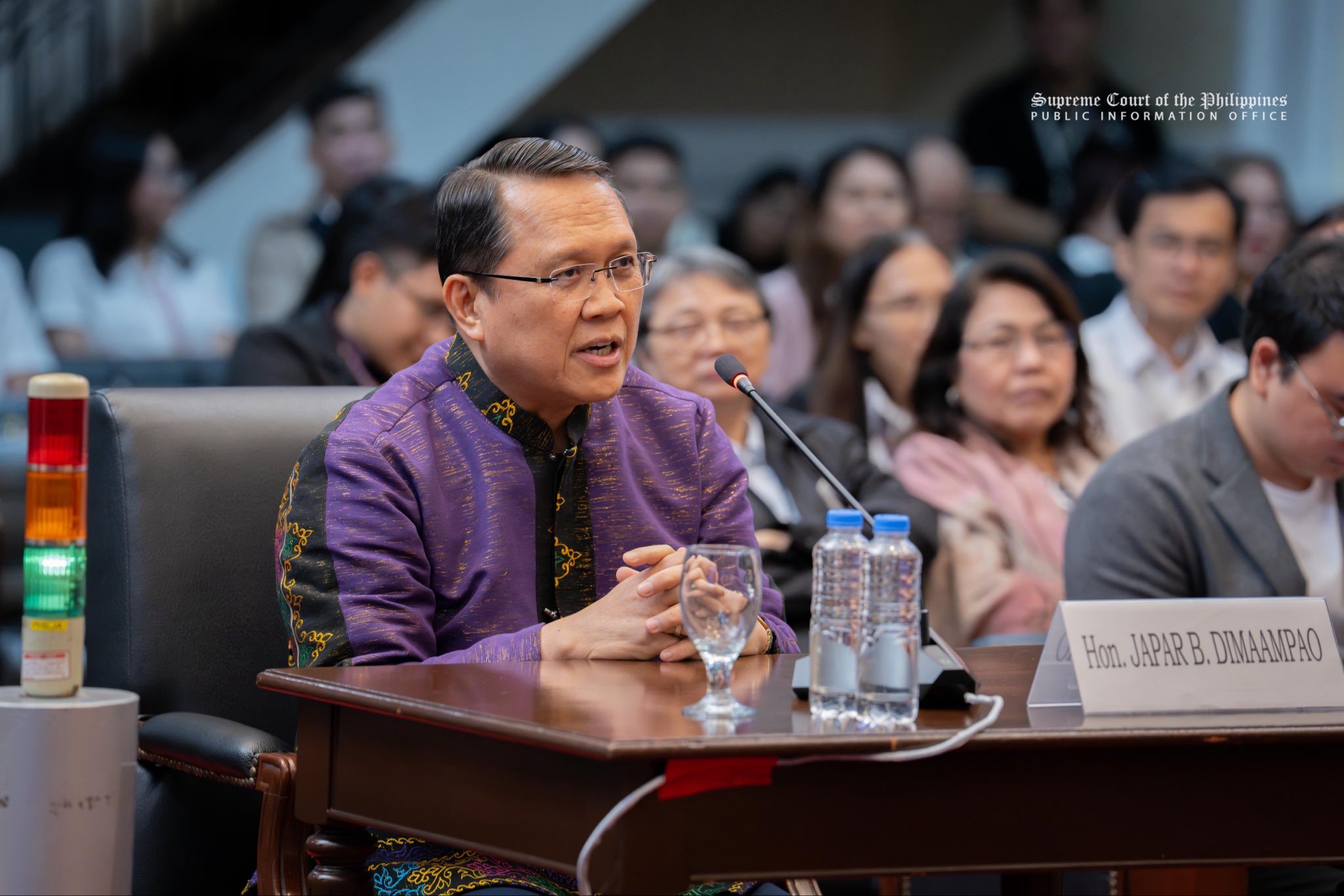
FOR CJ. Associate Justice Japar Dimaampao during the Judicial and Bar Council's public interview for chief justice on Monday, October 26. Supreme Court of the Philippines 'I would like to be remembered not simply as first Muslim to serve as chief justice but as a chief justice who upheld the supremacy of the Constitution, defended and protected the independence of the judiciary, and ensured that justice was served without fear or favor,' Dimaampao says Japar Dimaampao, the incumbent Muslim associate justice of the Philippine Supreme Court, is vying to become the chief justice, emphasizing the importance of humility and service to the people. Dimaampao aims to address delays in the justice system and promote transparency and integrity within the court, proposing measures such as digitalization and decentralization of oversight. He believes in a fair application of the law, advocating for substantial justice and the need for judicial restraint, while hoping to leave a legacy of equality and access to justice for all Filipinos. This is AI-generated. Read the article for full context. Report any errors. MANILA, Philippines – There have only been two Muslim associate justices of the Supreme Court (SC) in its 125 years of existence. First was late former associate justice Abdulwahid Bidin of Tawi-Tawi, who was appointed to the High Court by the late former president Corazon Aquino in 1987; and incumbent Associate Justice Japar Dimaampao, who was elevated to the SC in September 2021 by former president Rodrigo Duterte. Dimaampao took one of the seats for associate justices that was vacated by Chief Justice Alexander Gesmundo when the latter became chief magistrate. The justice is once again vying to replace Gesmundo, this time, as SC chief justice. “[My experience] has reminded me that the law belongs not only to those who practice it, but ultimately to the people whom it is meant to serve,” said Dimaampao during the Judicial and Bar Council’s (JBC) public interview for aspirants on Monday, October 26. “If given the opportunity to serve as chief justice, I will bring with me not only experience, but humility borne of experience…. For I believe that leadership in the judiciary is not about standing over others. It is about standing with them in pursuit of judicial independence… in pursuit of justice, and in fruitful service to the Filipino people.” Dimaampao is one of the five SC associate justices in the running to become Gesmundo’s successor. The JBC has concluded the interviews on Monday and will proceed to deliberations. Afterwards, the council will submit to President Ferdinand Marcos Jr. a short list of nominees. Marcos would then appoint the country’s 28th chief justice. Currently, Dimaampao is the second most junior among the candidates and is holding seat no. 11 at the High Court. If chosen, Dimaampao will serve for seven years or until 2033. During the interview, Dimaampao promised that apart from technological innovation, the public would feel that the justice system is working under his term, if ever appointed. He said he would serve with humility and dedication, explaining that his decision to bid for the position was motivated by his desire to give back. “After 2027, our role is to build not only a more modern judiciary but to develop a more human judiciary – one that is trusted by the people, accessible to the vulnerable, and resilient in times of crisis,” said Dimaampao. “It must also be one that is prepared for challenges of a future we have yet to fully pursue.” Visions for the court Dimaampao said the SC would address the problem about delays in cases if he become chief justice. He also said he would keep the Court abreast of global trends in justice, particularly the use of artificial intelligence. If appointed, he said these would be implemented in the first three years of his term. Dimaampao said he wants court decisions to be easily understood by ordinary people. “It must be shown to them that the decision has the following qualities: One, clear in reasoning. Two, consistent in doctrine. Three, concise in expression. And then, the fourth one is that it is just in result,” he explained. Dimaampao also discussed the Bar examinations, which are administered by the SC every year. He said he is known as a strict but reasonable professor, but believes that the qualifying exams for lawyers should test the examinees’ analytical ability. “And if we are restricted on that, there will be less passers,” he explained. JBC member Senator Kiko Pangilinan asked one question to all the candidates. He asked them whether it was the justice’s system failure that there were lesser people held accountable in corruption cases. Dimaampao said he would propose measures to make the Court graft-free: institutionalize transparency and digitalization, and build a culture of integrity. He also said he wants to decentralize oversight and include civil tracking in these cases. “If I will be given that opportunity to serve, I will be guided by this ‘Fiat justitia ruat caelumet‘ (Let justice be done though the heavens fall),” the justice explained. “We must sponsor seminars on ethics and remind these people of the judiciary about their duty. Particularly judges – they must be reminded of their constitutional duty.” What type of justice will Dimaampao be? During the interview, Dimaampao said he believes that the maxim “dura lex sed lex” (the law is harsh but is the law) should be reviewed. For him, if the application of the law would cause irreparable damage to the parties, courts should consider applying this maxim with caution. “To my mind there has to be an exception to that. Yes, the law must be followed. But if it results in a irreparable injury or damage to the parties, why can we treat that as an exception to the law? And there we attend substantial justice and fairness,” he explained. Dimaampao was asked when the SC should exercise its power of judicial review – or the mandate to revisit whether another branch of government has erred in following rules and violated the Constitution. He said judicial restraint is a constitutional philosophy and that courts should exercise their constitutional authority with caution. He also spoke of social justice. Dimaampao said justice is for everyone, regardless of their socio-economic standing. “Never prefer the poor simply because they are poor, [and] reject the rich simply because they are rich,” he said. If named chief magistrate, Dimaampao said he would adhere to the concept of collegiality and would respect all members of the bench. The public, according to him, should expect that he would be a model in following constitutional standards and independence. Dimaampao said he hopes to be remembered not only as the country’s first Muslim chief justice but also for the legacy he leaves to the judiciary. “I would like to be remembered not simply as the first Muslim to serve as chief justice but as a chief justice who upheld the supremacy of the Constitution, defended and protected the independence of the judiciary, and ensured that justice was served without fear or favor,” Dimaampao said. “Me being [the] first Muslim to serve as Chief Justice is a milestone. But I hope that this legacy will go beyond my identity. I want to show that regardless of one’s religion, ethnicity or background, every Filipino deserves equal protection under the law and equal access to justice,” he added. – Rappler.com How does this make you feel? Loading
Dimaampao vies to be PH’s first Muslim chief justice, vows a ‘more human judiciary’
Full Article
Original Source
Read the full article at Rappler →KhanList aggregates and links to publicly available news content. We do not host full articles from third-party sources. Always verify important information with original sources.