
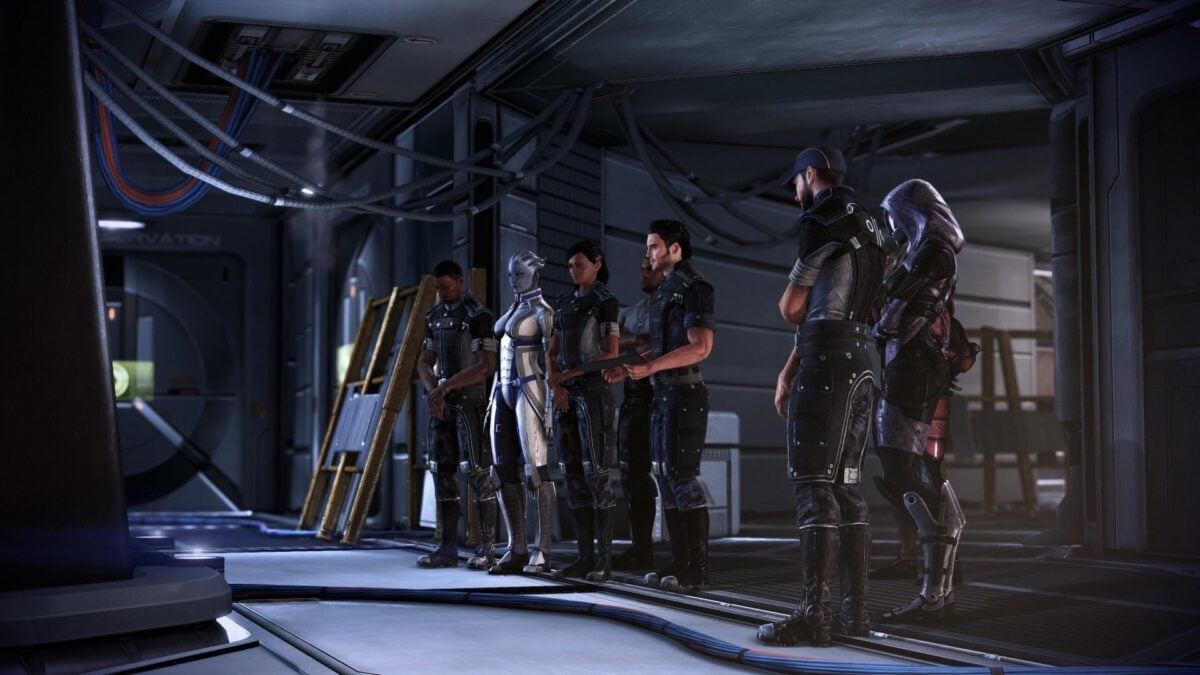
When I initially put out a call for fans, developers, creators, and media to reach out to me with stories about their experiences with BioWare, the now-shuttered developer of some of the most beloved western RPGs of the past 30 years, I was frankly overwhelmed by the outpouring of responses from people who had a story to tell. I was so overwhelmed, in fact, that I was only able to use a fraction of what showed up in my inbox for this collection of memories, praise, righteous anger, and mourning. Whether they were old heads who had been playing BioWare games since the days of Shattered Steel and the original Baldur’s Gate or folks who fell in love with the Edmonton studio’s work through Mass Effect and Dragon Age, it’s clear that BioWare’s games left an imprint on fans that has outlived the company itself. (Submissions have been lightly edited for style and clarity.) Greatness from small beginnings If BioWare’s games have proven anything, it’s that everyone’s story has its own unique beginning, and that’s reflected in how its fans came to know its work through so many different points of entry. My first BioWare experience was with the first two Baldur’s Gate games. I wasn’t much of a PC CRPG gamer in 1998 but BG1 just absolutely blew me away with what, at the time, felt like endless options for character customization, the broad sweep of the story that felt like a true investment in the Dungeons & Dragons tabletop I had been playing for only a few years at that point – and the Forgotten Realms where I cut my teeth as both player and Dungeon Master – and the amazing writing on the characters. This doubled in effect when BG2 arrived in the year 2000, and between those two games I lived in BioWare’s Forgotten Realms like it was a second home. — Phil Morgan, host of Deleted Saves Podcast I swiped Baldur’s Gate from my dad when I was nine – he wasn’t into role-playing games and I have no idea why he had it, but it clicked immediately for me and I spent hours trying different types of characters, killing NPCs I shouldn’t have, and getting to know that world. It blew me away when I realized I could recruit different party members in Baldur’s Gate, and that it had an impact on the story. It meant I could replay the game over and over and make different choices to see what would happen, and that became something BioWare was known for. — Chuck Zimmerheld, Giant Bomb Years [after playing KOTOR], my next experience was attending a Video Games Live concert with conductor Jack Wall, who was the composer for the first two Mass Effect games, and that’s where I first heard the Mass Effect theme. That song was so beautiful to me that I knew I had to play the game it had come from. I didn’t have a lot of money at the time, but I scrimped and saved and got my brother to go half in with me on an Xbox 360. I bought a used copy of Mass Effect before we’d even gotten the Xbox, I was so excited. It blew my mind AGAIN in so many ways. A shooter RPG. A unique space adventure not tied to the IPs I’d enjoyed all my life. I fell in love with all of the unique characters and the idea of a space-faring future where humans weren’t the dominant species felt so fresh and exciting. — Jeremy Greco, BioWare fan © BioWare My first experience with BioWare, and one of my earliest memories of gaming in general, was watching my older brother play Dragon Age: Origins in 2010 on our PS3. I was frankly terrified watching it as an 8 year old. To this day, seeing the Darkspawn still conjures up a deep-rooted childhood fear of the Blight sweeping across the land. I remember playing through the game a few years later, thinking I was braver, and being absolutely horrified by the Circle Mage origin. I mean the Harrowing was insane to me. I think it took me maybe a week of going back and forth to finally finish that prologue. That game absolutely set the bar for me of dark heroic fantasy and hugely influenced my taste in games and stories ever since. — Jerram Carr, junior narrative designer A studio that left a mark on the RPG genre BioWare’s games were the origin story for many developers’ own careers. You can trace the influences and inspirations that shaped the work of many designers and writers back to the worlds the company created. I think the most impactful game for me was Dragon Age: Origins. I was in college excited for a new Bioware game, but at the same time struggling with accepting myself as a gay man. I had the chance to flirt with Alistair as a man, and while he ultimately rejected me, he helped me feel seen; that it was okay to be gay. I remember crying on the floor, moved that a 3D character had given me so much grace to be myself. I remember wanting to make games so people could have moments like I did. Moments to accept ourselves and see ourselves reflected positively. When I did get the chance to make queer people feel seen in Destiny it felt like I was helping pay back the gift the DA:O team had given me. I even talked about it in the Bungie weekly blog. — Nigel Davis, senior producer at Entangled Publishing, formerly at Bungie The creators at BioWare pushed the industry forward with player choice in games. Optional party members, loyalty quests, morality systems, and huge choices with multi-game impacts. RPG’s aren’t the same without them. — Chuck Zimmerheld, Giant Bomb Few studios can say that they changed the way genres are made. BioWare can. There’s an entire generation of developers and narrative designers that work in the industry because they were inspired by the games BioWare made across a 30-year run that largely produced classic after classic after classic. The systems the folks at BioWare designed worked their ways into other games in ways that you could see and interact with. My buddies and I used to joke that BioWare invented the wheel because Mass Effect’s dialogue wheel felt like it was everywhere after the original game was released. — Will Borger, journalist and consultant © Beamdog / BioWare For me, it all traces back to those first two Baldur’s Gate games. There’s a direct line from those to my work today, including my writing on Pacific Drive, where I’ve tried to remember to highlight the everyday as well as the extraordinary, to add jokes as well as drama, to imagine how even the smallest details shape the most fantastical world. And to remember that, if you hide a little secret somewhere, players will always, always find it. I think BioWare understood that players weren’t taking the roles of adventurers, but players are adventurers, always on the hunt for the next clue, character or collectible, and they really enjoyed indulging them as much as they could. — Paul Dean, writer, Pacific Drive My time in development is not spent creating digital worlds (currently), I design mechanics for expressing actions and desires in the space of a world full of character interactions and player agency. Game theory is a lived experience because I love games, I play them, and they shaped me. Dungeons & Dragons is in some ways closer to my style of product, but it is not what I think of when I am writing. I’m thinking of Liara T’soni, Captain Anderson, Canderous Ordo, Jolee Bindo, Hawke, Varric, Blackwall, Dorian, Solas. — SalubriousBrew, pen and paper RPG developer I wasn’t a fan of much as a kid. I didn’t like Star Wars, or RPGs, or games that looked older than me. I didn’t even play KOTOR on a half decent console: my first playthrough was on my dad’s iPad! So when I, dorky Nigerian kid, got this weird-looking rpg on a whim, I couldn’t have imagined that, well over a decade later, it’d be one of the main reasons I aspire to one day do narrative design for a video game. It’s not like I grew up reading stories about millionaire game writers or anything, lol. I’m not in it for the money. I just think that making something that means to someone else what KOTOR meant for me—that’d be pretty damn cool. — Mo, BioWare fan BioWare was the first studio to show me that a game can tell a worthwhile story, that a game can make you cry and make you laugh. These days, I’m making games about fart jokes, but there’s a throughline from Garrus talking about “popping the heatsink” and Kasumi inspecting Shepard’s underwear drawer to what I do now. Other studios left more of a mechanical impact on my game development sensibilities, but BioWare showed me that games could be more than the sum of their parts. — Mira Swor, engineer at Jackbox Games How shaping characters shapes you BioWare’s approach to roleplaying, and the prowess with which the studio pulled it off, became things many RPGs would aspire to replicate in the years that followed, and the opportunity its games provided to explore the perspectives of different types of people was more far-reaching in its impact than even the studio might have expected, particularly when it chose to highlight queer characters and stories. As a trans lesbian growing up closeted in a very rural, very conservative, very religious household in Florida, my opportunities to engage with queerness were deeply limited. When I went off to college, I was free to do what I wanted for the first time. My first week on campus, I walked down to the campus GameStop and bought Mass Effect 1, Mass Effect 2, Dragon Age: Origins, and Dragon Age II all at once by trading in some old games. I didn’t really do it because I knew they were queer games. I just liked scifi and fantasy. I popped in ME1 first. I had heard a lot of people praise Jennifer Hale’s performance as FemShep. That was enough of an excuse to bypass my repression, letting me create a female avatar for the first time ever. That alone was a really big deal for me, but the real paradigm shift happened the first time I realized I could flirt with Liara. I remember pausing at the choice for quite some time, feeling sick to my stomach with anxiety. I’d been raised to believe that the feeling inside me that wanted to explore a lesbian romance was of the devil, a threat to my immortal soul. But ultimately, I forged ahead. In a very real way, that was the first time I ever chose my burgeoning queerness. I’d experienced queer feeling before, but always passively. This time I passed a threshold. — Saoirse Stone, BioWare fan, critic, author, Editor-In-Chief at Stone Freedom Even just having queer characters and the ability to be queer in a mainstream AAA game without it being a joke resonated and reverberated so far through my life that it helped open my closet door just a little more. It was because of Mass Effect and Dragon Age that I got to explore sexuality and gender in a way that felt safe – in the comfort of my dorm room, sure, but also in the comfort of the worlds themselves. To see a gay relationship being celebrated or a trans person existing in the world as just a normal thing – it helped build my courage and eventually landed me where I am today: happy and comfortable in my body and in who I love. There aren’t many games that can say they helped people do that. —- Patrick Quinn, BioWare fan © BioWare / Kotaku My first experience with Bioware was Knights of the Old Republic. I grew up a big fan of the franchise and was really curious about a game that let me make all the decisions in it AND it let me play as a woman? I was sold from the jump. But upon exploring the game, seeing new worlds, getting to know my companions, I realized that even my queerness could be explored when I met Juhani at the Jedi Academy. It wasn’t a full romance, it didn’t even trigger real cutscenes. But the moment I learned I could get that conversation loop with her, I would visit her on the ship every time I could, hoping new dialog would loop in our Will They Won’t They. It was the first time I really felt seen as a baby butch in a game and it’s been a standard I’ve held games to ever since. — Erminia, Community Manager I learned who I am through their games. It’s not hyperbole. They helped me figure out the kind of person I would grow to be. As a pansexual nonbinary person their games were a safe space to experiment and experience things to see how it made me feel. The joy of falling for characters like Thane and Kaidan and knowing what that kind of love could feel like made me feel seen. Being able to play as a nonbinary Qunari in Dragon Age: The Veilguard and share my own gender journey with Taash to comfort them is one of the most gender-affirming experiences of my life. I never felt more confident about who I was than when I was playing one of their games. — Matt Storm aka Stormageddon, Podcast co-host for the “Fun” & Games Podcast and Reignite – A BioWare Replay Podcast The bonds forged in BioWare games The passion people have for BioWare games is a shared one, and even though the company is gone, the communities its work fostered will persist long after publisher EA closes its doors. But it’s not just about having forums in which to talk about these games or places to post fan art or cosplay; several people had stories about how BioWare’s games established lifelong connections, made them feel closer to the ones already in their lives, or helped them see a path forward after a loss. © BioWare / Kotaku My dad was a submariner. He loves BioWare games, Mass Effect specifically. He saw me playing one day, and asked if I minded if he tried it out. He loves that series. I think he felt a connection to Shepard (specifically Jennifer Hale’s version) as a fellow ship captain. After he retired, the series became one of his projects. He’s dedicated to the perfect playthrough. He’s got what we call the Book of Knowledge. In it is the result of every dialogue choice, the location of every collectible (including the ones that aren’t in the strategy guides), and how best to complete every quest. It’s the most complete guide to those games I have ever seen. He has several characters running at once, records all of his playthroughs, and he’s turned that into a story he’s chronicling of his Shepard. It’s not for anyone else; just him. When I visit, we talk about Mass Effect and Dragon Age and he asks me when I think the next game is coming out. One year, for his birthday, the only thing he wanted was to hang out with me over the holidays and finish Mass Effect 3 because it was the one I hadn’t finished, and he wanted to see how I’d play it. We’d sit there and compare choices, builds, talk about the characters. For several years, I just bought him models of the ships for birthdays and Christmas. We’d go to cons and he’s trying to get the autographs of all the voice actors. It was something we could connect over even though we live on opposite ends of the country. I haven’t spoken with him since the closure, partially because the thought of being the one to tell him breaks my heart. I know how much that series means to him, and how much respect he had for the folks who worked on every aspect of it. I have a better relationship with my dad because of BioWare’s games. For me, that’s their legacy. I hope the folks who worked there know how much the art they made meant to so many, and that their games connected us to the people we love. — Will Borger, journalist and consultant While I was already a fan at the time, the most impactful moment for me – and one that solidified how deeply my love for BioWare would go – came in the midst of my grief over losing my mother to suicide in January 2012. Two months after her death, Mass Effect 3 was released. By that point, nothing was bringing me distraction or relief, not even my beloved video games, but I had already preordered it so I picked it up anyway. Played through the campaign, then decided to give BioWare’s first foray into multiplayer a try. It proved to be the only outlet at that time to take my mind off my pain and be elsewhere. Interacting with other fans in the community, fighting the Reapers together, and being head-butted between waves by a friendly Krogan was the catalyst for helping me feel a little bit like my old self again. It gave me hope that I could find fun once more and could eventually reclaim my life from the depression I’d fallen into. It was honestly the first time I had smiled and laughed since her death. All that alone would have been impactful enough, but then things went deeper. BioWare was being lit up online about the Mass Effect 3 endings, and I felt bad for them after the game had personally helped me so much. I decided to write and mail off an old-fashioned letter to the Edmonton studio address, telling them my story and thanking them for creating a game that at least one fan really enjoyed and found succor in. I did it that way simply hoping it would actually be seen by the team rather than an email lost to the void somewhere in all the negative noise. The team not only received my letter, but passed it around and were incredibly touched by it. So much so that I was surprised one day to find not only a letter back from them, but an autographed lithograph and other goodies… including an “Honor The Fallen” Normandy patch. I’m tearing up again now 14 years later just remembering it. Chris Priestly, former BioWare community coordinator, wrote to me in that reply letter all those years ago: “We often lose sight that our games can do more than be mere entertainment and, occasionally, can make a real difference.” — Tiffany Lowe, BioWare fan Mass Effect 3 was particularly meaningful to me as it was released during a tumultuous time in my personal life. I was going through a divorce in which the mother of my child (only two at the time) had essentially vanished and left us alone. I was struggling not only with the loss, but with being a single parent all of a sudden. The few moments I got to play ME3 during that time were cathartic. Allowing me to focus on tasks I could handle. It kept me from wallowing. Truly, the “friends” I had in my companions helped pull me through the dregs of my depression and kept me from drowning. All of their games have done something similar for me (I could go on and on), and if there’s anything I want the developers to know about their legacy, it’s this: their work mattered. Their stories touched my life in a way that not only set me on a path to telling my own stories as a professional writer (and writing about games), but got me through hard times. — Jordan Maison, BioWare fan and media Veilguard came out at a weird time for me. My mother-in-law had died a couple years prior, two days after I had her first grandchild and a few hours after she got to hold that grandchild for the first and last time. We spent a year helping my husband’s family adjust to this whole new life without the cornerstone of their family, and after that year we decided to sell the house to pay off my six-figure student loans. That plan worked out, but we spent the following year living together with my husband’s family, mourning together and bringing new kids into a world without their grandmother. By the end of our year living there I had another newborn, lingering health issues from pregnancy, and a new house that I was being pushed to move into a week after giving birth. And then the 2024 election happened. I would not leave my room for weeks. I just wanted to hold my babies in bed where I felt safe. I promised my husband that we could get a PS5 when we moved in, and one of the first games he bought was Veilguard specifically for me. I didn’t really go in with expectations, and I hadn’t replayed Inquisition in years, but it felt a lot like coming home. It made the family room feel as safe as the bedroom. I spent late nights running up and down the stairs to feed a baby every few hours between game chapters, but I really couldn’t put it down. © BioWare / Kotaku I think it just helped to feel like the world wasn’t falling apart, because in a game I have the power to fix it, and to give power to the people who feel powerless in the face of everything moving against them in the world. I was genuinely so engulfed in the story that I didn’t realize Varric was dead. It hurt a lot to think that my guiding pillar in that space was gone. But it emphasized that I have the strength to do the things I was afraid to do without my mother-in-law and everyone else who’s left us. (We actually had a slew of family deaths, but that was the most jarring.) I don’t think I’d be as well off mentally right now if I didn’t have Veilguard at the right time. — Elam Bonebright, illustrator At some point [while playing Dragon Age: Inquisition], I tweeted about how I needed to find someone else who had played it, anyone, because I was obsessed, and I had absolutely no idea how vast and passionate a fandom I had just alerted to my presence. What followed was 6 years of community and friendship that looking back, probably saved my life. I chatted in Discord servers, I made my first ever fan art and even a few viral memes, and I laughed and I cried at the beautiful things other fans made. I met countless people who loved Dragon Age as much as I did, and some of them have even become real-world friends. Among them are a handful of DA devs whose names made me so proud to see in the Veilguard credits that I cried. Watching the death of the franchise and now the closure of the studio alongside them has been heartbreaking. What I think is remarkable is that my experience is far from extraordinary: BioWare had a way of writing stories that made people feel seen and could bring them together, and most crucially, could do so for people who didn’t necessarily fit into the “typical” gamer community. While this chapter is over, its impact is not, and I know the many creative people impacted by layoffs and now the studio closure will go on to make more beautiful, uniting things. I can’t wait to see them. — Steph Rideout, BioWare fan My wife and I came together because of Mass Effect. We were friends who realized we had this thing in common and somewhere between the game’s shared language and sharing our headcanons about our Shepards’ exploits, we fell in love. We’ve been together for over 12 years and married for six. Earlier this year, we planned a week-long vacation with friends we’d also made through Mass Effect and Dragon Age, last month we finally had the trip happen. People from all across the States from different backgrounds came together to be geeky friends in person. All because we each loved the stories BioWare told us and made connections through that. We’re already planning for next year. — Erminia, Community Manager I’ve been a fan of BioWare games for almost 17 years. I was introduced to Mass Effect in 2010 in the basement of my new friend Joe’s house. He, another new friend Caitlin, and I started hanging out in Caitlin’s mom’s basement shortly thereafter. I watched the two of them play Mass Effect and would occasionally grab the controller and work on my own Shepard. In 2014 they introduced me to Dragon Age: Inquisition and that’s what made me buy an Xbox One (which I still have and still play these games on!). I hadn’t gamed much since middle school but loved Inquisition and replayed the Mass Effect games. Both series influenced who I am as a 34 year old. I cosplay Shepard and the Warden and have plans to make more costumes. I am an archivist who does their best to uplift marginalized voices and makes sure history is told how it happened (despite what Varric may try to add). I value my community and what makes each person in it unique and amazing. I was a bridal party person for Joe and Caitlin, who got married on N7 day in 2020. They are still two of my closest friends and I cannot imagine our 20s without BioWare, especially Mass Effect. — Taz, BioWare fan Memorable moments and unforgettable characters BioWare’s games are often lauded for their character work, difficult choices, and revelatory story moments. But which of the studio’s games was the very best in this regard depends on who you ask. When I first played Dragon Age: Origins, I was a young queer person that had only very recently come to terms with my orientation and identity—just a gayby!! I think I’d heard that there was romance in the game, but I had no idea about the inclusion of gay romance in it. When I first came across same-gender romance content in the game, I was stunned. I’d literally never experienced anything like it in a game before. It had never even crossed my mind before that this could be a thing, that this was possible. It seriously blew my mind. To see this in such a way, in a medium you love, the hero of a story; it was so meaningful and moving that I cried at the computer. I’ll always remember that. That’s when I knew [BioWare would be important to me]. — Felassan, BioWare fan, content creator, and blogger I’m not interested in relitigating *everything* about [Mass Effect 3’s] ending after all these years. But to cut to the chase: I loved it, because after three games of saving the world, it was the first time I felt a protagonist was tired. Not that I was bored with the game. Not that combat had become rote. Just that Shepard was *exhausted* from saving the world. And when she got to her final glory, no, it wasn’t some cutscene cavalcade of sins remembered flashing before my eyes. It was me, and just me, holding the controller, considering everything I had done to and for this galaxy, and being asked to make a judgement call. And that judgement call, unlike any other game I had ever played—and extremely few since—was to choose peace. To choose evolution. To share. To Synthesize. And for Shepard to rest. Before they even added the extended endings, I remember sitting there, thinking of what kind of universe Shepard would never get to see. And, seemingly unlike the rest of the internet, I was content. — Justin Clark, games media © BioWare / Kotaku The introduction of Steve Cortez. I think that was still my first experience with a game that gave me [a gay romance] option, and certainly the first one that wasn’t giving that option in a way that stank of “oh look at how progressive we are being, aren’t we amazing?!” At the time it was at least a year before gay marriage became legal in the UK, and so it felt significant. Since then BioWare has been a studio that I associate with telling stories over trying to fit in with what the rest of the AAA competition was doing at the time. — Gabe Titchiner, BioWare fan I played Mass Effect for the first time when I was a teenager. Things weren’t great at home. I had just come out as a lesbian and my family didn’t accept it. I was struggling to find acceptance and community. Mass Effect provided that to me. Playing through an incredibly well-written sapphic romance spanning three whole games gave me a sense of belonging at a crucial time in my life. Commander Shepard became my role model. I found the Mass Effect community online and developed friendships in it that have lasted over a decade. Those games and the friendships I found through them changed me forever. — Sage, BioWare fan I think [what impressed me the most] was how Dragon Age II subverted the expectation of player agency. This wasn’t Mass Effect, or Origins, or KOTOR where the right selection of choices could save the world. Your world was going to hell no matter what. You just got to choose what kind of person you wanted to be while your life burned down around you. The game thereby became an altogether more intimate tale of a found family caught in the tide of history. The cast of violent, sexually fluid weirdos remains one of the all-time great RPG parties, and the deeply cursed city of Kirkwall is an all-time great fantasy setting. With a narrative that spans years, you get to feel like you haven’t just gone on adventure: you’ve built a life for yourself and your friends. When you must choose who to side with at the end of the game, whether to side with the inevitability of authority or with the chaos of rebellion, that moment carries a weight that most RPGs can’t match, precisely because the game has spent its efforts investing you in the characters and the setting, not just the plot. I don’t give a good goddamn what people say about it: for my money, Dragon Age II is one of the greatest video games ever made. It challenged my beliefs about what made a good narrative, and that made me a better author and critic. — Saoirse Stone BioWare fan, critic, author, Editor-In-Chief at Stone Freedom The twist in KotOR was my “I am your father.” It completely got me and I’ve been trying to replicate that feeling for almost my whole life. — Eric Perez, BioWare fan The Reveal™ in KOTOR is legendary, but even outside that, you could already see that this studio was special in the way it could build a universe for you. Learning the ancient history of the sand people hit me in the way the best epic fantasy and science fiction does. […] Whoever wrote and animated the bit in Mass Effect 2 where you’re sneaking onto a Geth station and Joker notes that their stealth systems just hide emissions and anyone could see the Normandy by looking out a window, and Legion explains that windows are illogical while Joker silently makes a robot face and robot arms gestures? I love you. Top five video game jokes of all time. — Chase Wheatley, BioWare fan I used to tell people I hated [Dragon Age II], but I was still compelled by it. I played all the different classes, genders, and personalities, trying to get the shape of the thing. I realize now that DAII was ahead of its time. It was revolutionary in the way the characters developed and changed over time, reacting to the events in Kirkwall because of their pasts in ways I couldn’t predict. — Shayna Moon, senior technical director © BioWare The moment in BG1 that I stepped outside of Candlekeep in the prologue was just… It was a moment I’ll never forget. For the first time, I was THERE. BioWare had provided for me a moment of discovery that had previously only existed at the nexus of character sheets, graph paper and dice. And seconds later when Elminster arrived with his classic red attire and the line “Ho there, wanderer…”, that has created a moment that has stayed with me for almost 30 years. — Phil Morgan, host of Deleted Saves Podcast I remember the first time I played through Mass Effect as a teenager, and feeling the floor dropping out from under me. Towards the end of the game you meet Vigil, a virtual intelligence of the Prothean race. Vigil explains how everything we’ve been doing, every battle against the Geth that we’ve been fighting, has all been just another turn in a long cycle perpetuated by the Reapers, and it felt like getting hit by a bag of bricks. A massive chasm had opened up before me and I felt this immenseness to the world and story that I was just seeing the tiniest glimpse into. I was completely enthralled afterwards. It was genuinely magic. A mystical moment for me. —- Jerram Carr, junior narrative designer The Suicide Mission in Mass Effect 2 is one of the greatest achievements in the medium. It culminated in choices [that were] impactful, relevant, and personal without feeling contrived. Some things you learn to appreciate; others, like this, you know are legendary the moment you encounter them. — Colin Mancini, TTRPG designer The moment that sticks with me is the night I beat Dragon Age II. It was during finals, so I was already taking time away from studying to mainline this game. I hit the credits and that beautiful orchestrated version of “I’m Not Calling You a Liar” by Florence and the Machine and I remember sitting on my uncomfortable couch in my otherwise empty dorm living room and feeling this incredible sense of accomplishment and loss and connection. Someone had made this for me and I’d played it and loved it and now it was over, and the world felt a little bit different. — Aysha U. Farah, narrative designer There’s so many moments in BioWare’s games that felt impactful to me, but if I had to narrow it down to one it would definitely be Dorian facing off with his father in Inquisition. I had never seen a major, AAA game cover a topic as hard and real as conversion therapy like that. It was an act of incredible bravery on David Gaider and the whole writing team’s part to put that in and left a major impact on me as a queer fan. From that moment on I knew I felt safe and seen in BioWare’s games, and it’s why I’ve returned to their games over and over again to find some manner of safety and solace in a world that keeps taking it from us LGBTQ+ folks bit by bit. — Brendan, BioWare fan © BioWare / Kotaku I found that usually when I played create-your-own-character RPGs, I’d try to create characters mostly reflective of myself. But with BioWare games, I started to not do that anymore. I started to make characters no longer tied to myself like that. I gave them their own personalities, designs and instead of asking, “What would I do?” when it came to making a choice, I started asking, “What would my Warden do?” or “What would my Shepard do?” Because of this, I’d spend hours in character creation, going over the choices in their games to fine-tune which ones my characters would make and why. How it would suit them. BioWare gives you a backstory to work with and the rest is yours to play with. And because I’d spend so much time thinking about these intricacies, I began to realize BioWare was helping me learn things about storytelling and character design. I could only do this because BioWare gave me the tools and I will forever be grateful for them for it, for it taught me things and allowed me to enjoy things I’ve rarely gotten from a developer of any other video game. It showed me how to love and appreciate story and the characters in them in a way I hadn’t previously. — AzzieSky, BioWare fan The big twist in [KOTOR] gets talked about a lot. But, for me, the thing that really comes to mind is saving the character Juhani on my second playthrough. You’re training to be a Jedi who does good, Jedi things; they tell you to go find some tainted grove on Dantooine and cleanse it. Juhani is a young Cathar Jedi—probably the first explicitly queer character in all of Star Wars, by the way—who has fallen to the dark side. She took a lightsaber to her own master during training, and now she feels lost and unwilling to return to the Jedi Enclave. You, as the player, get to decide how to handle this: you choose your words wisely and hope she’ll listen to reason. And the first time, I failed to get through to her, and I had to cut her down in battle. On my second run, though, I talked some sense into her, and she became my Jedi companion through the rest of the story. She’s a rich character, and I hadn’t even realized she was a possible ally the first time. I’d simply killed her. But her redemption arc is really beautiful, especially when you learn that her master ultimately survived. — Alex James Kane, writer and YouTuber © BioWare / Kotaku To this day, I don’t think I’ve ever been as emotionally immersed in a scene as the late-game DAII quest when Varric confronts his traitorous brother. The game gives the player a say in whether Varric should kill him or let him live, and as with so many BioWare game decisions, there isn’t an obvious right or wrong answer. But in that moment, I wasn’t a player trying to determine right or wrong. I was Hawke, last of her line, begging Varric not to sacrifice the only sibling he had. And I had no idea whether he’d listen to me—not because I didn’t trust the game to give me agency, but because I trusted the game to give Varric the agency to do whatever was truest to his character. — Charlotte Reber, she/her, fan and author of Dragon Age II from Boss Fight Books “I’d say good luck, but you don’t need it. You already have everything you need.” BioWare has been gutted by EA repeatedly over the course of its life, and as a result, many of the people who made the studio’s greatest games were already gone by the time it closed. But even in those final months, people who had been involved in games like the original Mass Effect trilogy were working on the game that would have been Mass Effect: Universe. Now that the entire team is scattered to the winds, its legacy still remains, and wherever they go on to create games now, hopefully we’ll see the studio’s DNA in whatever comes next. © BioWare / Kotaku I hope the folks who worked at Bioware know that, across several games, they let me dream, not just of strange new worlds, but better worlds, when we needed them most. I cannot thank them enough for that. — Justin Clark, games media I’d hope everyone who helped bring the games to us knows that they helped me learn so much about myself, and how I think about things. Like realizing I’m Ace-leaning because of Bellara’s romance. Or how much of my attitude towards life was shaped by Varric, Sera, Iron Bull (“people are just people”) and their takes on things. There’s so much more I can say, but I just hope they know I’m forever grateful. — @LavaCastle, BioWare fan Funnily enough I don’t have any particular hopes about what BioWare’s developers think of the legacy they left behind, because the groundswell of support that happened in the last 24 hours has probably reached most all of them (it’s certainly more than I was expecting from the internet given the tones in which BioWare has been discussed in modern videogame discourse). I think even the ones that have deliberately cut themselves off from the community (understandably, in some instances) know they are loved, they are appreciated, and are responsible for some of the most formative storytelling experiences in the medium amongst their peers beyond even that of the RPG genre. I suppose I hope they know that they and their stories are worth their weight in gold, and no amount of braying from culture warriors and armchair developers will ever change that. — Jeff, BioWare fan and The Last Staunch Defender of Anthem On The Planet I hope they know just how powerful they made their worlds. From Garrus and each character you could impact in Mass Effect 2, to the way they carved out a special place for a character’s emotions to simply be. I felt like taking your time in these games and experiencing the characters’ stories was the goal. I hope they all also know how loved they all are. Not just for the things they created, but for the way they approached the human condition in all their games so eloquently. BioWare, thank you. We see you, and we love you for your humanity imprinted in the stories you told. — Arielle Danan, journalist and freelance video editor at IGN The organization may be gone, but the stories they told and worlds they created will live on forever in the hearts of the countless people their stories touched. Cliché, but true. BioWare will forever be a name that means exceptional and significant RPGs, but it’s the people and developers behind that name that made that impact. — Winter, BioWare fan It’s actually surprised me how much the news of BioWare’s final end has taken me out. Everyone knows it’s been a shambling corpse for years, arguably since the doctors left, but especially—as my spouse points out—since longtime writer Mary Kirby was turfed. It’s been pulled in so many stupid directions by the C-suite and not really had a proper identity in years. And yet. When I discovered KOTOR, and first learned it was made in my home province of Alberta, I was stunned. I didn’t know we had a games industry. That stuff happened in Japan and L.A. and places like that, not Edmonton. Edmonton was the frozen wasteland where hockey players got underpaid in Canadian money until they were free to go south for the real dough. But, no, here was a big-name game studio trying to do more interesting things (especially for the time) with story, character, and even sex in games. Sure, we know now that BioWare was never the progressive paradise it liked to portray itself as, but at the time it felt like a counter to all the fuckass conservatives in my homeland, the oil barons and the ranching yokels. And the Easter eggs! They were for me! The Athabasca-class freighters in Mass Effect were named for Lake Athabasca in northern Alberta (and Saskatchewan). I knew that! That was for me! I was being winked at by big-name game developers! It feels like an old friend I’d drifted away from over the years has been taken off life support. Sure, things were never going to be what they once were, and no, living on this way obviously isn’t what they would’ve wanted, but it’s still a day of grief and shock in spite of everything. — Doogie, BioWare fan I hope all the devs know that their work mattered. It mattered so, so much. They put out quality work in a genre space that both elevated narrative expectations for the medium and offered a lifeline to a lot of scared, lonely queer kids. — Saoirse Stone, BioWare fan, critic, author, Editor-In-Chief at Stone Freedom I hope you know that you all deserved better. I love the worlds you created, and you all deserve to keep creating in them. You deserve to get to try again after a misstep. You deserve recognition for your impact on the industry and on your fans. You deserve all the money currently filling the pockets of people who already have too much and who will continue to profit off the IPs you created. You deserve to keep doing what you love. I wish you all the best. — Chase Wheatley, BioWare fan If there’s one thing I’m certain of, it’s that BioWare will live on, in some fashion, in the hearts of its fans. We’re too passionate, and strange, and wonderful to let it all go just because some money-hungry fascists think that art is something they can own and kill. BioWare belongs to the community now. Dragon Age and Mass Effect belong to the artists, and writers, and weirdos, and outcasts. To the queers, both baby and late-in-life. I don’t know what happens with the developers and the worlds, but I do know that we won’t let them die. The things Bioware made matter too much for that to happen. I want the developers to know that. That what they did mattered to us, and we won’t abandon that trust just because the studio is gone. — Christine Joy Sonneault, writer [Ex-BioWare writer] Sam Maggs once described BioWare as “the best narrative studio in the world,” and I’d like to think all the folks who have been a part of it knew, on some level, they had really achieved that. We have CD Projekt and some other really great interactive storytelling now, but when Knights of the Old Republic and Mass Effect arrived on the scene, there was nothing else with that level of ambition, and they managed to really rise to it. The first Dragon Age feels a lot like Peter Jackson’s Lord of the Rings trilogy to me, in that sense. The medium bends and strains under all this talent, and wanting the narrative to have all this branching, with full voice-over and lifelike in-engine facial animation. Plus, your created character gets to be present within all of those cinematic moments. They did a lot of things first, they connected with players on a level most game studios simply don’t, and they delivered a really beautiful game in Dragon Age: The Veilguard, which I’ll forever cherish as their return-to-form moment. — Alex James Kane, writer and YouTuber © BioWare What makes me sad is seeing so many people saying that MASS EFFECT IS DEAD and…I disagree. That’s not how art works. Mass Effect is art, and art is eternal. Art transcends its creator and eventually begins to belong to the people who experience it. That’s precisely why I chose the name We Are Mass Effect for my project. Mass Effect will continue to live on as long as people talk about the series, quote its dialogue, create fan art, or simply recommend it to someone else, allowing that cycle to begin all over again. Of course, I understand that when people talk about its death, they’re mostly referring to the franchise itself. We might never get another Mass Effect game, but that honestly doesn’t matter to me. In fact, I hate the capitalist dynamics of franchise culture, where a work’s name has to be exploited endlessly until its legacy is completely diluted into a collection of mediocre, artificial products orbiting around the original masterpiece that started it all. Don’t get me wrong, I’m only human, and of course I was excited to see what Michael Gamble and the rest of the team were planning for the next Mass Effect. But from a more spiritual perspective, none of this really changes anything for me, apart from my concern for all the unfortunate people who now have to leave their jobs. And that’s why, to me, Mass Effect is alive, and it always will be. Because Mass Effect is art, and art is eternal. — Ariel, creator of the We Are Mass Effect project The Lord of the Rings and Star Wars sparked my interest in high fantasy and science fiction, but BioWare turned them into lifelong series I’d follow for most of my life. I may never experience a Mass Effect or Dragon Age narrative again, and that is really unfortunate. — Jerrad Wyche, Controlled Interests I hope that all the development team members, wherever they’ve gone between then and now, know that BioWare games have saved lives. They’ve influenced how I write, draw, and play around in my own creative universes. These are games and characters that have become fondly remembered defining moments in several decades of my life. I honestly don’t know how I would have reacted to several life events if Dragon Age games and Mass Effect games weren’t lodged in my brain and hadn’t provided me with some very happy memories. — Andrew Fedge, BioWare fan Some righteous anger for the road Grief is often more than just sadness, as there can be anger mixed in there as well. BioWare’s closure, coming two months after the private equity conglomerate made up of Saudi Arabia Public Investment Fund, Silver Lake Partners, and Trump son-in-law Jared Kushner’s Affinity Partners acquired Electronic Arts for $55 billion, is violent cultural vandalism, and whether you liked the studio’s later output or not, it’s fine to call a spade a spade. Beyond feeling sad for BioWare “the studio” for shutting down, I am especially sad for the real people who made BioWare what it is: all of the employees who lost their jobs because of (in my opinion) idiotic business decisions from way higher up. It angers me that the creatives who spend so much time and energy putting their hearts and souls into their work to invent these immersive worlds for us to experience are being treated so poorly, and I sincerely hope we get a “reboot” on the entire video game industry in the future. — Niema Moshiri, Associate Teaching Professor of Computer Science & Engineering, UC San Diego Can I say fuck EA? If so, fuck EA, fuck Jared Kushner, fuck private equity. If not, then I’d like to say that I hope that if the Mass Effect show comes out and is successful like Fallout then I hope the executives are raked over the coals for making such a short-sighted decision. — Taylor, BioWare fan It’s going to be a process but I know eventually I’ll be able to make peace with the fact that BioWare is no longer with us. Despite everything, they had an incredible run of games that left such an impact on millions of LGBTQ+ gamers like myself, and that is something that can NEVER be taken away no matter what bloodless skinsuit holds the rights to their IP now. Legendary BioWare creatives like Mike Laidlaw, Mark Darrah, David Gaider, Casey Hudson, and Karin and Trick Weekes just to name a few are out making their own games and projects again and I can’t wait to play them. I’m choosing to see the light at the end of this tunnel and recognize that while BioWare the company may be gone, BioWare the community, the games, the art, and the talent will live on and there’s not a single fucking thing Jared Kushner or Mohammed bin Salman or any of their underlings at EA can do about it. — Brendan, BioWare fan For anyone who has ever doubted that video games are political, I am asking you to look at the chain of events that led to this closure and realize that a lack of federal financial regulation is the reason that this happened, along with bold-faced corruption from the Trump administration. Entertainment is made by people, and right now if you play video games, the people making your entertainment are suffering. I’m one of the lucky ones who’s currently employed, but every day I feel the strain of just how many of my friends and developers I look up to are currently out of work or suffering on teams that don’t properly value them. Learn the history of labor organizing and recognize that the way we get great games like BioWare’s is to have strong, stable teams that are allowed to do their jobs without the interference of a corporate rat like Andrew Wilson or Jared Kushner. — Shayna Moon, senior technical director © BioWare It’s not like words could ever convey how much BioWare’s games—Mass Effect and Dragon Age in particular — mean to me. Language is not built to capture feelings like this; it’s both a tragedy and what makes life beautiful. And I wouldn’t be living this life without those games. I mean that quite literally. Mass Effect helped me during the most difficult period of my life as a teenager, and Dragon Age inspired me to dream. In the last ten years, I’ve been many things: game journalist, game design consultant, PR specialist, community manager, social media manager, marketing consultant. Writer and narrative designer. This industry does not deserve us dreaming that our lives will be intertwined with it, but nonetheless…I still dream of writing games for a living. I’ve accomplished almost every major dream I’ve had in my life thus far. I can trace this ambition directly back to that first time I experienced Mass Effect 3 and Dragon Age: Inquisition. It feels fitting, then, that my dream of working at BioWare someday is the one dream that got away. My heart is shattered and grateful in equal measure. What a damned industry. What incredible dreamers whose creations will outlive whatever remains of this industry. As Shepard once said: “Nobody ever fell in love without being a little brave.” Thank you to every person at BioWare who made those games with kindness, creativity, and hope despite the ever-difficult circumstances. I think experiencing their work was the first time I ever fell in love, and that love makes me a little more brave every day. It had to be them. Someone else might have gotten it wrong. — Natalie Checo, marketing and PR specialist Dragon Age II’s story isn’t precisely a classical tragedy, but it does follow a tragic arc: a hero who loses everything, rises back up, becomes a champion—and then loses it all, not to hubris, but to hostile forces beyond their control, leaving them stranded once again in a world where hope is tenuous and the future deeply uncertain. That doesn’t mean Hawke failed, or that everything they did was pointless. They did so much good along the way. They changed lives, saved lives, laughed and wept and fought and loved, and made the world a better place for it. That’s the BioWare story. And like all BioWare stories, it’s a pretty damn good one. Thank you for letting us join the party and fight at your side. — Charlotte Reber, she/her, fan and author of Dragon Age II from Boss Fight Books
Developers, Creators, And Fans Remember BioWare: ‘I’ve Been Trying To Replicate That Feeling For Almost My Whole Life’
Full Article
Original Source
Read the full article at Kotaku →KhanList aggregates and links to publicly available news content. We do not host full articles from third-party sources. Always verify important information with original sources.