
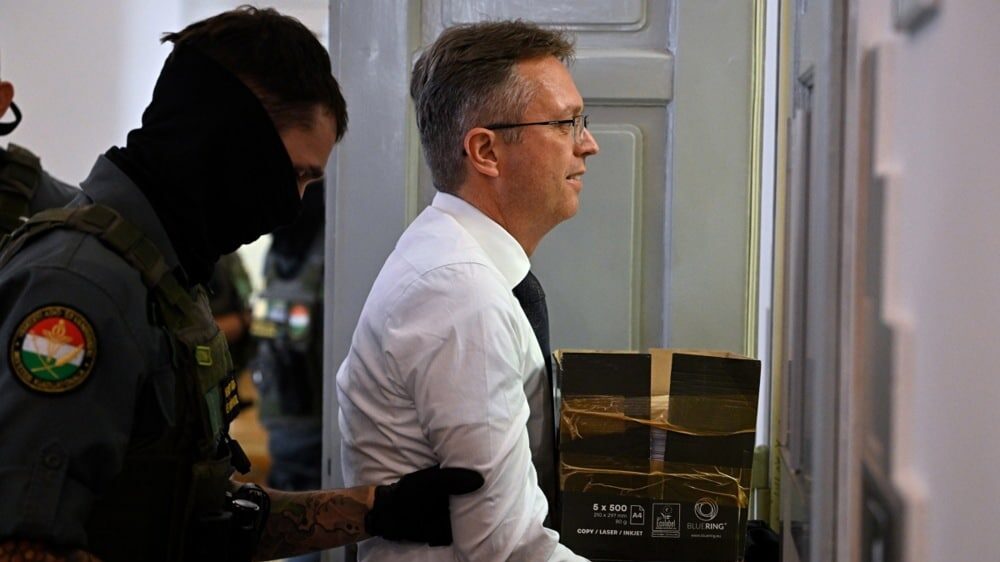
Two former ministers were arrested this week after Hungarian authorities launched Operation Purgatory to root out corruption during the years of Viktor Orban’s government. Former national development minister Miklos Sesztak – dubbed the “feudal landlord” of his constituency in eastern Hungary and a member of the Fidesz party-allied KDNP – is accused of being involved in the large-scale embezzlement of public funds. Between 2015 and 2018, Sesztak and his business partner allegedly amassed 12 billion forints (33 million euros), following accusations that companies awarded public procurement contracts paid 10 per cent in kickbacks to circles close to the minister. The former minister was one of the wealthiest MPs, with assets worth more than 1 billion forints in 2026, according to his asset declaration. His wealth has doubled since 2019 and increased fivefold since 2014, amid longstanding claims the income generated by his law firm in Kisvarda, a provincial town, could not have accounted for the scale of such wealth. Also arrested was former culture minister Balazs Hanko, who is accused of overseeing the distribution of 17 billion forints from the National Cultural Fund to artists and musicians close to the government just a few weeks before the April 12 general election. Many of the artists participated in Fidesz’s election campaign or allegedly received funding for fictitious activities. Before his arrest, Hanko told the Fidesz-aligned Hir TV he was the victim of a “culture war” being waged by the new government to drive patriotic artists out of the cultural scene. Both politicians deny any wrongdoing. In a Facebook video evoking the music of The Godfather, PM Peter Magyar said the two were not “lone criminals” but part of a political-economic mafia allegedly led by Orban.Russia said it will expel Hungarian diplomats from the country in retaliation for Hungary’s move earlier in September. Magyar’s government threw out 10 Russian diplomats on September 8, alleging they had breached the Vienna Convention by engaging in espionage activities in Hungary. Russia announced it would retaliate but waited several weeks before taking any action. The move did not come as a surprise to Hungarian diplomacy, which reacted coolly to the announcement. “The Hungarian government takes note of the decision of the Russian side, which we regard as a retaliatory measure in response to the previous Hungarian action. Hungary has no interest in the escalation of diplomatic tensions. The operations of our missions in Russia will continue uninterrupted, and Hungary’s diplomatic presence in Russia will remain in place,” the ministry said. Although there had been speculation that Russia might use energy as leverage and cut off Hungary’s oil and gas supplies, this did not happen. Russia, in the meantime, welcomed the Hungarian government’s decision not to participate in the Carpathian 8 regional cooperation format launched by Ukraine and its move to block MOL Group from building a fuel storage facility in eastern Hungary to store fuel for Ukraine.Polish Defence Minister Wladyslaw Kosiniak-Kamysz visits the Rzeszow Garrison, in the vicinity of Rzeszow-Jasionka Airport in Poland, 24 September 2026. EPA/Piotr Polak Poland alters rules of engagement for airborne threats; US permanent base still under review Poland is changing its rules of engagement to allow a faster response to threats in its airspace, following a series of incidents linked to Russia’s war against Ukraine. Under the new procedures, pilots will no longer have to approach an object closely enough to identify it visually before a decision is made to shoot it down. Instead, “positive identification” can be based on radar and other military systems, as well as information supplied by Ukraine. The aim is simple: speed. Defence Minister Wladyslaw Kosiniak-Kamysz said on Wednesday the procedures were already being implemented at a military level without the need for legislative changes. What was needed, he said, were “clear, ‘learned by heart’ procedures set by military command” for pilots and other personnel involved in air defence. The shift comes as NATO is reinforcing air defences on its eastern flank. Sweden said on Wednesday it will again contribute Gripen fighter jets to a NATO air-surveillance mission protecting Polish airspace and a key logistics hub in southeastern Poland used to support Ukraine. The deployment will begin in October. A sobering update this week on Poland’s push for a new permanent US military base: after months of talks and President Donald Trump recently saying “great progress” had been made, the Pentagon now says it is only “examining potential opportunities” for one. In a report to Congress, Deputy Defence Secretary Elbridge Colby described talks with Poland as an “ongoing exploration of potential opportunities for permanent basing of US forces in Poland”. No location or deployment has yet been agreed. The cautious language comes as Washington is simultaneously reducing its military footprint in Europe. The same document says the number of US brigade combat teams on the continent has fallen from five to three, including the withdrawal of a rotational brigade previously deployed in Poland. The broader drawdown has already affected the country: in May, Washington cancelled the planned deployment of roughly 4,000 soldiers from an armoured brigade, although another rotational brigade remains in the country. Trump had said on September 17 that a location could be announced “very soon”. For now, however, Warsaw’s confident rhetoric appears to be running ahead of any firm commitment from the Pentagon. Slovak PM Robert Fico, temporarily in charge of the Environment Ministry, is welcomed by the former minister Tomáš Taraba at the ministry in Bratislava on October 1, 2026. TASR PHOTO – Pavel Neubauer Fico juggles jobs and coalition; another fatal school attack shocks Slovakia Robert Fico is currently Slovakia’s prime minister and, temporarily, its environment minister. The second job may prove easier than keeping his three-party coalition together. On Wednesday, President Peter Pellegrini handed the environment portfolio to Fico after dismissing Tomas Taraba. Taraba’s increasingly bitter feud with Slovak National Party (SNS) leader Andrej Danko culminated in an unprecedented episode in Slovakia’s recent political history: SNS MPs joining the opposition in voting to remove a minister nominated by their own party, after Fico had rejected a request to dismiss Taraba. The minister’s exit resolves one problem but leaves Fico with a larger one. Back in parliament as an independent MP, Taraba says he remains loyal to Fico, but will decide on how to vote on a case-by-case basis. With 76 votes needed for a majority, the government has little room for such conditional loyalty – particularly with the 2027 budget due in October. If parliament fails to approve it, Slovakia would enter a provisional budget regime, limiting monthly spending to one-twelfth of the current year’s budget. The coalition reckons it has 78 MPs, but that number could fall on individual votes. There is no obvious replacement for Taraba either. SNS claims the Environment Ministry under the coalition agreement and wants Deputy Environment Minister Filip Kuffa, though Taraba himself has questioned Kuffa’s qualifications. Kuffa has also faced criticism from the opposition in the past. The turmoil revived speculation about an early election, an option Fico himself recently put on the table. For now, however, the three coalition parties have strong reasons to keep the government alive. SNS is polling below the threshold for entering parliament, while coalition partner Hlas opposes an early vote, saying it has yet to deliver everything it promised its voters. Fico also has major projects and unfinished legislative business he may want to see through. Moreover, ending parliament’s term requires 90 MPs, meaning the coalition would also need opposition votes. At this point, an early election remains possible, though not probable. Fico and his Smer party have survived bigger challenges in the past, most notably in 2018 after the murder of investigative journalist Jan Kuciak and his fiancee, Martina Kusnirova, and subsequent mass protests. Fico resigned as prime minister, but Smer remained in government until the 2020 election. Slovakia is again confronting violence in its schools this week after a 13-year-old boy killed a teacher and a classmate in the northern village of Staskov, northern Slovakia. Bozena Mariakova, 61, and the unnamed female pupil died after the boy attacked them with a knife. He also seriously wounded another teacher, whose condition is now reported as being stable. The boy has been placed in a psychological detention facility. At 13, he cannot be held criminally responsible under Slovak law. What happened before the attack is now under scrutiny. Days earlier, the murdered girl had reportedly alerted teachers to an image created by the boy showing a concentration camp with teachers’ faces. He could have had his conduct grade lowered over the incident. Psychologists spent two hours with his class on Monday, while the school had also filed a criminal complaint with police five days before the attack. Police are now reviewing how local officers dealt with that complaint. Little is publicly known about the boy. Residents told Slovak media he was being raised by his grandmother and mentioned unspecified difficulties involving his mother. A woman who knew him from church remembered him as a bright boy who served at Mass and read well, but rarely appeared cheerful. The attack comes less than two years after a student killed two people at a school in Spisska Stara Ves, eastern Slovakia. It also coincides with parliament debating a government bill on preventing radicalisation and mobilisation to violence among young people. People gather on Old Town Square for an anti-government demonstration organized by Million Moments for Democracy in Prague, Czechia, 28 September 2026. EPA/MARTIN DIVISEK Czech coalition survives no-confidence vote; shoemaker Bata closes last CE factory The Czech government on Thursday, as expected, survived a vote of no confidence brought by opposition parties, who hold only 92 seats in the 200-member Chamber of Deputies – shy of the 101 ballots needed to bring down the three-party ruling coalition. The final debate and vote on the motion was already postponed from Wednesday as both camps remained entrenched in their positions. The five opposition parties agreed last month to call for a vote of no confidence in PM Andrej Babis’s government over the coalition’s controversial budget for 2027, which includes one of the highest deficits in modern Czech history, persistent concerns about the PM’s conflicts of interest in relation to his Agrofert agro-chemical conglomerate, and what they’ve described as the government’s repeated attacks against democratic institutions, public media and civil society since taking office. “We will show where the government is failing, because in reality, even though it promised people before the elections that things would get better, things are actually worse,” said Martin Kupka, leader of the centre-right ODS party. “This country is not and will not become ‘Babisistan’,” he added. On the other side of the aisle, government politicians downplayed the importance of the no-confidence motion as mere political posturing, just a little over a week ahead of municipal elections and partial senatorial elections to be held across Czechia on October 9-10. “I haven’t spoken in the Chamber of Deputies for a long time and I miss it,” a defiant Babis said as his MPs defended the government’s policies and track record during its first year in office. “Citizens deserve to know the truth when they have to listen to the lies of the opposition.” The government already survived a vote of no confidence called by the opposition back in February shortly after being officially sworn in. In a symbolic move, the historic Czech shoemaker Bata will gradually close its factory in Dolni Nemci, located in the Zlin region close to the Slovak border, starting next year, the company announced this week – marking the end of its only remaining plant in Czechia and Central Europe. “Shutting down production at our plant in Dolni Nemci was a very difficult decision for us,” said board member Andrea Montagnoli. “Unfortunately, this type of operation cannot stay profitable under current market conditions.” The closure of the plant – which last year produced 150,000 pairs of shoes and has been part of the Bata group since 1992 – will affect close to 100 employees, although the company has vowed to implement a support and retraining program for laid-off workers. Founded more than 130 years ago, the Bata footwear giant currently operates in more than 50 countries, has 6,000 stores worldwide, and has in recent years largely shifted production out of Europe, primarily to Asian and African countries.
Democracy Digest: Operation Purgatory Snares Former Hungarian Ministers
Full Article
Original Source
Read the full article at Balkaninsight →KhanList aggregates and links to publicly available news content. We do not host full articles from third-party sources. Always verify important information with original sources.