
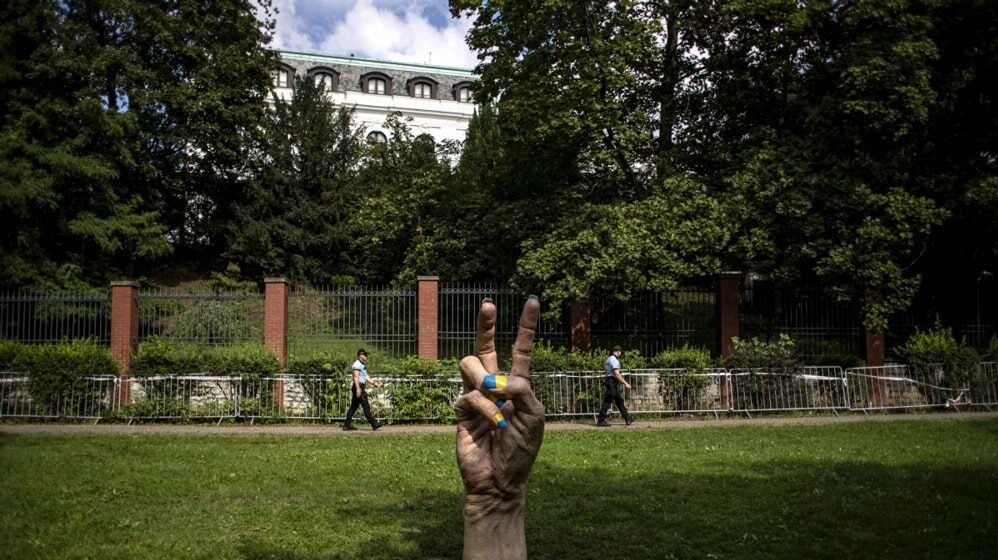
The Czech Republic amended the rules for Russian diplomats travelling in and out of the country as of this week. According to the new regulations, Russian diplomatic personnel must now notify the Czech authorities of their plans to cross the border at least one day in advance, announce the purpose of their trip, as well as the precise route, duration and places of their stay. Foreign Minister Petr Macinka had hinted at the change in the past and Czechia has long lobbied at the EU level to restrict the ability for Russian diplomats to travel freely within the borderless Schengen Area, highlighting the fact that many Russian intelligence personnel have been operating under diplomatic cover. “I consider it an absolutely right step, because it is a reciprocal measure that the Russian Federation also applies to our diplomats,” Foreign Minister Macinka said. “Given the current situation, it is absolutely natural that European states try to prevent the free movement of Russian intelligence officers on their territory.” According to EU rules in effect since January, Russian diplomats must notify authorities of countries other than the one they’re accredited in advance, but individual states can opt to introduce stricter rules. Meanwhile, Czech opposition parties have criticised what they’ve described as a half-measure. “We are still only halfway there. Russian diplomats can continue to travel to the Czech Republic on Schengen visas, and the Czech state cannot say ‘no’ to them,” said Martin Kupka, the head of the opposition right-wing ODS party.President and former NATO general Petr Pavel led the Czech delegation to the US this week and delivered a national address at the UN General Assembly, warning of “profound changes that are reshaping the post-war system”. During his speech, Pavel also focused on the threat that Russia poses to European security, pointing to the recent drone incursions at German airports. “When rules are set aside, brute force fills the vacuum. A world dominated by the competition of great powers is an unstable world, less capable of addressing the most pressing challenges of our time. It is a world where a single spark can ignite a fire.” He also called on China to use its clout and influence to convince Russia to end its war of aggression in Ukraine. During his visit to the US, Pavel had earlier paid tribute to the victims of the 9/11 terrorist attack by Islamic extremists, and at the UN pushed the Czech Republic’s bid for a non-permanent seat on the Security Council for 2032 and 2033. The last time Czechia held a seat on the UN’s top body was in 1994-1995, and it lost a latter bid in 2007 to Croatia.Poland’s Foreign Minister Radosław Sikorski directly responds to his Russian counterpart Sergey Lavrov at the UN Security Council, rejecting Russia’s characterization of the 2014 events in Ukraine and disputing claims over the Russian language. Photo: YouTube Sikorski confronts Lavrov as tensions rise; Russian helicopter enters Polish airspace Polish Foreign Minister Radoslaw Sikorski used a UN Security Council meeting on Wednesday to deliver a direct message to his Russian counterpart, Sergey Lavrov: that after more than four years of full-scale war, Russia had failed to achieve its central objectives in Ukraine, and lacked the economic weight to outlast the countries supporting Kyiv. “You have been trying to conquer Donbas for over 12 years and Kyiv for over four,” Sikorski said. Ukraine, he noted, has only one-tenth of Russia’s GDP. But Poland alone has almost half Russia’s GDP, while Europe has roughly 10 times as much and NATO 25 times as much. “You can still kill a lot of people, but you cannot win,” Sikorski said. “You can stop this imperial war of choice at any time.” He ended by addressing Lavrov personally: “Sergey, I know you’re listening. Tell your boss: enough is enough.” Hours before Sikorski spoke in New York, a Russian Mi-8 helicopter flying from the Kaliningrad region crossed into Polish airspace north of Braniewo at 11:08 on Wednesday. According to Poland’s Operational Command, it penetrated about 300 metres into Polish territory and remained there for 42 seconds. Warsaw scrambled fighter jets and raised the readiness of its ground-based defences. The Operational Command said the flight pattern suggested Moscow was again probing Poland’s ability to respond. The pressure continued on Thursday morning, this time from attacks inside Ukraine. PM Donald Tusk said Russian strikes close to the Polish border forced authorities to evacuate the border crossings at Hrubieszow and Dorohusk. “Just as we were talking, Ukraine was attacked again near the Polish border,” Tusk said during a meeting with Bulgarian PM Rumen Radev. He warned that “autumn and winter may be critical”. The incidents come as Warsaw is seeking stronger security guarantees from Washington and dealing with an unexpected hitch in talks over a permanent US military presence. Defence Minister Wladyslaw Kosiniak-Kamysz had been due to meet his US counterpart Pete Hegseth at the Pentagon on Wednesday, with a permanent US Army base in Poland among the expected topics. The visit was cancelled at Washington’s urgent request, officially because of a scheduling conflict connected with Chinese President Xi Jinping’s visit to the US. No replacement date has been announced. The timing caused unease in Warsaw. Onet reported, citing unnamed government sources, that some Polish officials suspect Hegseth may be seeking to slow discussions on the permanent base. Subsequent reporting, however, indicated that the Pentagon initially tried merely to change the meeting’s time before cancelling it, suggesting the explanation may be less straightforward. The uncertainty comes days after Donald Trump said “significant progress” had been made towards establishing a US Army base in Poland and suggested its location could soon be announced. Hungarian PM Peter Magyar (L) and European Commission President Ursula von der Leyen (R) give a press conference following a meeting at the European Commission headquarters in Brussels, Belgium, 29 May 2026. EPA/OLIVIER HOSLET Hungarian students return to Erasmus+; Romanowski’s Budapest home searched by police EU Commission President Ursula von der Leyen suggested that Hungary should gain access to another 4.2 billion euros from the previously frozen Cohesion Funds. “Hungary has taken important steps to strengthen the rule of law and safeguard the financial interests of the EU,” von der Leyen said. The funds have been blocked since 2022, due to concerns over academic freedom after the government of Viktor Orban reorganised Hungarian universities into controversial public-interest asset foundations, chaired by boards stuffed with Fidesz politicians or government appointees. The decision is awaiting approval by the Council of the EU (which represents member states), but is expected to be announced as early as the next EU summit in mid-October. Hungary will also be allowed to re-enter the EU’s student mobility program Erasmus +, and its universities will again be able to participate in the Horizon program. Hungarian Transport Minister David Vitezy has already hailed the prospect of access to billions of EU funds and said the money would be used to upgrade Hungary’s rail infrastructure, including Budapest’s suburban rail system and the capital’s metro line. Hungary could also gain access to a further 10 billion euros from the EU’s post-pandemic recovery funds at the end of September, which is expected to provide a boost to Hungary’s economy and help strengthen its currency. However, 2 billion euros of the Cohesion Funds remain suspended over concerns about the country’s asylum policy and anti-LGBTQ legislation. The former will be a hard nut to crack especially after the government further extended Hungary’s controversial “state of alert” due to (non-existent) mass migration in early September. Police searched the offices of a company linked to the Fidesz-connected Centre for Fundamental Rights, once the organiser of the alt-right CPAC conferences held during the time of the Orban government. The company allegedly paid a former “foreign official under international arrest warrant” a monthly salary exceeding 3.5 million forints (9,500 euros) from public money, although he carried out only a minimal amount of work. Although the police did not name the individual, Fidesz was happy to identify the “foreign official” as former polish deputy Justice minister Marcin Romanowski, who fled to Hungary and received asylum from Orban’s government in late 2024. Even though there was an international arrest warrant out for him, Romanowski disappeared from Hungary shortly after Fidesz lost power in April. The police searched the apartment where he had been living in Budapest and seized piles of documents. The now-opposition Fidesz party claimed that the Centre for Fundamental Rights is an important “intellectual think tank of the civic, Christian and national political community”, and complained about what it described as a politically motivated process. “Marcin Romanowski fled to Hungary due to the political persecution of the [Donald] Tusk government, which, like the Tisza Party, is building an authoritarian system in Poland,” Fidesz wrote in a statement, which took a rather bizarre turn at the end: “Fidesz remains steadfast in its belief that both countries will succeed in freeing themselves from their Brussels colonial rulers, and that cooperation between Polish and Hungarian patriots will once again enter a golden age.” Pictured is a notice regarding the price of diesel fuel at a gas station in Bratislava on March 27, 2026. Photo: TASR – Jaroslav Novák Slovakia gets its way on Russian sanctions; Fico shifts on fuel prices Slovakia has succeeded in getting two Russian billionaires removed from the EU sanctions list after Robert Fico’s government had lobbied for the move since at least March. Alisher Usmanov and Mikhail Fridman will have their assets unfrozen and EU travel bans lifted. In exchange, member states agreed to extend the sanctions list for three years. Until now, it had to be renewed every six months. France also pushed for Usmanov’s removal, reportedly in connection with negotiations over French citizens detained in Azerbaijan. Luxembourg, meanwhile, sought Fridman’s removal. Latvia opposed the compromise, arguing that sanctions should be strengthened while Russia continues its war against Ukraine. It eventually abstained, allowing the agreement to pass, but said it would keep sanctions against both men at the national level. Ukrainian Foreign Minister Andrii Sybiha called the decision “shameful and unjustifiable”, and urged EU countries to impose their own sanctions on Usmanov and Fridman. It is not the first time Fico’s government has secured someone’s removal from the EU sanctions list. Slovak citizen Jozef Hambalek, the European head of the Russian nationalist Night Wolves motorcycle club, was previously delisted after Slovakia pushed for his removal. With diesel having risen to just below 2 euros a litre, Fico’s government on Wednesday announced a cap on fuel retailers’ margins and cheaper public transport. From October, retailers will be allowed a maximum margin of 10 cents per litre. Second-class train fares will be halved for the month and the government will ask regions and cities to cut bus and public transport fares by 30 per cent. The measures are different from those discussed only days ago, when government politicians talked mainly about cutting excise duty and even an extra tax on the Slovnaft refinery. Fico rejected both on Wednesday. His government has already intervened in the fuel market this year. When oil prices surged in spring, it introduced limits on diesel purchases and different prices for Slovak and foreign motorists – the latter criticised by the EU. Fuel prices are awkward territory for Fico politically. While in opposition in 2022, he filmed himself at a petrol station when petrol cost 1.53 euros a litre and criticised the government for not cutting fuel taxes. The opposition is now making a similar argument. For example, SaS MP Marian Viskupic says Fico contributed to higher prices by raising VAT from 20 to 23 per cent. He proposed reducing VAT and excise duty to the minimum allowed, coupled with an agreement with Slovnaft to lower its margins. Fico rejected cuts to fuel taxes, saying similar measures elsewhere in the EU had cost hundreds of millions of euros without producing results. His government also has little fiscal room for broad tax cuts as it struggles to bring Slovakia’s large budget deficit under control. Fico also inevitably blamed Brussels, calling it “absolute cynicism” for the EU to leave member states to deal with the oil crisis on their own. He said he would write to EU Commission President von der Leyen seeking action at the EU level. Economist Radovan Durana of the INESS think tank welcomed the decision not to cap prices themselves, warning that doing so could lead to shortages and queues at petrol stations.
Democracy Digest: Czechia Restricts Rules for Russian Diplomats Travelling
Full Article
Original Source
Read the full article at Balkaninsight →KhanList aggregates and links to publicly available news content. We do not host full articles from third-party sources. Always verify important information with original sources.