
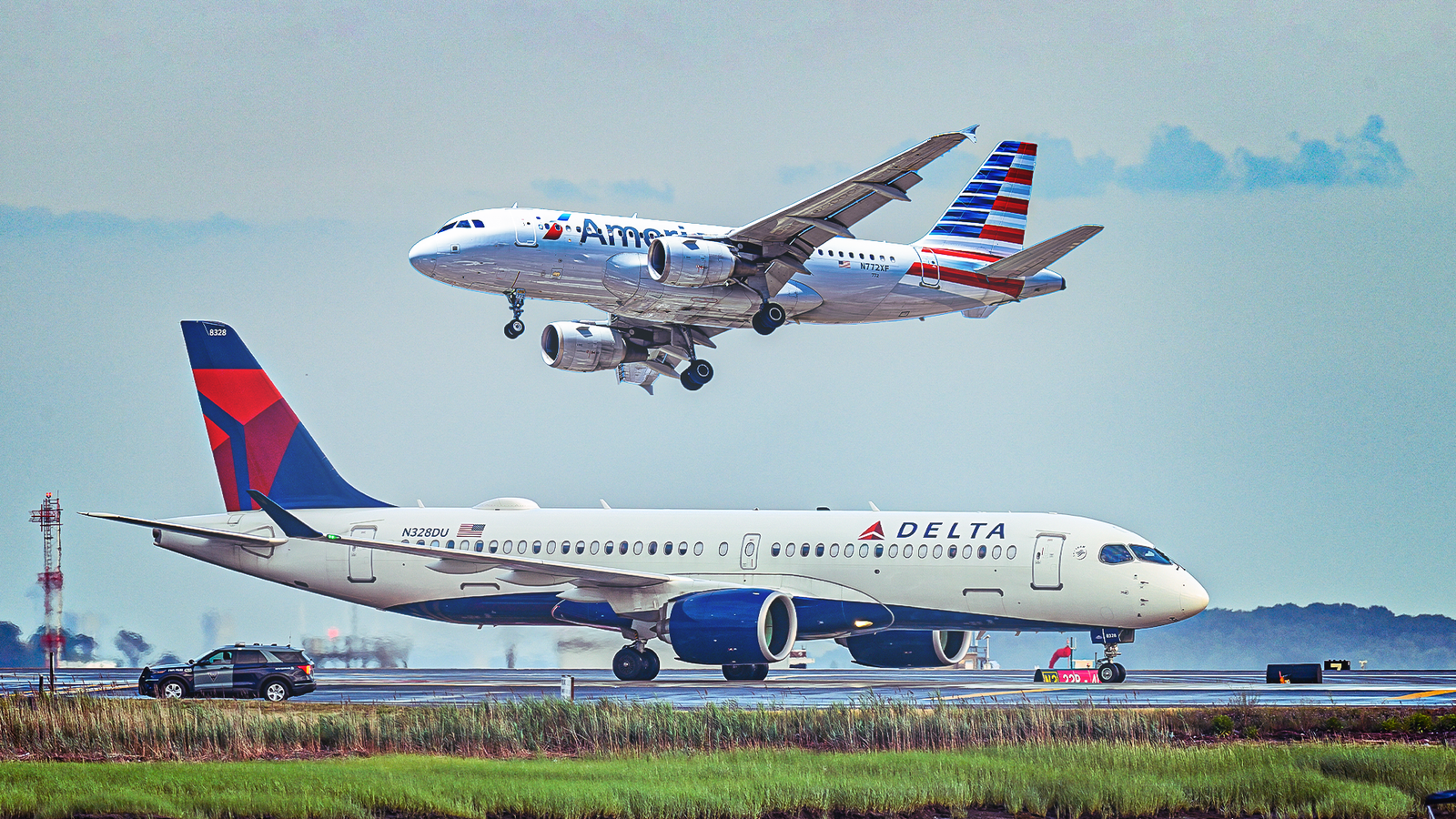
American Airlines, Delta Air Lines, and United Airlines all operate the Airbus A319. Together, the three operate over 250 examples, using it as a core aircraft slotting above their regional jets and underneath their larger narrowbodies. However, the aircraft is also old, having debuted in 1996. The US carriers need to replace these aircraft soon, yet two out of the three haven't ordered the Airbus A319neo, Boeing 737 MAX 7, Airbus A220, or Embraer E2. Delta Air Lines has ordered 145 Airbus A220s, split between 45 A220-100s and 100 A220-300s. The 109-seat A220-100s are much smaller than an A319-100 and are really sized closer to the airline's Boeing 717-200s. The 130-seat A220-300s, however, are almost perfectly sized to replace the 132-seat A319-100s. The other airlines have not ordered this aircraft, nor any others to replace their A319s (as well as the 737-700 in the case of United). However, they might not need these planes to replace the A319-100. Delta's A220 Fleet & The Circumstances Of The Order Credit: HarrisonKim1 I Shutterstock Delta first ordered the A220 back in 2016 when the aircraft was still being sold by Bombardier as the CSeries. At the time, the CSeries was a promising plane, but orders were relatively scarce, and Bombardier was desperate to break into the US market in particular. The original order consisted of 75 CS100s (now the A220-100), and Delta received the planes at such an attractive price that it prompted Boeing to file an anti-dumping petition, which was later overturned. Delta got an amazing price for these planes that is unlikely to be matched. The aircraft is, of course, excellent for its intended missions, but capital cost plays a huge part in the economics of acquiring and operating an aircraft type. The circumstances of the order make the A220 more compelling for Delta than it would be if American or United ordered the type simply because they would need to pay more money. This is especially true when considering that it would come with high integration costs. Delta has experienced excellent results with the A220, and has since added 70 orders in total. While the original order solely consisted of 75 CS100s/A220-100s, all subsequent orders have been for the A319-sized A220-300. Meanwhile, the airline has converted 30 A220-100 orders to the larger variant. While the A220-100 is a competent aircraft in its own right, the A220-300 has more seats without burning significantly more fuel, and the aircraft doesn't even have a significant range penalty for most airlines' purposes. The Real Replacement For The A319-100 Credit: Walter Cicchetti I Shutterstock While the US airlines operate large fleets of last-generation small widebodies, American and United have not ordered any current-generation examples. However, this is because their replacement for the A319-100 is the A321neo and the 737 MAX 10. Both airlines have been upgauging because the A321neo and 737 MAX 10 offer significantly better per-seat economics than other narrowbody aircraft. This makes them much more compelling to operate than their smaller counterparts. American Airlines has ordered 206 A321neos in total while also acquiring ten used examples, and it's ordered 115 737 MAX 10s. United Airlines has ordered 210 A321neos, 224 737 MAX 9s, and 167 737 MAX 10s. Both airlines have also ordered the 737 MAX 8, but in smaller numbers (103 for American and 123 for United). What will actually happen is the new large narrowbodies will take over the carrier's highest demand routes, displacing smaller aircraft down the network and sending the A319-100s to the scrapyard. Delta has done this exact thing, ordering 100 737 MAX 10s and 189 A321neos. While it is taking new A220s, these aircraft are not necessarily replacing the A319-100s one for one. Instead, Delta will again use its new large narrowbodies to take over its busiest routes, which will displace other aircraft, including the A220s in some cases. Meanwhile, the A319-100s will go away. For all three airlines, it's their large narrowbodies that will enable displacements throughout the network. Why Small Narrowbodies Are No Longer Popular Credit: Markus Mainka I Shutterstock Over the past 15 years, Delta has ordered 145 A220s, while it also leased 88 717s from Southwest Airlines for an exceptionally low price. American Airlines ordered 32 A319-100s new from Airbus. Otherwise, all of Delta's narrowbody orders have been for the A321-200, A321neo, 737-900ER, and 737 MAX 10. American has otherwise only ordered the A321-200, A321neo, 737-800, 737 MAX 8, and 737 MAX 10. Similarly, United has only taken the A321neo, 737-800, 737-900ER, 737 MAX 8, and 737 MAX 9, while holding orders for the MAX 10. There has been a noticeable trend of US airlines favoring larger narrowbodies, and even the mid-size 737-800s and 737 MAX 8s have fallen out of favor. These aircraft simply deliver superior economics to the shrinks in their families, as the added fuel burn is far outweighed by their increased revenue potential. The tradeoff is shorter range and runway performance, but only a handful of mainline stations have truly challenging conditions. At the same time, the A320neo and 737 MAX families have solved the performance and range issues. Across the board, US airlines are upgauging, switching to larger aircraft for short-haul flights. In the past, another reason why airlines would buy smaller aircraft is to right-size capacity, but the US legacy carriers have strongly employed fare segmentation as a core commercial strategy. This has reduced the need to operate smaller narrowbodies, since releasing various numbers of differently priced tickets can help fill planes on slower days. This is something that United Airlines CEO Scott Kirby has publicly commented on. Fare segmentation and basic economy fares mean that his airline no longer requires a small narrowbody to meet demand, allowing United to standardize on larger, more economical aircraft. Tellingly, United ordered 45 737-700s in 2016, added another 20 units, then converted all orders to the 737-800 and 737 MAX 9 later the same year. What Made Small Planes Work For Delta Credit: photojohn830 I Shutterstock American Airlines ordered 32 A319-100s new from Airbus, while also acquiring a handful of used examples. United Airlines converted all of its later 737-700 orders to larger variants, while also acquiring a handful of used A319-100s. Delta, on the other hand, ordered 145 A220s while also acquiring 88 717s. Of course, the capital costs play a huge role in this. Specifically, the 717s were essentially a once-in-a-lifetime opportunity due to Southwest's acquisition of AirTran, which originally owned the planes, while the A220s were sold at very low prices. However, another benefit of the small narrowbodies to Delta comes from its pilot agreement. The agreement stipulates scope clauses, which place limits and restrictions on regional jet flying contracted out to other airlines under the Delta Connection brand. The largest planes that may be flown for Delta Connection are 76-seaters, and there are hard limits on how many of these planes Delta may operate under the Delta Connection, as they are more economical than 70-seaters or 50-seaters. Delta's scope agreement, however, allows the airline to add additional 76-seaters if it adds a new small mainline narrowbody. The 717s, in addition to being cheap to acquire, unlocked additional 76-seaters for the Delta Connection brand. The A220 order did the same thing, and this is a significant benefit given the scale of the regional operations run by the US airlines. However, this was also a very specific set of circumstances that, combined, made the two purchases work for Delta. Fewer Benefits For American & United Credit: Jon Tetzlaff I Shutterstock An opportunity like the 88 717s that Southwest was looking to offload rapidly was only going to occur once, as is also the case for the pricing on Delta's initial A220 order. Beyond this, American Airlines specifically does not have a trigger in its scope clauses for additional 76-seaters if it acquires a new small narrowbody type. Rather, the size of the 76-seater fleet is tied directly to the airline's overall mainline fleet size. For American, the aircraft has to have merit on its own, and that's difficult to justify. United Airlines does have the same trigger clause as Delta, which means that acquiring an aircraft type sized like the A319-100 would unlock additional 76-seaters. However, the carrier is currently focused on substantial network-wide growth through frequency increases and upgauging. Airlines & Orders (Planespotters.net) A220 Total Orders 737 MAX 8 Total Orders 737 MAX 9 Total Orders 737 MAX 10 Total Orders A321neo Total Orders American Airlines 103 aircraft 115 aircraft 206 aircraft (plus ten used) Delta Air Lines 145 aircraft 100 aircraft 189 aircraft United Airlines 123 aircraft 224 aircraft 167 aircraft 210 aircraft Buying 100+ A220s does not fit its general strategy today, especially considering United's current order book, which is dominated by larger aircraft variants. For both airlines, there is less benefit to acquiring the A220 or a similar small narrowbody aircraft type like Delta has. Apart from the unique circumstances that made the 717s and A220s attractive to Delta, however, the Atlanta-based carrier is also practicing upgauging and is noticeably doing so throughout the network. The carrier has also shied away from the 737 MAX 8, and there's a distinct possibility that it may simply not order this variant at all.
Delta Air Lines Is Already Flying The Replacement For Its Aging Airbus A319s, But American & United Don't Have One
Full Article
Original Source
Read the full article at Simpleflying →KhanList aggregates and links to publicly available news content. We do not host full articles from third-party sources. Always verify important information with original sources.