
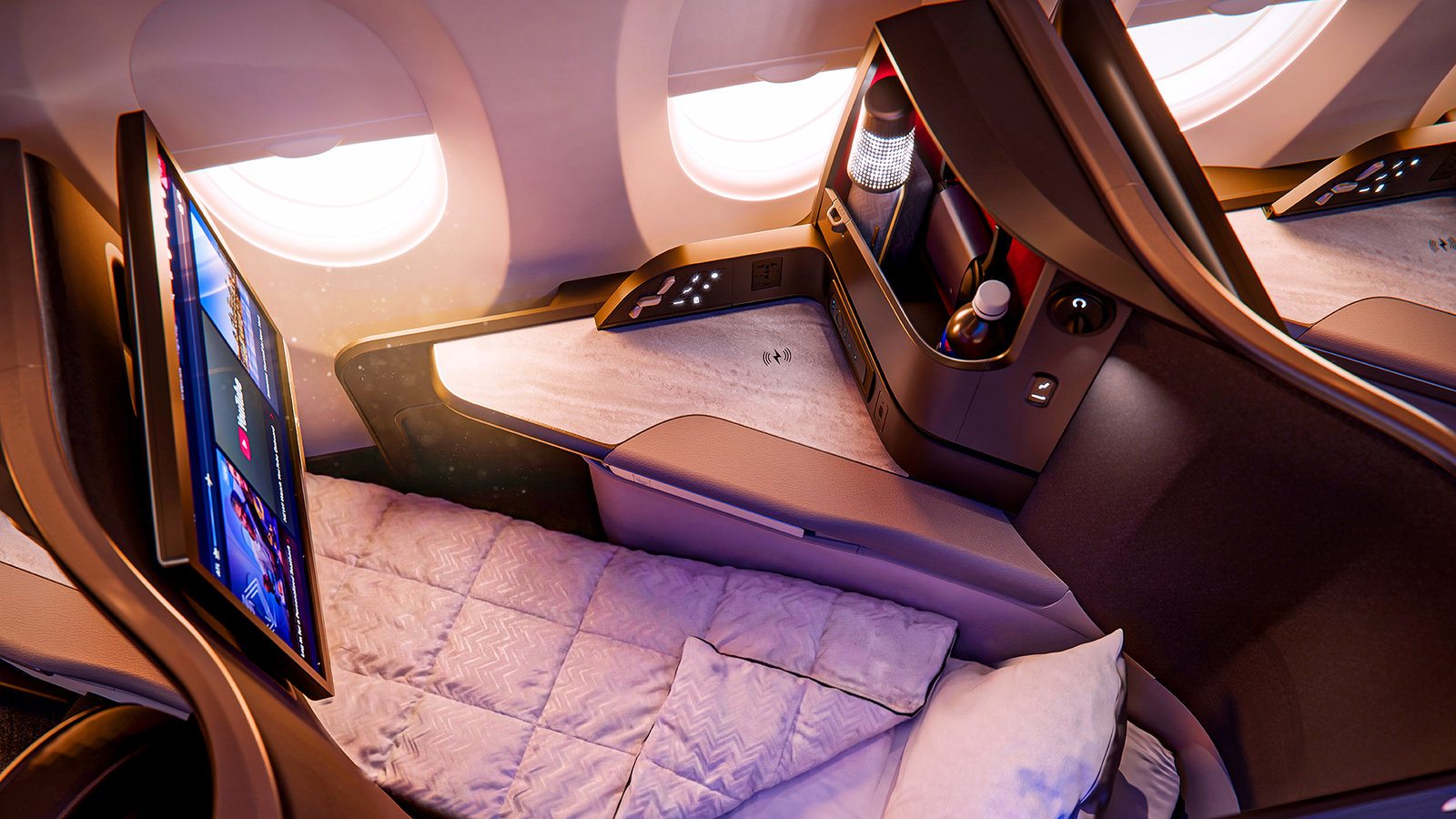
Published Oct 16, 2026, 7:00 AM EDT Airline and Airport Management Graduate, Student Commercial Pilot and Commercial Aviation Writer. Based in London & Nagoya Delta Air Lines and Thai Airways are set to introduce the same long-haul business class seat platform in 2027, setting the stage for an unusual convergence in premium cabin selection. Both international carriers have selected Thompson Aero Seating’s VantageNOVA suite to power their long-range widebody fleets. The decision gives both airlines a shared technological baseline, but their ideas for how to use this seat show the fundamentally different commercial priorities across the transpacific and transatlantic markets. The simultaneous rollout of the VantageNOVA suite can be viewed as an experiment in cabin customization. Both carriers will deploy identical hardware featuring a staggered 1-2-1 configuration, full-height sliding privacy doors, and lie-flat beds measuring 80 inches (203 cm) in length. However, while Delta is configuring its incoming Airbus A350-1000s with a uniform, single-tier corporate layout, Thai Airways is using the platform to remove First Class entirely in favor of a two-tiered business class hierarchy. What Is The VantageNOVA? Credit: Thompson Aero At its core, the Thompson Aero VantageNOVA platform is a next-generation evolution of the classic 1-2-1 staggered business class layout. Built on a modular chassis, the suite provides every passenger with direct aisle access alongside full-height sliding privacy doors. In its fully flat position, the sleeping surface extends to a minimum length of 80 inches (203 cm), created by aligning the footwell beneath the side console of the suite ahead. Each baseline suite features a high-definition 24-inch (61 cm) 4K inflight entertainment screen set into the forward monument wall, accompanied by standard Bluetooth audio pairing and universal power outlets. The VantageNOVA platform integrates modern ergonomic features directly into the seat frame design. The main seating structure incorporates a zero-gravity recline mechanism, which tilts the seat bucket backward to elevate the passenger's legs and relieve lower back pressure during long-haul cruise flight. Operating controls are split between a main console panel and a secondary bedside unit designed for easy access when the seat is fully reclined. Storage is integrated into the side console, featuring dedicated compartments for personal electronics alongside a flush-mounted wireless charging pad. For international widebody operators, selecting a pre-engineered platform like VantageNOVA offers a balance between development speed and cabin personalization. Designing an entirely bespoke business class seat from scratch can often take upwards of three years in safety certification, crash testing, and line-fit engineering, as per Business Insider. The VantageNOVA is therefore seen as the established platform, one where airlines can skip core structural testing while retaining freedom over surface materials, control interfaces, console geometry, and front-row monument options. The Launch Customer Credit: Delta Air Lines Delta Air Lines was announced as the global launch customer for the VantageNOVA platform, debut-testing the suite on its incoming flagship Airbus A350-1000 fleet in early 2027. According to Simple Flying's coverage of Delta's suite unveiling, the carrier is deploying the new seat as the cornerstone of its premium transpacific and transatlantic operations. The arrival of the A350-1000 also brings the arrival of Delta's first major business class hardware overhaul in nearly a decade, replacing earlier generations of staggered and reverse-herringbone seats with a unified, fully enclosed suite product. To distinguish its product from off-the-shelf alternatives, Delta applied extensive custom engineering, a process Thompson Aero referred to as 'Deltafication'. The seat features automotive-inspired tactile control buttons shaped like the seat itself, allowing passengers to adjust recline angles intuitively in a darkened cabin. Consoles are finished in custom polystone engineered to mirror real marble, paired with dark blue and charcoal upholstery with signature red accent stitching. Additionally, Delta is pairing the hardware with Missoni bedding and dedicated walk-up snack bars in the forward galley, blending high-end tactile touches with corporate travel utility. Crucially, Delta's commercial strategy centers on a uniform, single-tier business class environment. Rather than partitioning the front bulkhead row into a separate subclass, Delta is installing 53 identical Delta One suites across the forward section of the A350-1000. Every passenger purchasing a business class ticket receives the exact same seat pitch, screen size, and privacy area. The approach reflects Delta's focus on corporate contract consistency, a focus that is firmly on high-yielding business travellers receiving a predictable, premium hard product regardless of their row assignment. A Total First Class Removal Thai Airways is using the VantageNOVA introduction to make a sweeping cabin reset across nearly its entire long-haul widebody fleet. The Thai flag carrier will launch the retrofit program in mid-2027 across 14 Boeing 777-300ERs, with completion targeted for the end of 2028, as per One Mile at a Time. Following the 777 rollouts, retrofits will begin on 21 Airbus A350-900s starting in 2028, while 45 incoming Boeing 787-9 and 787-10 aircraft will arrive pre-fitted with the suites straight from the factory floor. Central to this fleet overhaul is the complete removal of Royal First Class. As detailed by Business Traveller, Thai Airways is retiring its dedicated four-seat first class cabins on the 777-300ER fleet, choosing instead to focus its premium investment entirely on a modernized business class product. As explored in Simple Flying's analysis of airlines phasing out first class, global carriers are increasingly abandoning dedicated top-tier cabins on long-haul routes where high-spec business class suites with privacy doors capture identical high-yield demand. Standardizing on a single seat platform across its long-haul widebodies is a crucial step as Thai Airways emerges from debt restructuring. Operating a uniform business class seat shell across three distinct aircraft families dramatically simplifies maintenance spare parts inventory, ground servicing, and flight crew type-rating qualifications. It is, of course, a rather drastic move, but eliminating bespoke first class hardware creates an operational model optimized for consistency across its Bangkok hub network. A New Approach To Segmentation? Even though Thai Airways is retiring traditional first class, it is not abandoning ultra-premium revenue opportunities. Instead, by taking advantage of Thompson Aero’s front-row bulkhead monument options, the carrier is creating a distinct two-tiered business class cabin dubbed Business Class Plus, as noted by Aerospace Global News. Located in the front row of the cabin, these four upgraded suites feature expanded floor space, massive 32 inches (81 cm) 4K monitors, and companion seating designed for shared inflight dining. Additionally, the center suite privacy divider can be lowered entirely to form a four-person social quad for families or corporate teams traveling together. To offset the expanded floor plan of these premium front-row suites, Thai Airways is adjusting layout density further back in the aircraft. On the Boeing 777-300ER fleet, the economy class cabin will shift from a nine-abreast 3-3-3 arrangement to a ten-abreast 3-4-3 layout. As per Simple Flying's guide to 777 seating configurations, moving to ten-abreast seating reduces individual seat width, allowing the airline to squeeze additional main-cabin seats into the fuselage to offset front-cabin real estate losses. Delta opted for absolute cabin egalitarianism, deploying 53 identical suites across its A350-1000s to deliver a consistent, single-tier product for corporate contract buyers. Thai Airways, conversely, uses more of a tiered structure, monetizing the front row as a pseudo-first class while funding the footprint through main-cabin economy densification. Both strategies take on the same underlying seat geometry, but deliver entirely different passenger segmentation profiles. A Distinct Cabin Design Language Where geometry remains identical, interior material choices are what take factory-built suite shells to distinct cultural statements. Thai Airways tailors its VantageNOVA cabin with a heritage-inspired palette, wrapping seat structures in rich royal purple and soft cream upholstery, as per Executive Traveller. Side consoles feature warm wood-grain laminate accents that evoke traditional Thai craftsmanship, establishing an inviting, residential atmosphere throughout the cabin. The cabin is truly synonymous with luxury, and the Star Alliance carrier creates an environment that feels distinctly aligned with its long-standing reputational focus on Southeast Asian hospitality. In contrast, Delta Air Lines dresses the identical hardware in an industrial corporate design language. The SkyTeam founding member uses deep midnight blue and charcoal upholstery, framed by crisp steel grey trim and subtle red accent stitching. Consoles are finished in custom polystone engineered to recreate the textured look of natural marble, providing a sleek, durable surface for corporate travelers. Combined with dark-mode seat control units and structured geometry, Delta's aesthetic choices emphasize high-efficiency corporate luxury tailored for premium transpacific and transatlantic business corridors. These contrasting interior schemes demonstrate how soft product customization turns mass-manufactured cabin hardware into a true extension of brand identity. While both airlines share the same structural chassis beneath the cushions, no passenger stepping into either cabin would mistake one for the other. Global carriers now increasingly rely on custom colorways, bespoke lighting accents, and specialized tactile materials to forge unique cabin identities atop standardized structural molds, all to make sure that every passenger feels a unique experience. Proof In The Proven Adopting off-the-shelf seat architectures like the VantageNOVA, global airlines can greatly reduce certification delays and bulk-procurement overhead while retaining total authority over cabin segmentation, yield generation, and visual identity. More often than not, high-density business class suites now match the privacy standards once exclusive to international first class, and so the true commercial differentiator between competing carriers is no longer the mechanical shell beneath the cushion, but how aggressively network planners structure cabin hierarchy to maximize revenue per square inch. For Delta, the financial validation of its uniform 53-suite layout rests on maintaining corporate contract loyalty as its first 20 A350-1000 aircraft enter service. For Thai Airways, whether monetizing four front-row Business Class Plus suites offsets the yield risk of densifying its 14 Boeing 777-300ER main cabins to a ten-abreast layout will be important to keep an eye on. As deliveries begin in early 2027, these two contrasting approaches will offer a definitive industry case study in whether single-tier cabin consistency or multi-tiered suite segmentation generates superior long-haul profitability.
Delta Air Lines & Thai Airways Will Fly The Exact Same Business Class Seat, But Very Differently
Full Article
Original Source
Read the full article at Simpleflying →KhanList aggregates and links to publicly available news content. We do not host full articles from third-party sources. Always verify important information with original sources.