
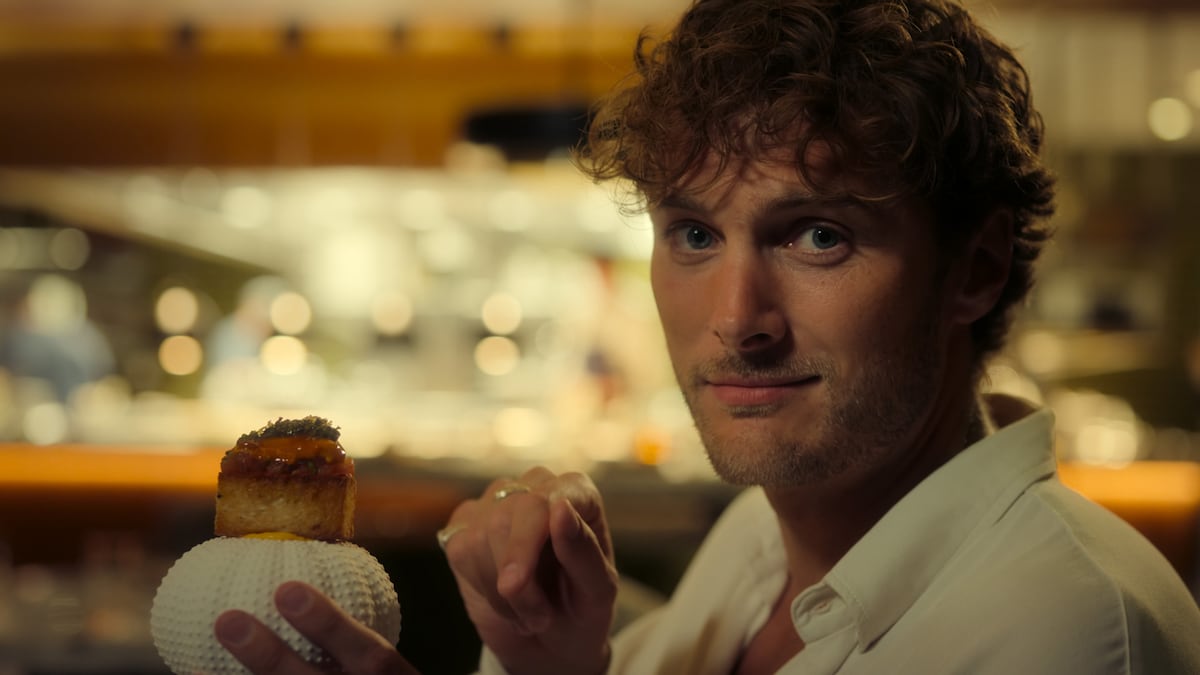
Jesse Burgess, host, filmmaker and co-founder of the award-winning food and travel channel Topjaw, says his role in the documentary series Knife Edge: Chasing Michelin Stars is a dream job. In reality, it’s an even more polished extension of his earlier social media work: he travels the world to introduce viewers to the intense realm of haute cuisine. He visits (and samples) the planet’s most acclaimed restaurants as they face the Michelin Guide’s annual season.“It’s a dream, but eating like that can be especially stressful, with three cameras around you, especially when you’re in a restaurant with other diners. You try not to be a nuisance despite having a lot of lights pointed at you and, at the same time, not to let the food fall out of your mouth,” he says in a video interview. “Not to mention what it means for the technical crew to film in kitchens that, contrary to appearances, almost never have any spare room. They have to respect the work of the chefs who are in the middle of a very important service for them,” he adds.The truth is the series, which has just returned to Apple TV with an eight-episode second season that premiered last week, is a visual marvel that doesn’t feel like the result of a gourmet vacation. It not only offers unprecedented access to 16 of these exclusive establishments, but it also tells personal stories that surpass the plots of many fiction series.Among the most striking real-life stories this season is that of Adam Dahlberg and Albin Wessman closing their Michelin-starred restaurant in Stockholm and reopening in a larger space. The recognition belongs to the restaurant and is not a permanent, personal award for the chef, so the pair in practice relinquished their star. They have 52 days to prove the new venue deserves to regain that honor, with the possibility of aiming for a second star. “It’s one of the things that struck me most this season. They had kept their star for a decade and they dared to try something new. But I was even more impressed by Niklas Ekstedt, also in Stockholm, who decided to create a restaurant centered on cooking without electricity, relying on fire and traditional Scandinavian techniques while aiming for a second star. What’s powerful is that we see him learning on the fly, with the restaurant already open,” Burgess says.Another story this season follows a chef and his family as they risk everything to put a small island on the Michelin Guide map. And in central Rio de Janeiro, a father and son — two generations of a legendary family of cooks — each seek recognition on their own terms, with their respective offerings located very close to one another.A sandwich shop transforms each night into a fine-dining restaurant while a young couple attempts to put Filipino cuisine at the center of one of the most competitive culinary scenes in the United States. These are very different situations that nevertheless face the same questions: what will Michelin decide, and will all that effort have been worth it?Although one of these high-level kitchens is often described as an army headquarters because of the focus and discipline required, Burgess would define it as “a choreographed dance; it’s like being on a stage every day.” “A soldier receives a lot of training and may practice for years without ever applying those skills in real life. In the kitchen, by contrast, they use all those elements daily and, in fact, there is very little time for training,” the host explains.Part of the documentary’s educational value comes from statements by the usually inaccessible Michelin Guide inspectors, who explain in their own words what they look for in a restaurant, while maintaining the discretion typical of their institution. The series also tries to explain to viewers why, even when prices at these establishments are very high, profit margins often remain slim. When Burgess is asked about DiverXo, which two years ago raised its menu price by 23% to reach €450, the food expert defended Madrid chef Dabiz Muñoz’s decision. “There’s a very common misconception: thinking that if I go to a restaurant and it costs me a lot to eat there, then the chef or whoever’s in charge probably drives off in a Ferrari at sunset, making a fortune at the expense of all the customers,” he says. “They’re often places with few tables; if something goes wrong at a four-person table, they can lose the profit for the entire night. I know restaurants that are full all the time and have a 4% annual profit. If any unexpected event hits, like a pandemic, everything goes to ruin,” he argues.Burgess’s passion for food was born thanks to his mother. “She was a flight attendant. Since I was five years old she began working on private flights. She would bring me food from wherever she traveled. By age 11 I had already tried Russian caviar and Mediterranean prawns, Danish pastries… I was obsessed with her job,” he recalls.Knife Edge: Chasing Michelin Stars has executive production by the chef Gordon Ramsay, known to audiences as the strict and sometimes ill-tempered creator of the international format Kitchen Nightmares. His fame is such that the internet is full of memes of his fiery reactions. “If you want to know whether Gordon ever put two slices of bread on my head while shouting that I’m an ‘idiot sandwich,’ as in one of his best-known parodies, the answer is no,” the series host jokes. “But the fact that moment is so popular shows he knows how to do television. Throughout his career he’s been very attuned to what’s culturally relevant, and that has been a great help in creating this project,” Burgess concludes.
Deliberately losing a Michelin star to try to win it back in 52 days: Apple TV’s culinary miracles
Full Article
Original Source
Read the full article at English →KhanList aggregates and links to publicly available news content. We do not host full articles from third-party sources. Always verify important information with original sources.