
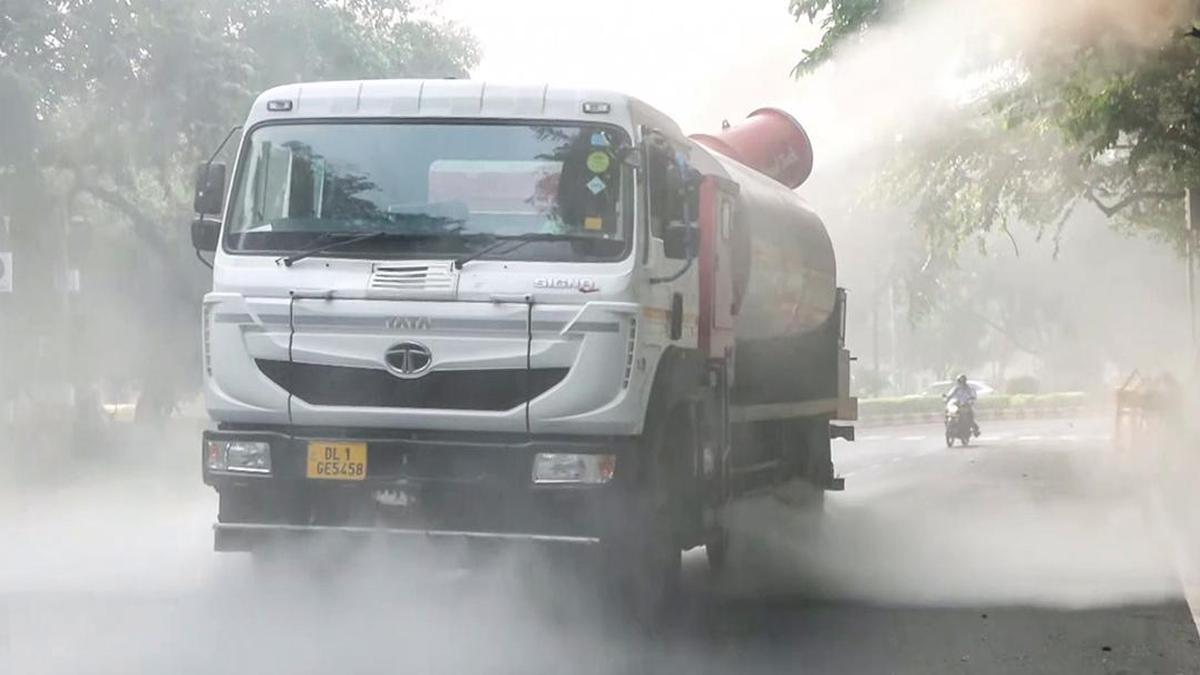
A truck-mounted anti-smog gun deployed by the New Delhi Municipal Council (NDMC) sprays water mist along a road near 10 Janpath to curb air pollution, in New Delhi on Wednesday. | Photo Credit: ANI Delhi’s early winter air pollution levels were higher in 2026 than in previous years, with the average PM2.5 concentration in the week preceding Deepavali reaching a three-year high, an analysis by the Centre for Science and Environment (CSE), released on Wednesday, showed.The analysis also found that emergency traffic restrictions imposed by the government had failed to ease congestion, with evening gridlock trapping toxic nitrogen dioxide (NO2), a marker of vehicular pollution, until midnight.The week before Deepavali recorded an average PM2.5 concentration of 236 micrograms per cubic metre. “This marks a 97% increase over the 120 micrograms per cubic metre recorded in 2025 and a 32% jump over the 179 micrograms per cubic metre seen in 2024, highlighting a significantly steeper pre-festive pollution surge this year,” the CSE stated in an official release.The CSE said it arrived at these findings through a detailed analysis of air quality data from the Central Pollution Control Board’s portal, hourly dynamic estimates of pollution source contributions by the Indian Institute of Tropical Meteorology, crop fire data from the Indian Agricultural Research Institute, and traffic data.‘Tipping point’“Deepavali pollution is an annual tipping point, but elevated particulate levels before the festival this year show that baseline pollution is higher than in previous years,” said Anumita Roychowdhury, executive director (research and advocacy) at the CSE.She said year-round emission control across key sources remained inadequate. “Had air quality been cleaner leading into winter, and episodic spikes from farm fires and firecrackers kept in check, seasonal weather shifts would not have triggered such severe pollution,” she said.‘Smog persisted’According to the CSE, severe smog persisted during the period even as the contribution of stubble burning declined. The analysis also highlighted the role of non-farm sources, particularly transport, the largest contributor to pollution among Delhi’s local sources.“While the share of stubble smoke rose during this period, severe pollution episodes continued even when farm fire contributions dropped. Traffic congestion analysis confirms that vehicular emissions heavily drive daily toxic exposure. Furthermore, emergency restrictions barring pre-BS VI vehicles have failed to reduce traffic volumes significantly,” Ms. Roychowdhury said.Beyond stubble burningDelhi’s air quality deteriorated sharply in late October, with the AQI entering the ‘very poor’ category on November 2. However, the contribution of stubble burning to the city’s pollution remained low, according to the CSE analysis.“The contribution of stubble burning to citywide PM2.5 was a modest 3.9% during GRAP Stage I enforcement. It rose to 11.5% on November 1 (ahead of GRAP Stage II invocation), and eased to 8.6% on November 2. Farm fire smoke peaked at a season high of 16.2% on November 4,” the CSE said in its release.“Yet by November 6, when GRAP Stage III was triggered, Delhi’s AQI deteriorated to 382 even as stubble smoke fell to around 8% — proving that severe pollution episodes persist independently of declining farm fires, driven instead by intense local emissions,” it added.Vehicular pollutionAccording to the IITM’s Decision Support System (DSS) data for November 1-8, pollution transported from neighbouring NCR districts accounted for 54.43% of Delhi’s PM2.5, followed by local sources at 33.06% and stubble burning at 14.29%, the analysis showed.“Among Delhi’s local pollution sources, vehicular transport was the dominant polluter at 52%, well ahead of residential activities (13%) and Delhi’s peripheral industries (11%),” the statement added.Construction contributed 7%, while energy use and waste burning accounted for 5% each. Road dust and other sectors contributed 4% each, according to the CSE. Published - November 12, 2026 05:45 am IST
Delhi’s early winter air pollution highest in 3 years: Study
Full Article
Original Source
Read the full article at Thehindu →KhanList aggregates and links to publicly available news content. We do not host full articles from third-party sources. Always verify important information with original sources.