
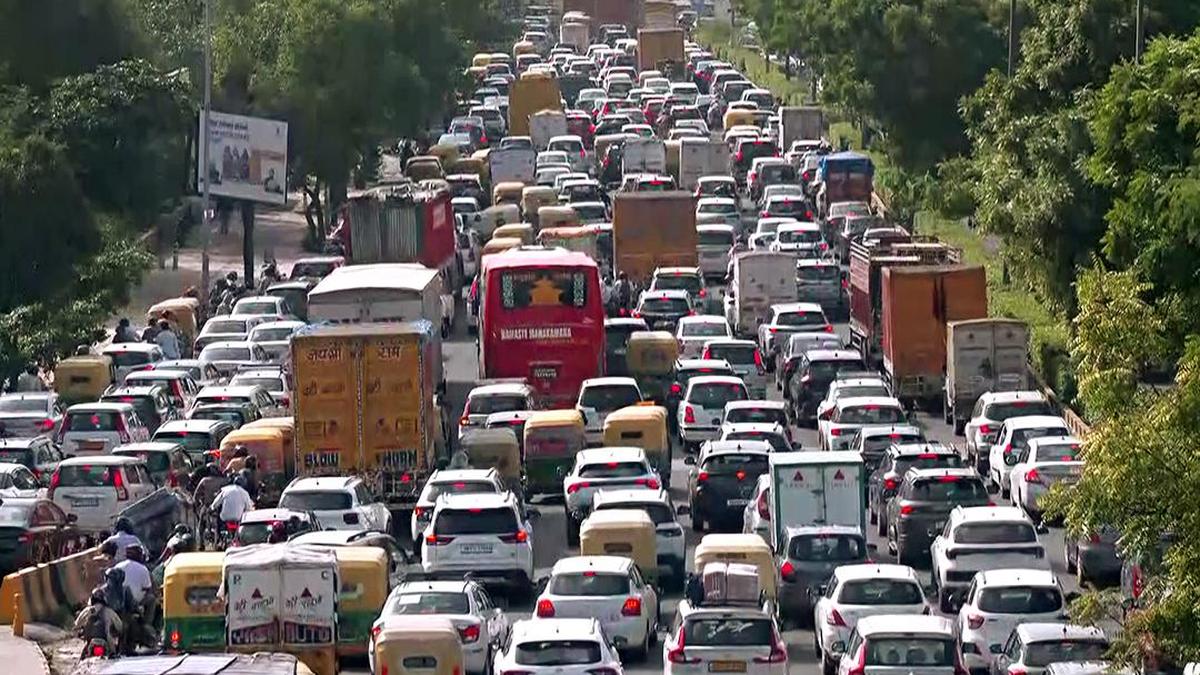
The scale of the problem at Sarai Kale Khan is hard to miss from the foot overbridge near Sundial Park. During peak hours, streams of vehicles from the Delhi–Noida Direct (DND) Flyway, Barapullah, Ring Road and Delhi-Mumbai Expressway converge at the interchange, with rows of red brake lights stretching towards the junction.The 800-metre Sarai Kale Khan stretch handles at least 1.1 million vehicles a day, as per traffic police estimates. At its most congested point, 14 lanes funnel into just three and create a bottleneck that affects traffic on the DND Flyway and Barapullah Flyover. The resulting queues extend towards Noida, Mayur Vihar, and parts of south and south-east Delhi. In addition, metro, railway network, and Inter-State Bus Terminal converge at this multi-modal hub.And just 500 metres away, a newly opened exit of the Delhi-Mumbai Expressway towards Ashram has emerged as a separate road-safety concern, with the Delhi Traffic Police flagging the short weaving length at the junction as a potential accident black spot. Screengrab showing traffic at Sarai Kale Khan stretch on Google Maps According to DCP (Traffic), Southern Sandeep Gupta, the opening of the Ashram exit over the weekend has also altered traffic patterns by shifting some congestion that was earlier concentrated around Kalindi Kunj towards Sarai Kale Khan.Commuters travelling between Faridabad and Noida who earlier used the Kalindi Kunj route are now using the Sarai Kale Khan stretch and taking a U-turn to access the D.N.D Flyway. Vehicles travelling from Noida towards Faridabad, meanwhile, are increasingly using the Delhi-Mumbai Expressway.The problem at Sarai Kale Khan is essentially one of multiple traffic streams converging into limited road space. Three lanes from the Ring Road, three from the D.N.D flyover, three from the Delhi-Mumbai Expressway and two from the Barapullah Flyover, along with three arterial roads connecting east and south Delhi, converge before traffic is funnelled into a three-lane flyover towards ITO.During the morning peak between 8.30 a.m. and 10 a.m., and the evening peak between 5.30 p.m. and 8.30 p.m., the interchange turns into a slow-moving gridlock.Traffic queues on the Ring Road routinely stretch up to two kilometres, while vehicles descending from the Barapullah Flyover and D.N.D remain bumper-to-bumper for more than half a kilometre before negotiating the loop. The congestion can spill towards Noida, Mayur Vihar Phase-I and roads across south and south-east Delhi, traffic police estimates suggest.The reverse movement has a similar bottleneck. For traffic travelling from ITO towards the D.N.D, vehicles first converge before being divided between the D.N.D and Ring Road. Near the IOCL petrol pump, eight to nine lanes narrow into three before the traffic bifurcates, creating another point where queues build up.The traffic police have deployed four to five personnel at the junction, however, officials on ground said traffic personnel can only regulate movement to a limited extent when multiple traffic streams are being forced into a road section with inadequate capacity.Direct DND link among proposed fixesThe Delhi Traffic Police has proposed interventions to the National Highways Authority of India (NHAI), which are under consideration.One proposal is to create a direct connection from the Delhi-Mumbai Expressway to the D.N.D, eliminating the need for vehicles to take a U-turn to access the flyway.Another proposal being explored is a direct connection towards NH-9. This could provide vehicles travelling towards east Delhi and Meerut with an alternative route and reduce the volume of traffic passing through the Sarai Kale Khan junction.Short weaving length raises accident concernsJust about 500 metres from the Sarai Kale Khan junction, the new Delhi-Mumbai Expressway exit towards Ashram presents a different problem.The exit, which opened to the public three days ago, brings five lanes of high-speed expressway traffic into an already busy junction where three-lane traffic from Sarai Kale Khan is also approaching at speed. The Delhi Traffic Police has flagged the location as a potential accident black spot.The technical concern is the weaving length — the distance available for vehicles to enter a road, merge with existing traffic, change lanes and then separate towards different routes.Immediately afterwards, vehicles have to separate towards two major routes — New Friends Colony and the Ashram Flyover. “The merging length, also called the weaving length, is very short,” Mr. Gupta said. The limited distance leaves drivers little room to adjust their speed and change lanes before the next diversion, increasing the risk of collisions.The traffic police had raised concerns about the junction even before a trial opening of the new arrangement ahead of the BRICS summit, while NHAI in its safety audit found the merging to be safe for traffic operations. During the trial, officers found the movement difficult and potentially dangerous.The concern, Mr. Gupta said, is that road infrastructure may appear adequate when individual stretches are examined separately, but the interaction between different traffic streams becomes problematic when viewed as a complete junction.As a temporary measure, the traffic police have installed a traffic island — a physical barrier in the middle of the road — to prevent the traffic streams from immediately mixing. The separation gives vehicles additional time and space to merge gradually rather than converging at the same point.The traffic police has also written to the NHAI seeking permanent road-safety interventions at the junction, including traffic-calming measures such as rumble strips to slow vehicles before they reach the merging point while a traffic signal is also being planned.A traffic officer deployed at the location said the movement had been challenging, with vehicles from the Delhi-Mumbai Expressway entering the junction continuously and at high speed. Two personnel have been deployed during peak hours as commuters familiarise themselves with the new route.The location already carries substantial traffic, including vehicles travelling from ITO towards Ashram and those coming from Noida and Ghaziabad towards south Delhi. The addition of high-speed expressway traffic therefore creates another conflict point within a short stretch.PWD studies wider traffic movementMeanwhile, the PWD is conducting a traffic simulation study covering the wider Sarai Kale Khan stretch to identify measures to improve traffic movement.The study will assess how traffic from the multiple approaches interacts at the interchange and what changes to road geometry or traffic management could ease the bottleneck.
Delhi-Mumbai Expressway exit towards Ashram an ‘accident black spot’; Sarai Kale Khan traffic congestion ‘hotspot’ sees 1.1 million vehicles a day
Full Article
Original Source
Read the full article at Thehindu →KhanList aggregates and links to publicly available news content. We do not host full articles from third-party sources. Always verify important information with original sources.