
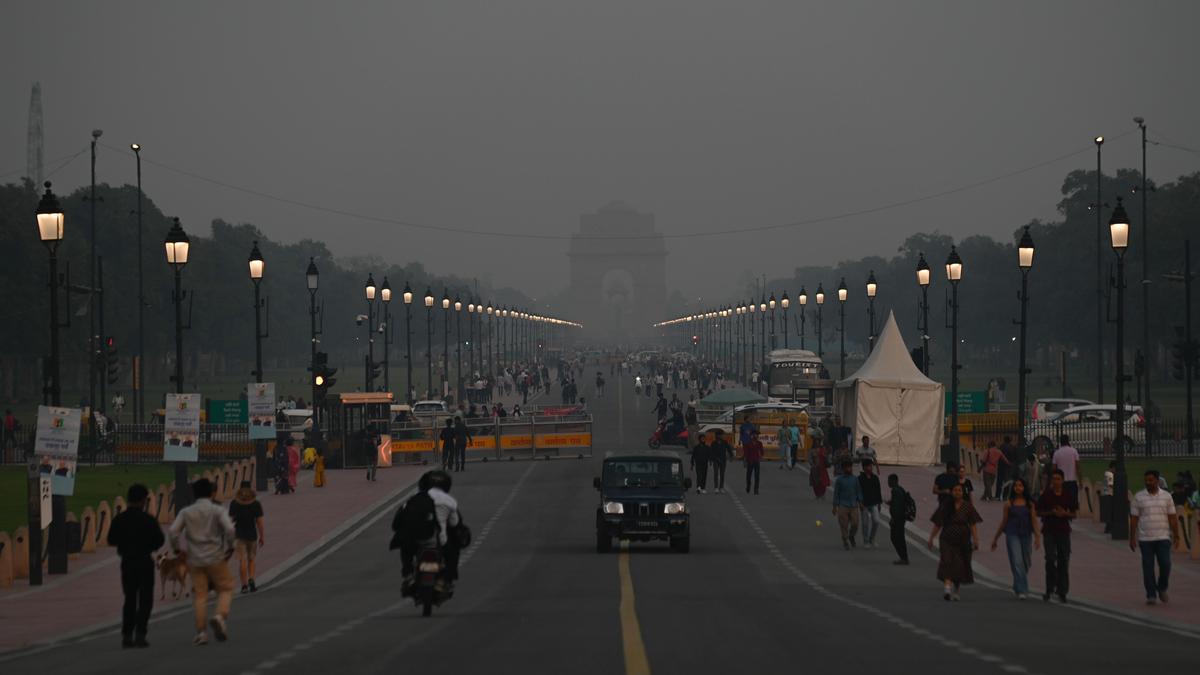
Delhi’s air quality improved to the ‘poor’ category on Tuesday, with the 24-hour average AQI recorded at 299, just below the ‘very poor’ threshold of 300. | Photo Credit: ANI The Central Pollution Control Board (CPCB) on Tuesday (November 10, 2026) indicated that it was considering steps to capture peak levels of particulate matter (PM), a major pollutant, that exceed the existing monitoring range, after air quality data from several government monitoring stations in Delhi went missing for hours during the pollution spike following Deepavali on Sunday.The Hindu reported on Monday (November 9, 2026) that the data gaps had led to an artificially lower official air quality index (AQI), making air quality appear better than it actually was, according to experts.In a statement on Tuesday (November 10, 2026) , the CPCB said PM levels were measured only up to 1,000 micrograms per cubic metre (µg/m³) for AQI calculations, which explained the missing data on Deepavali night, when actual concentrations exceeded this limit.“The PM analysers deployed at the time of introduction of the NAQI (National Air Quality Index) [in 2015] were calibrated for a measurement range of 0-1,000 µg/m³. Accordingly, consistent with this, the designed system of automated data validation treats hourly readings beyond the calibrated range as outside range, and such readings are not used in the computation,” the CPCB statement read.“During extreme episodes, which are occasional, like Diwali firecracker bursting, this may appear as a data gap at the particular station concerned, and those hours do not contribute to the 24-hour average of the relevant pollutant for the concerned station,” the statement added.Deliberations under wayThe CPCB said internal deliberations and consultations on processing data “beyond system design range” were under way.The CPCB also said spikes in ambient pollutant concentrations, such as those caused by firecrackers bursting, are episodic and short-lived. “The NAQI recognises that prolonged exposure, rather than a momentary reading, is a more relevant indicator of ill effects on human health,” the statement read.Under the AQI calculation methodology adopted by the CPCB in 2015, the overall index is based on eight parameters and is calculated only if data are available for a minimum of three pollutants, out of which one should necessarily be either PM2.5 or PM10.“The methodology was formed in 2015 and at that time it was decided that the accuracy was good only up to 1,000 µg/m³ and both PM2.5 and PM10 were capped at it for calculation of AQI. But the equipment got better with time and Delhi’s air quality analysers and instruments were also updated, but the methodology was never updated after that,” an official told The Hindu.“But now there are discussions of raising this cap so that peak values above 1,000 µg/m³ could be measured,” the official added.Of the 59 air quality monitoring stations in Delhi, 46 are operated by the Delhi government’s Delhi Pollution Control Committee (DPCC), which does not calculate the AQI. The DPCC had recorded PM2.5 and PM10 levels exceeding 1,000 µg/m³ on Deepavali night, though several readings were initially missing.The CPCB uses data from these 46 stations, along with readings from other monitoring stations, to calculate the AQI.Air quality improvesMeanwhile, Delhi’s air quality improved to the ‘poor’ category on Tuesday, with the 24-hour average AQI recorded at 299, just below the ‘very poor’ threshold of 300.Experts attributed the improvement to increased wind speeds and said air quality was likely to improve further over the next few days. Published - November 11, 2026 05:30 am IST
Delhi: CPCB mulls raising monitoring cap after readings go blank
Full Article
Original Source
Read the full article at Thehindu →KhanList aggregates and links to publicly available news content. We do not host full articles from third-party sources. Always verify important information with original sources.