
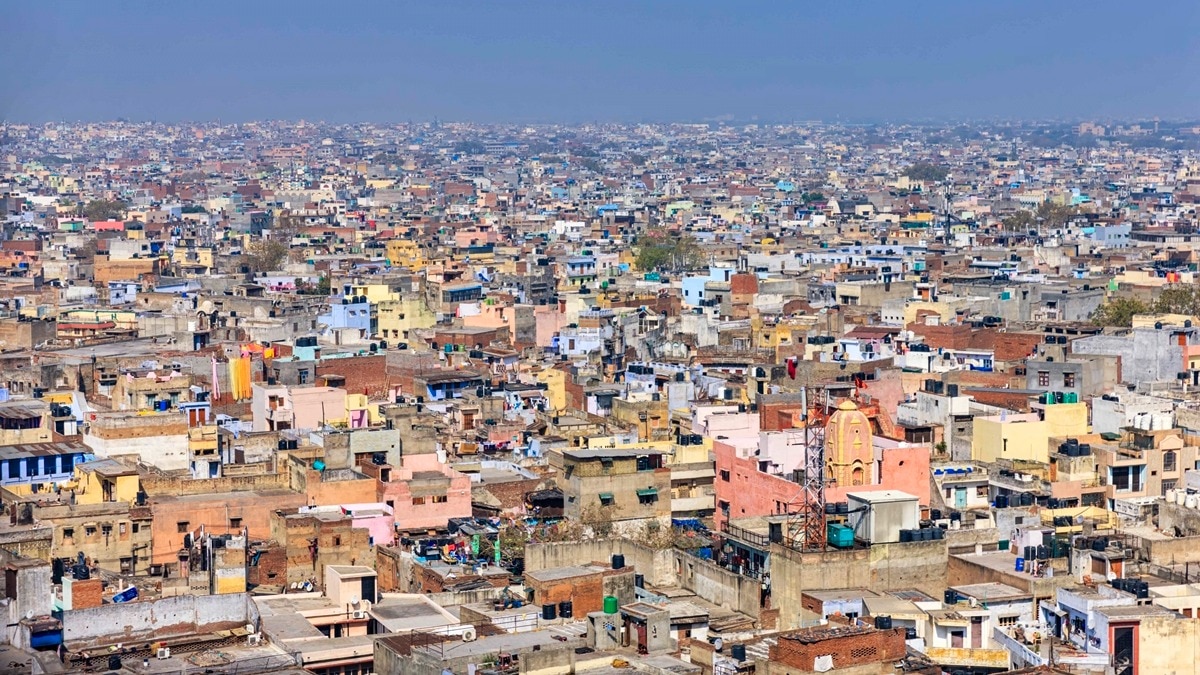
The Satya Niketan building collapse that killed seven people has renewed scrutiny of Delhi's structural safety. The incident has sharpened focus on research warning that a large share of the capital's buildings could be vulnerable in a magnitude 6.0 earthquake.A major earthquake in densely packed Delhi could trigger not just building failures but also obstruct rescue operations. (Photo: Getty)The collapse of a five-storey building in Delhi's Satya Niketan, which killed seven people and left others trapped beneath tonnes of debris, has once again exposed a frightening question hanging over the capital: how safe are Delhi's buildings when the ground begins to shake?The concern is far bigger than a single building.A recent study has estimated that nearly 38 per cent of Delhi-NCR's approximately 8.9 million buildings could be vulnerable in a magnitude 5.0 earthquake scenario along major active faults in the region.That translates to more than 33 lakh buildings potentially at risk, underlining the enormous scale of Delhi's earthquake vulnerability. Seven people were killed when a multi-storey building housing student PG accommodation collapsed in Delhi's Satya Niketan on Sunday afternoon.At least five people were rescued from the debris, while several others, including students, were feared trapped as a massive rescue operation continued.DELHI IS HIGHLY VULNERABLE TO EARTHQUAKES Delhi lies in Seismic Zone IV, the second-highest earthquake hazard category in India.The capital is vulnerable not only to earthquakes originating from local faults but also to powerful seismic events in the Himalayan region.Scientists have warned that Delhi's complex geology, proximity to active faults and enormous population make it particularly vulnerable to a major earthquake.The Satya Niketan collapse has exposed some of the very vulnerabilities that could turn an earthquake into a large-scale urban disaster. Rescue operation underway a 50-year-old five-storey building housing a boys' hostel collapsed in a congested bylane in Satya Niketan near Delhi University's south campus. (Handout via PTI Photo) Preliminary reports and investigations have raised concerns over the building's age, alleged unauthorised additions, structural alterations and construction activity. The building, located in a densely populated student hub, had reportedly been modified over the years before collapsing, triggering questions about oversight and structural safety in Delhi's rapidly changing neighbourhoods.Authorities are now considering structural audits and new safety measures for public-use buildings and PG accommodation.That concern becomes even more serious when viewed against Delhi's enormous and complicated building stock.38% OF DELHI BUILDINGS VULNERABLE TO M6.0 QUAKEA research paper by scientists from National Center for Seismology, published in Environmental Earth Sciences in 2026 estimated that Delhi-NCT could have around 8.9 million buildings and found that about 38 per cent of buildings could be vulnerable under a moderate earthquake scenario along major faults in the region.The study, conducted by Rajat Pasricha, Kapil Mohan, and O P Mishra, specifically modelled potential damage from a magnitude 6.0 earthquake scenario and highlighted high population density, old structures and complex local geology as major risk factors.This does not mean 38 per cent of Delhi's buildings would necessarily collapse. NDRF and fire department officials conduct a rescue operation after a 50-year-old five-storey building housing a boys' hostel collapsed in a congested bylane in Satya Niketan near Delhi University's south campus. (PTI Photo) Earthquake damage depends on the location, depth and characteristics of a quake, local soil conditions and the quality and design of individual buildings. But the findings underline the scale of Delhi's vulnerability.Delhi's challenge is therefore not simply predicting the next earthquake. It is preparing the city before one arrives.WHY IS DELHI SO VULNERABLE?The capital is packed with densely populated colonies, ageing buildings, narrow access roads and structures that may have undergone unregulated modifications or additions over decades.In such areas, a major earthquake could trigger not just building failures but also obstruct rescue operations.Researchers have also found that local ground conditions can significantly influence how seismic waves affect different parts of Delhi. Some studies suggest that subsurface conditions can amplify earthquake shaking, with short-period waves posing particular risks to low-rise structures.The Satya Niketan collapse may not have been caused by an earthquake. But it has offered a chilling warning of what structural weakness can do even without the ground shaking.If a magnitude 6.0 earthquake hits Delhi, the question will not only be how powerful the quake is. It will be how many of the city's buildings are truly ready to survive it.- EndsPublished By: Sibu Kumar TripathiPublished On: Sep 8, 2026 13:18 IST
Delhi building collapse: Over 30 lakh buildings vulnerable to M6.0 earthquake
Full Article
Original Source
Read the full article at Indiatoday →KhanList aggregates and links to publicly available news content. We do not host full articles from third-party sources. Always verify important information with original sources.