
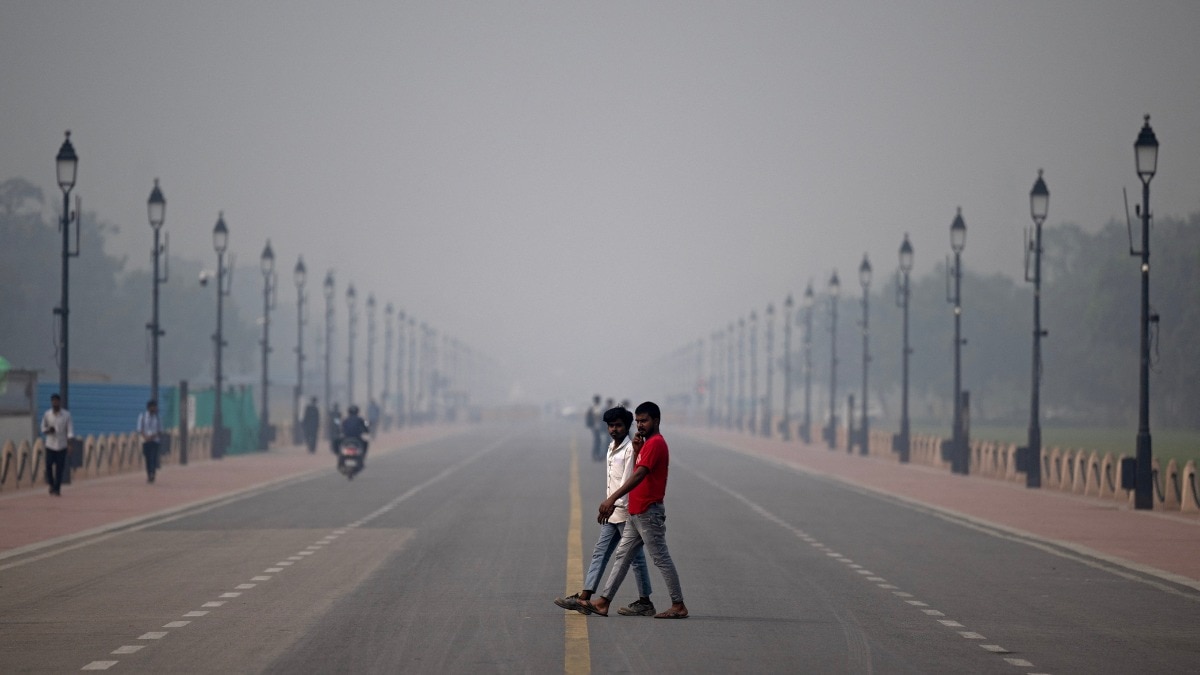
As Delhi prepares to light up for Diwali, its skies are getting darker under a thickening blanket of pollution. Delhi's overall Air Quality Index (AQI) stood at 368 on Thursday, placing the city in the 'very poor' category and edging closer to the severe threshold of 400, with at least 18 monitoring stations across the capital recording 'severe' pollution levels.Jahangirpuri was among the worst-hit areas, recording an AQI of 459, followed by Nauroji Nagar Ring Road at 416 and the area around AIIMS at 402, all in the 'severe' category, according to the Central Pollution Control Board (CPCB).Several other parts of the capital also recorded alarming pollution levels, with IIT Delhi at an AQI of 447, Punjabi Bagh at 446, Alipur at 437, Vivek Vihar at 434 and RK Puram at 416.India Gate recorded an AQI of 399, just short of the severe mark, while Anand Vihar fared relatively better at 296, in the 'poor' category. On Wednesday, Delhi's AQI had climbed to 377, firmly in the 'very poor' category, marking its highest reading since January 20, when the index stood at 378. The reading was the worst in 288 days, with as many as 22 monitoring stations across the capital recording 'severe' pollution levels.DELHI POLLUTION MAY WORSEN AS WINDS WEAKENWhile changing wind patterns could offer some temporary relief on Diwali, the day after the festival, could bring a fresh spike in pollution as wind speeds weaken and pollutants begin accumulating over the national capital. Mahesh Palawat of Skymet said moderate northwesterly winds originating from northwest Rajasthan are expected to prevail over Delhi until November 7. Light easterly winds are likely to set in from the night of November 8, potentially helping disperse some pollutants on Diwali.However, the relief could be short-lived. Palawat said the easterly winds are expected to weaken further on November 9, creating conditions for pollutants to accumulate and pushing the AQI higher.Additionally, Meteorologist Navdeep Dahiya, in a post on X, also indicated that wind speeds could increase from the current levels of less than 5 kmph to around 10-20 kmph on November 6 and 7. This could help disperse smog across Delhi, Haryana, Punjab and Uttar Pradesh.Dahiya said the improvement could bring AQI levels down by 20-30 per cent during afternoon and evening hours and 10-20 per cent at night, compared with current levels.However, wind speeds could weaken again between November 8 and 13 due to an approaching western disturbance, potentially pushing pollution levels towards their seasonal peak.The Air Quality Early Warning System has attributed the expected deterioration to unfavourable meteorological conditions. The ventilation index is likely to remain below 6,000 square metres per second, while average wind speeds are expected to stay below 10 kmph, conditions that restrict the dispersion of pollutants.Meanwhile, Manoj Kumar of the Centre for Research on Energy and Clean Air (CREA) also warned that unfavourable weather, rising farm fires and vehicular emissions could push several pollution hotspots into the 'severe' category, with AQI readings crossing 450.Kumar flagged November 9 as a particularly concerning day, warning of a further deterioration after Diwali. He also called for stricter implementation of Graded Response Action Plan (GRAP) measures to tackle the multiple sources of pollution.FACTORS CONTRIBUTING TO DELHI’S AIR POLLUTIONData from the Decision Support System (DSS) showed that stubble burning contributed 20.2 per cent to Delhi's pollution on Wednesday, followed by transport emissions at 15.5 per cent.Industries accounted for 2.9 per cent, residential sources 3.8 per cent, construction 2.2 per cent, waste burning 1.3 per cent and road dust 1.1 per cent.Pollution from neighbouring NCR districts also added to the capital's burden, with Ghaziabad contributing 7 per cent, Rohtak 3.8 per cent, Gurugram 2.7 per cent, Sonipat 2.2 per cent, Jind 1.8 per cent and Bhiwani 1.3 per cent. Other sources accounted for 28.5 per cent.- Ends
Delhi air turns toxic ahead of Diwali as 18 stations record severe AQI, AIIMS at 402
Full Article
Original Source
Read the full article at Indiatoday →KhanList aggregates and links to publicly available news content. We do not host full articles from third-party sources. Always verify important information with original sources.