
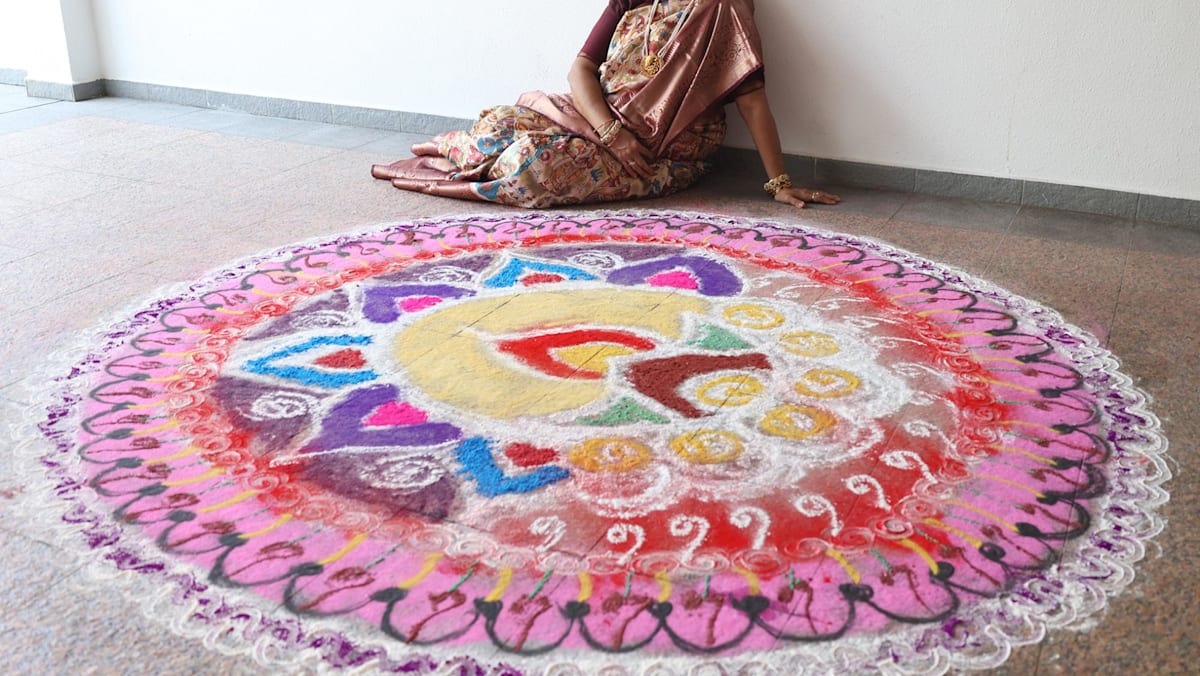
SINGAPORE: Crouched close to the ground in a heavily-draped saree, 67-year-old Vijaya Mohan held a plastic bowl of coloured powder in one hand, deftly using the other to sprinkle it onto the floor and trace intricate patterns.Her eyes remained fixed on the design taking shape before her. Every movement seemed almost instinctively to the rangoli artist, who has spent more than six decades mastering the Indian art form.Traditionally created at the entrances of homes during Deepavali and other celebrations, these colourful designs are among the first things guests see when they arrive at someone’s home during the festival of lights. Derived from the Sanskrit word rangavalli, which means rows of colours, rangoli symbolises warmth, joy, prosperity and good fortune into the household.Madam Vijaya’s concentration was momentarily broken when she spotted her 15-year-old grandson forming a pattern in the wrong direction and tried to correct his technique.But he had other ideas, suggesting an alternative that he felt would improve the design. After some back and forth, the pair eventually settled on a compromise.For Mdm Vijaya, keeping a centuries-old tradition alive also means being willing to adapt.She knew that if she wanted younger generations, including her grandson, to develop the same passion for rangoli, there had to be room for new ideas – even if that meant occasionally departing from the methods she grew up with.With young people spending much of their time on screens, she saw an opportunity to use technology to bridge the gap between tradition and a digitally savvy generation. Rangoli artist Vijaya Mohan (fourth from left) looking at her her grandson, Pranav Bakshi (left most), add the finishing touches to a rangoli they created at the porch of her house, on Oct 30, 2026. (Photo: CNA/Ooi Boon Keong) A few years ago, she collaborated with an electronics company to create an interactive rangoli experience, where participants could step on a musical pad to trigger colourful patterns projected onto the ceiling.The installation featured around 200 designs created by Mdm Vijaya, while another interactive element allowed participants to colour patterns on their phones and see their creations projected overhead.She now hopes to build on that concept by introducing students to digital rangoli designs before encouraging them to try the traditional method.“I want the younger generation to be more interested. So I will first go with their way and teach them with their own interest. And then teach them how it’s done traditionally.” Far from viewing artificial intelligence (AI) as a threat, Mdm Vijaya sees it as another way to introduce rangoli to wider audiences and encourage them to explore the craft's cultural roots.While she has yet to incorporate AI into her work, she hopes to experiment with it in the future. “I won’t say the art will die. The art will be there ... but in a different way, the latest way,” she said. Rangoli artist Vijaya Mohan working on a rangoli at the porch of her house, on Oct 30, 2026. (Photo: CNA/Ooi Boon Keong) SIGNIFICANCE OF RANGOLI Mdm Vijaya learnt rangoli from her mother in India at the age of five. As a child, she would create designs along the roadside with friends, often competing to see who could make the biggest one.Even then, she dreamt of creating the world's largest rangoli – an ambition she carried with her for decades.In 2003, she realised that dream in Singapore, creating a 2,756 sq ft rangoli — roughly the size of three badminton courts — at Whampoa Community Club, earning a Guinness World Record for the world’s largest rangoli. Working alone for seven hours, she arranged hundreds of kilograms of coloured powder into an elaborate design, enduring the physical strain of bending continuously under hot filming lights.She has also amassed more than 50 entries in the Singapore Book of Records for her creations, such as the largest rangoli made with drinking straws and the biggest art display with bananas. These achievements have drawn attention to an art form she believed deserved greater recognition.“People enter your house with different kinds of emotions, different kinds of feelings. So when they see the design and see the colours, their mood will change immediately because colours give a lot of energy. It activates the chakras of your body. And the house will have a very positive atmosphere,” she said, referring to the Sanskrit concept of energy centres in the body.“And when the gods and goddesses see the design, they bless the house with health, wealth, and prosperity.”While awareness of rangoli has grown, Mdm Vijaya believes keeping the tradition relevant in Singapore would require adapting to changing local preferences. She noticed that people wanted decorations that could last throughout Deepavali, rather than traditional powder designs that could easily be washed away. So she began creating rangoli on acrylic sheets and boards that could be framed and displayed for longer.These adaptations also made the craft more accessible to people sensitive to coloured powders or unable to bend down to work on the floor.Over the years, she has experimented with more than 40 materials, including flowers, pistachio shells, bottle caps, fruits and vegetables. Rangoli artist Vijaya Mohan holding the certificate presented to her by the Guinness World Records for the largest rangoli, at her house on Oct 30, 2026. (Photo: CNA/Ooi Boon Keong) In 2015, she founded Singa Rangoli, hoping to give the centuries-old tradition a distinctly Singaporean identity.Her passion has taken her overseas, including to Japan, China and the United States, where she has introduced rangoli to international audiences.As her projects grew more ambitious, so did her team. Today, she works with about 35 artists and volunteers, whom she affectionately calls “my daughters”.The artists work with Mdm Vijaya on both paid commissions and volunteer work. While they often contribute their time for free to community initiatives, Mdm Vijaya pays them for their work on corporate projects.Among them is 50-year-old Nalini Shastri, who described the team as a family.“(Mdm Vijaya) goes out of her way to help her members and gets emotionally attached to the team. We get very excited and proud by the work we do, and teaching others to do it is a very humbling experience.”Mdm Nalini also hopes younger generations will continue practising rangoli, even if the tools and techniques they use change.“We cannot protect it completely, but we must try,” she said. “I have a dream that in the next 20 to 40 years, we see young boys and girls still doing rangoli, but with different instruments and techniques.”KEEPING TRADITION ALIVEDespite decades of practising and promoting rangoli, Mdm Vijaya has encountered corporate clients who bargain over prices, leaving her feeling that the skill behind her work is undervalued.Some request elaborate designs measuring up to 2m by 2m, while expecting her to work within tight budgets and provide sketches beforehand. Rangoli artist Vijaya Mohan (left most) working on a rangoli with her grandson, Pranav Bakshi (right most) and members of her Singa Rangoli team, at the porch of her house, on Oct 30, 2026. (Photo: CNA/Ooi Boon Keong) Rising material costs have also forced her to raise prices, although she still tries to keep them as affordable as she can. Today, she charges corporate clients from about S$500 (US$392) to more than S$1,000. “I feel it is very sad. The company is so big and they are earning so much money,” she said. “But when it comes to paying, they say they can’t and they only have a fixed budget,” she added. “People think, ‘Ah, it’s just rangoli, it can be done.’ Try it, you do it, then you will see.”Yet, these experiences have done little to dampen her enthusiasm. “I am still doing it because I am crazy. I have a passion. I love to do it. The more I do, the more I am very calm,” she said, adding that she also conducts free workshops for children, people with disabilities and seniors.Back on the ground, Mdm Vijaya continues guiding her grandson and team members, occasionally leaving the more physically demanding sections of a design to younger helpers.At 67, she maintains a daily routine of yoga and exercise to stay fit. While determined to pass on her skills, she has no plans to throw in the towel just yet. “I am training them, so I can actually guide them, sit and do it with them,” she said. “But my ultimate wish is, until the day I die, I want to do rangoli. I cannot leave that. It is so connected to me. In my blood, veins, everything.” VALUE OF HANDMADE RANGOLI While Mdm Vijaya is among Singapore's longstanding rangoli artists, others are also finding ways to keep the craft alive. Rangoli artist Sudha Ravi (right), 55, and her daughter, Rakshita Ravi (left), 21, with the rangoli they created at the porch of their house on Nov 3, 2026. (Photo: CNA/Ooi Boon Keong) For more than a decade, 55-year-old Sudha Ravi has created intricate rangoli designs alongside her daughter, 21-year-old Rakshita Ravi.Their work combines traditional techniques with contemporary patterns and glitter accents. They also create pieces on foam boards and acrylic sheets for use as decorative displays and backdrops.Mrs Sudha noted that ready-made rangoli stickers and decals have become increasingly popular, with some people opting for them to save time and money.But for her, the value of rangoli lies in creating it by hand. She prepares her own materials, mixing rice flour, coloured powder and water before leaving the mixture to dry for four days.“If handmade rangoli disappears, we stand to lose our precious connection to our traditions, the joy of creating something with our hands and the memory shared across generations,” she said. Rangoli artist Sudha Ravi (left), 55, and her daughter, Rakshita Ravi (right), 21, working on a rangoli at the porch of their house on Nov 3, 2026. (Photo: CNA/Ooi Boon Keong) The mother-daughter pair has created commissioned works for banks, retail brands and even Singapore Airlines.They also volunteer at temples and conduct free workshops at children's homes and elderly care facilities.Their achievements include four entries in the Singapore Book of Records, including a creation featuring landmarks such as the Merlion and Marina Bay Sands.ONE GENERATION TO THE NEXTDespite the recognition, Mrs Sudha, who works as a banker, considers rangoli a passion rather than a business.“Every night before I sleep, I think: ‘What if I can’t do rangoli after 10 years?’ I’ll become very handicapped,” she said. “We stand to lose the precious connections of our traditions, and the joy of creating something with our own hands. So the younger generation should be more involved in this kind of cultural heritage.” The rangoli created by rangoli artist Sudha Ravi and her daughter, Rakshita Ravi at the porch of their house on Nov 3, 2026. (Photo: CNA/Ooi Boon Keong) Passing the craft to her daughter is therefore particularly meaningful, even if working together occasionally leads to disagreements over their designs.“I do feel the pressure because I want to match up to her expectations and thoughts,” said Ms Rakshita. “But it is doable because I've been learning from her and I've been working with her for a very long time. So I know how to amend and change (the designs).” She uses her iPad to experiment with designs, drawing inspiration from patterns online.An engineering undergraduate, she also juggles her studies and social life with rangoli commitments, which can require hours of preparation.“To put it simply, I just balance. We really plan and schedule things out,” said Ms Rakshita. The rangoli created by rangoli artist Sudha Ravi and her daughter, Rakshita Ravi at the porch of their house on Nov 3, 2026. (Photo: CNA/Ooi Boon Keong) But beyond the hours spent working together, their shared passion has also deepened their understanding of each other.For Mrs Sudha, it has been an opportunity to watch her daughter become more patient, responsible and confident.“Creating rangoli together has taught us patience, teamwork, understanding, and the importance of supporting each other's ideas,” she said.“More than creating beautiful artwork, it has given us precious memories and quality time as mother and daughter. Our shared passion has strengthened our bond, and I feel truly blessed to have my daughter as my creative partner.”
Deepavali in new colours: How Singapore’s rangoli artists are adapting an old craft
Full Article
Original Source
Read the full article at Channelnewsasia →KhanList aggregates and links to publicly available news content. We do not host full articles from third-party sources. Always verify important information with original sources.