
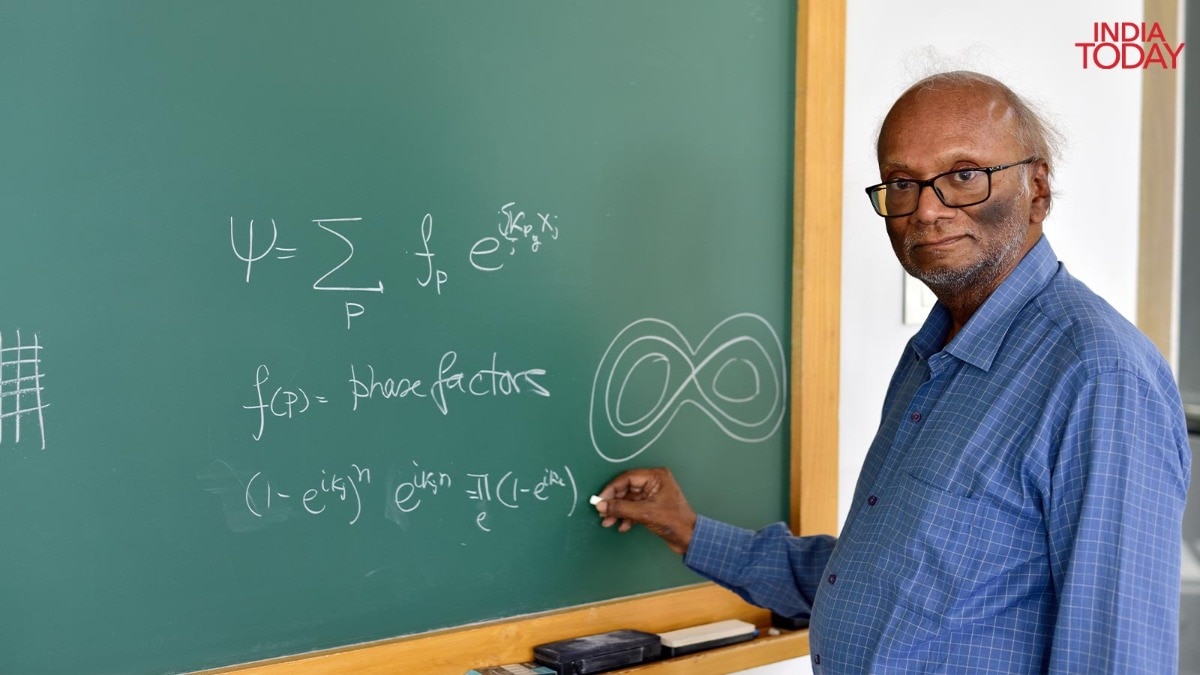
The video call had barely begun when a cat started meowing somewhere in the room. On the other end of the line was one of the most decorated physicists India has ever produced, and he did not brush the sound away or apologise for the ordinariness of his afternoon. He simply asked for a moment, rose, and walked to a quieter corner of his Bengaluru home, so the connection would hold, mentioning almost shyly that the cat lovers of the house were really his wife and daughter.Then Professor Deepak Dhar settled in and began to answer, and he answered the way a patient teacher answers a single curious student, turning each idea over slowly, in plain words, until even the hardest of them came quietly clear.Professor Dhar had every reason to be brisk, and showed not a trace of it. Days earlier, the Abdus Salam International Centre for Theoretical Physics in Trieste, Italy, had named him one of four winners of the 2026 Dirac Medal, among the most prestigious honours in all of theoretical physics, announced each year in August, on the birthday of the physicist Paul Dirac. The working life of a theorist. Professor Deepak Dhar prizes exact solutions, the rare problems that can be cracked completely on paper rather than only simulated on a computer. (Photo: Special arrangement) He shares it with Bernard Derrida, Marc Mezard and Haim Sompolinsky, honoured, in the words of the citation, "for pioneering contributions to equilibrium statistical mechanics and for carrying its ideas outward into non-equilibrium systems, optimisation, theoretical neuroscience and, in the end, artificial intelligence." It is only the second time that someone based in India has won the medal, after the string theorist Ashoke Sen.Four years earlier, Professor Dhar had already become the first Indian to receive the Boltzmann Medal, his field's highest recognition, given once every three years, sharing the 2022 award with John Hopfield, who went on to win the 2024 Nobel Prize in physics, and in 2023 came the Padma Bhushan. Yet the work at the heart of all this began with something a child sets off without thinking, on any beach in the world.THE GRAIN THAT STARTS THE AVALANCHE Professor Dhar is a statistical physicist. Statistical physics is the study of how vast numbers of small things, atoms, molecules, grains, add up to the behaviour we can actually see, the way invisible particles acting together make water freeze or a magnet lose its pull. It is the physics of the crowd rather than the single soul within it.His most famous work begins with something disarmingly simple, a pile of sand. Picture adding grains to a pile, one at a time. For a long while, nothing happens that you would notice; each grain settles where it lands. Then, without warning, a single grain sets off an avalanche, and the avalanches come in every size, from a slip of a few grains to a slide that reshapes the whole slope, with no way of knowing in advance which grain will do it.This is the picture at the centre of an idea called self-organised criticality, first proposed in 1987 by the physicist Per Bak with Chao Tang and Kurt Wiesenfeld. The name is forbidding, but it comes apart into two plain ideas.Start with the word critical. Physicists keep it for one very particular knife-edge state. Heat water towards boiling and, at one exact temperature and pressure, it reaches what is called a critical point, where liquid and vapour can no longer be told apart and the faintest disturbance ripples through the whole vessel. Cool a magnet and, at one exact temperature, it hovers between magnetised and not. Patterns formed by a growing sandpile, a model of proportionate growth in living things. Add more particles and the whole pattern simply grows larger, every part enlarging in step. (Source: Sadhu and Dhar, JSTAT, P11003, 2013) At such a point, a system has no single, typical size to its behaviour: a small nudge can produce an effect of any scale at all, from the negligible to the enormous. It is exquisitely, almost unnervingly sensitive. The catch, in every one of these familiar cases, is that you must work to get there. Someone has to set the temperature to precisely the right value and hold it steady. Nudge the dial a hair either way, and the spell breaks.Now, the second idea. Self-organised means that here, nobody is touching the dial. The sandpile, merely by being fed grain by grain, walks itself to that same knife-edge and stays there, tuning itself, with no hand on the thermostat. Build the slope too gently, and it is shallow and dull; build it too steeply and the whole face slides away at once. Left to itself, it settles at exactly the angle in between, the critical slope, where avalanches arrive in every size and the next one could be a whisper or a landslide. That is the quietly radical claim at the heart of the idea, that a great deal of the natural world arrives at this delicate, all-sizes-at-once state entirely on its own, unbidden, and simply lives there.Why should nature keep choosing that edge? Professor Dhar's answer was almost mischievous. The basic reason, he told India Today Digital, "is a kind of operating principle of laziness: don't do anything unless absolutely necessary."Beneath the joke lies a precise mechanism. Each small patch of the pile just sits, holding its grains, doing nothing, until the slope above it grows too steep and crosses a threshold, a local breaking point. Only then does it act, tipping its excess onto its neighbours. But that sudden gift can shove a neighbour past its own threshold, and that one past the next, so a single lazy little collapse can run outward as an avalanche, modest or immense. A simplified model of how cracks grow and spread in icebergs. (Source: J. Phys. A 48, 175001, 2015) Feed the pile slowly, one grain at a time, and two things are held forever in tension, the patient, even the arrival of new sand, and the fast, uneven slides that carry it away. Out of that tension, the pile finds its own balance, coming to rest everywhere just below the breaking point, the whole slope poised, permanently, a hair short of falling. That is what it means to sit at the critical edge with no one placing it there.Once you have the eye for it, you find it everywhere. There are many processes in nature where the driving mechanism is roughly constant in time, but the relaxation occurs in bursts of irregular sizes, Professor Dhar said.In earthquakes, the build-up of stress in rocks is due to continental drift that is fairly steady, but relaxation occurs in local bursts when some local stress exceeds a stability threshold. He offered a gentler cousin of the same idea, drawn from the sky. "Water leaves the oceans at a fairly even rate, yet it does not return evenly. It comes back in scattered local bursts of rain," Professor Dhar said.The push is patient and constant, the release is sudden and uneven, and the same simple logic sits beneath both.THE ORDER THAT DID NOT MATTERPhysicist Bak had the vision, but he made large claims with little rigorous proof beneath them. What Professor Dhar did, in a paper published in 1990, was make the picture exact, and he did it by noticing something that sounds almost too plain to be worth saying.In his version of the pile, when a heap topples and grains spill to their neighbours, the final resting state does not depend on the order in which you allow the topplings to happen. Take them in one sequence or in another, and you arrive at precisely the same place. That single property, that order does not matter, quietly opens a door.In the language of mathematics, the operations form what is called an abelian group, named after the idea that two actions give the same result whichever you perform first, the way three steps north and four steps east leave you in the same spot, no matter which you take first. And once a problem carries that hidden structure, it becomes possible to solve it exactly, to work out its behaviour cleanly on paper rather than only watching it unfold on a computer.This is rarer and more precious than it sounds. Some properties of this model can be solved exactly, Professor Dhar said, and that serves as a paradigm for understanding other systems where equally detailed theoretical calculations are not possible. An exact solution is a piece of bedrock, the firm ground on which less certain things can stand. From a few simple rules, an intricate, flower-like sandpile pattern emerges on its own, one of the designs at the heart of Professor Dhar's later work. (Source: Sadhu and Dhar, JSTAT, P11003, 2013) There is a deeper current here, and Professor Dhar named it himself. That business of the order not mattering ties the humble sandpile to a whole branch of physics, the study of integrable models, which are the rare and prized systems that can be cracked completely rather than merely approximated. There is a sub-field of physics called the study of integrable models, Professor Dhar told India Today Digital, where one could say that the key problem is to find a set of commuting matrices related to the model.To commute, here, is simply the formal word for that same plain idea, that the order in which you do two things makes no difference to where you end up. He had, in effect, shown some years earlier, with R Ramaswamy, that a driven, avalanching system could be solved exactly at all; the sandpile was where the method found its most beautiful home.For the physicists who have spent their lives near him, this is where the beauty lives. "What he achieved was a mathematically rigorous solution of a difficult nonlinear many-body problem, and this mathematical solution was elegant and beautiful," Professor Mustansir Barma, who has known and worked with Professor Dhar for more than four decades, told India Today Digital."Deepak's work on sandpiles was a great moment in the history not only of sandpiles, but of the field of self-organised criticality and, more broadly, of non-equilibrium systems," Professor Barma said. Professor Deepak Dhar, the first Indian to win the Boltzmann Medal and now a Dirac medallist, whose work turned a childhood plaything into deep physics. (Photo: Special arrangement) Those last words describe the great untamed frontier of the subject, systems that are constantly driven and never allowed to settle into a quiet balance, which is to say most of the living, moving world.Professor Tridib Sadhu, who took his doctorate under Professor Dhar, put his finger on what was so unusual about the method."He solved it by finding an intricate mathematical property, the abelian sandpile algebra, for which there was no earlier example," Professor Sadhu told India Today Digital.The structure was so new that mathematicians, and not only physicists, took an interest, and it grew into a small field of its own. Nor did it stay put.In the years that followed, Professor Sadhu said that Professor Dhar connected the sandpile to a surprising range of other problems that, on the surface, appear to have nothing to do with one another, so that the achievement is not a single solution, but a whole web of connections spun outward from it.A MIND THAT REFUSED TO STAY IN ONE PLACETo reduce Professor Dhar to the sandpile, though, is to miss the true shape of him. The depth of his work is matched by its breadth, Professor Barma said, but the breadth is never at the expense of depth. It is always deep and broad.The list is long. Early on, still a research student, Professor Dhar found a way to give a sensible dimension to shapes that are neither cleanly two- nor three-dimensional, the ragged, holey, self-repeating structures that ordinary geometry cannot easily name. We are used to whole-number dimensions, a line being one, a sheet of paper two, a room three. But a lacework of holes within holes sits awkwardly between them.His idea, which he first set out in 1977 under the name effective dimensionality, was to ask how heat, or a wandering particle, spreads through such a shape, and to read its dimension off the way the heat flows. The term spectral dimension, by which it is known today, was popularised a few years later by other physicists. A sandpile pattern built from 3,760 grains. Simple local rules, repeated, produce a self-similar design that echoes itself at smaller and smaller scales. (Source: Sadhu and Dhar, JSTAT, P11003, 2013) Years later, in the late 1980s, he became among the first to calculate a precise number, what physicists call a dynamical exponent, that governs how quickly a growing surface roughens over time, carrying a mathematical tool from quantum physics into the world of random, classical processes, a crossing between fields that, Professor Sadhu said, inspired a great deal of the work that came after.There is also the problem he says he would most love to see solved before he goes, and it hides in something as ordinary as a windowpane. Glass looks solid and settled, as though it has come at last to rest. It has not.Glasses are systems which look like they are in equilibrium, but there are a large number of metastable states, Professor Dhar explained, a vast crowd of half-settled arrangements the material can be caught in, each one stable enough to hold for now but not the true resting place.Given enough time, glass would arrange itself into an orderly crystal, the way quartz has. But that tidy ending is, in practice, out of reach. If glasses were allowed to sample all possible states they would become quartz, he said, but they are stuck in their places, and reaching a quartz-like structure is just not feasible within millions of years. The glass in your window is, in a quiet sense, forever on its way to somewhere it will never arrive. Chase-escape percolation, a snapshot of predators, in blue, and prey, in red. The prey spread by reproducing, while the predators can advance only after they have caught a prey. (Source: Physica A 577, 126072, 2021) Ask him whether all of this makes the world unpredictable, and he gently takes apart the old dream that to foresee anything, you must first know everything. In even a small piece of matter, there are more particles than we could ever track, and simply to write down the position and speed of each one, he said, would take so long that by the time you finished, everything would already have moved on. Prediction, in other words, was never meant to be a matter of chasing every grain.It is the art of finding the few things that matter and letting the rest wash out. "Order and randomness are not mutually exclusive concepts," Professor Dhar told India Today Digital. There is a general principle called the law of large numbers, the same quiet rule that lets an insurer know almost exactly how many claims will come next year while knowing nothing about any one of us.If a system is made of a large number of random components, its overall behaviour can be predicted quite well. The single grain is unknowable. The pile is not.THE FLOWER THAT DREW ITSELFIf one moment from our conversation stays with me, it is this one.Some of Professor Dhar's later work grew, quite literally, into pictures. Feed grains steadily into a system that obeys only a handful of simple local rules, close in spirit to the old computer pastime called the Game of Life, in which cells on a grid switch on and off according to what their neighbours are doing, and the material arranges itself into intricate, delicate, strangely reproducible patterns.Professor Sadhu, who worked on exactly this with him, described the wonder of it plainly."You feed particles at the centre, and just by following very simple rules, a beautiful, complex pattern emerges," Professor Sadhu told India Today Digital, "and it captures, in essence, what you would expect to see in biological growth." Another growing sandpile pattern. Feed in more particles and the design grows bigger while keeping its shape, the same proportionate growth seen in nature. (Source: Sadhu and Dhar, JSTAT, P11003, 2013) That last phrase is the whole point. Professor Dhar was drawn to these patterns because they seemed to whisper at one of biology's deepest riddles, how a single fertilised egg, every cell carrying the very same instructions, reliably builds something as complex and as sturdy as a living creature.His instinct, Professor Sadhu recalled, was never to drown a problem in detail. "When you model nature, you should find the simplest scenario that captures the physics," Professor Sadhu said, repeating a favourite line of his teacher's, that 'you have to keep the baby and throw out the bathwater.' Backbone of an Eden cluster, a typical configuration of a branching polymer molecule known as an Eden tree. (Source: Manna and Dhar, Phys. Rev. E 54, R3063, 1996) And then, once, the model did something no one had asked of it. They had written a set of simple rules meant to grow a shape a little like a flower. What came back was more than what they had put in."We were trying to make a flower with simple rules," Professor Dhar said, and it produced the stem and the corolla, the ring of petals, by itself. "It was a great surprise, very unexpected, and we still don't understand how it happened."A pattern that had drawn parts of itself no one had written into its instructions. Even now, decades on, the astonishment had not left his voice.THE PROFESSOR WHO EXPLAINSSpend time with the people who came up around Professor Dhar, and the portrait that forms has little to do with medals.There is the way his mind moves. He would make these leaps of imagination, Professor Barma said. "We would be discussing something, and he would say, look, it must be like this, a leap of logic which I was not able to follow, and it would take me a couple of days to understand. Usually he was right."Professor Sadhu, watching from a younger generation, reached for the same word. "Professor Dhar could see connections and patterns that are extremely rare to notice," Professor Sadhu said, "really at the level of what we call genius." Professor Deepak Dhar at the blackboard. Behind his most famous work lies a hidden mathematical structure, the property that a sandpile settles into the same final state no matter the order in which it topples. (Photo: Special arrangement) His students speak of his honesty before they speak of his physics. What was very inspiring was the honesty in the work, Professor Sadhu said. "He looked at a problem honestly and in depth, and taught us to do science in an ethical way."Even the beginning of the story is a human one. Per Bak visited TIFR and gave a seminar, Professor Barma remembered. "He more or less said he could explain all of nature through this, and all of us, including Deepak, thought the claims were strong, but the kernel was very interesting, and that is what triggered Deepak's interest," Professor Barma said. A grand, bold claim, quietly turned by a careful mind into something true.For Professor Barma, the award belongs to more than one man. "This is a great recognition not only of Deepak but of statistical physics in India, because the work was done here," he said. "We feel proud as a community. Nor should Professor Dhar's influence be counted only in papers. He is a great teacher, he lectures in schools and colleges, and that is a contribution of its own."WHY ANY OF IT CAN BE UNDERSTOODNear the end, I asked what all these years had actually felt like, away from the citations and the medals. Professor Dhar did not wave the question away."You feel happy that you can find something," Professor Dhar said simply, and that can happen more than once. His advice to the young was cut from the same cloth. Do it, he seemed to say, for the joy of it, and not for the prize at the end, because the prize reaches only a few. "Fame happens to only a small fraction," he told India Today Digital, but the satisfaction of being part of a noble profession is available to many more.There was one last thing I could not help asking. The universe might have been hopelessly, endlessly complicated, and yet the same few simple ideas keep surfacing across systems that have nothing to do with one another. Why should it be understandable to us at all? That, he agreed, is a great mystery that nobody really understands. A worm shares this universe with us and grasps almost none of it. That we can understand so much more than mere survival requires, he said, is a genuine surprise, and rather a wonderful one. Professor Dhar has spent more than half a century finding simple truths inside complicated things. (Photo: Special arrangement) Perhaps that is the quiet lesson of a life spent among sandpiles and glass and self-drawing flowers. Beneath the noise of a great many things behaving unpredictably, there is very often a hidden order, waiting only for someone patient enough, and humble enough, to sit with it until it shows itself.Somewhere in Bengaluru the cat was still calling, and the line held, and a man who has spent more than half a century finding simple truths inside complicated things went on explaining, unhurried and generous, as though there were nowhere in the world he would rather be.- EndsPublished By: Radifah KabirPublished On: Sep 3, 2026 11:00 IST
Deepak Dhar wins 2026 Dirac Medal: How the physicist found hidden order inside chaos
Full Article
Original Source
Read the full article at Indiatoday →KhanList aggregates and links to publicly available news content. We do not host full articles from third-party sources. Always verify important information with original sources.