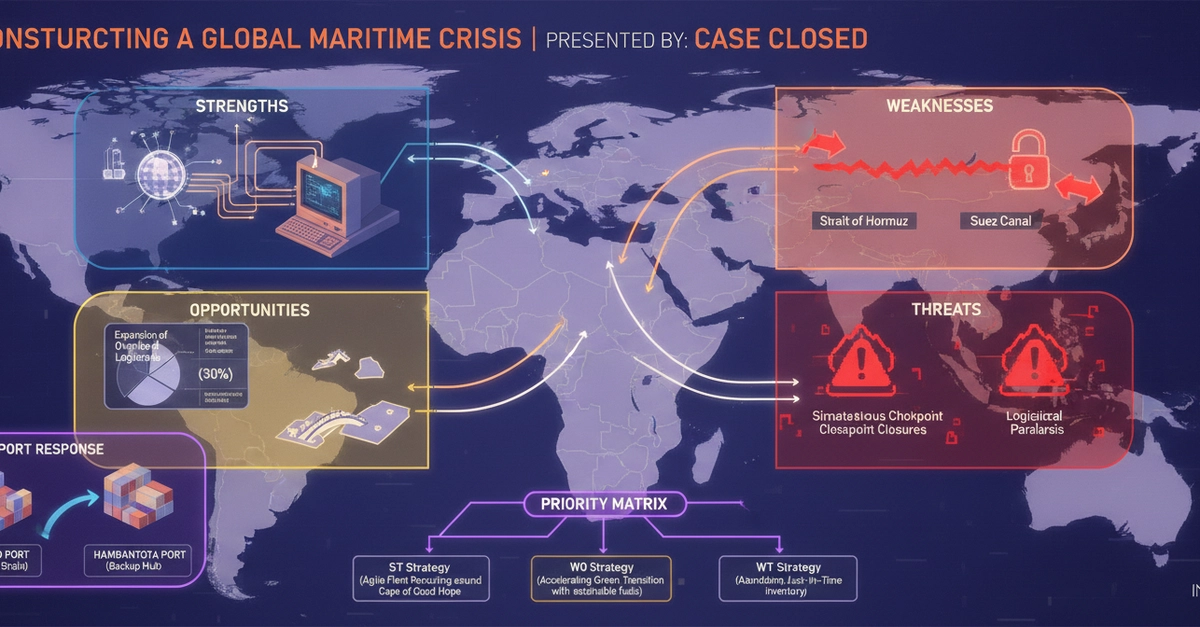
Geopolitical volatility isn't just a headline—it is a brutal stress test for global supply chains. When critical maritime chokepoints face sudden closure, the cascading disruptions hit transshipment hubs with unforgiving speed. As part of our submission for the INFINITY 7.0 Inter-University Case Study Competition, our team, Case Closed, dived deep into a high-stakes scenario: The 2026 Global Maritime Disruption & Sri Lankan Port Capacity Crisis. Here is a look at the data, the bottlenecks we uncovered, and the architectural recommendations we proposed to future-proof regional port infrastructure. 1. The Anatomy of the Disruption The baseline architecture of global shipping relies heavily on the hub-and-spoke model. However, the fatal flaw of this model is its vulnerability to single geographic chokepoints. When the Strait of Hormuz (which handles roughly 20% of the world's oil and LNG) and the Red Sea/Suez Canal route face severe restrictions or closures, the maritime network experiences immediate systemic shock: Massive Physical Rerouting: Ocean carriers are forced to divert around the Cape of Good Hope, adding 10 to 15 days of transit time per voyage. Asset Stranding: These extended transit times trap critical equipment (vessels and empty shipping containers) in transit, triggering an acute global container shortage. The Transshipment Influx: Rerouted cargo suddenly shifts toward alternative hubs like Colombo, Singapore, and Jebel Ali, pushing their operational capacities to the absolute limit. 2. The Bottleneck: Colombo's Capacity Crisis When Middle East chokepoints restricted traffic, the Port of Colombo experienced a massive, sudden demand surge, seeing a 20% volume growth within a tight February-to-April window, hitting over 761,000 TEUs in a single month. This sudden volume spike exposed critical infrastructure vulnerabilities: [Global Disruptions] ──> [Sudden Rerouting to Colombo] │ ▼ [Transshipment Exceeds 80% of Ops] │ ▼ [Extreme Yard Overcrowding] │ ▼ [2-3 Day Berthing Delays for ULCVs] │ ▼ [Carriers Begin Bypassing the Port] Enter fullscreen mode Exit fullscreen mode With transshipment exceeding 80% of total operations, the physical yard space reached maximum inelasticity. The resulting 2-to-3-day berthing delays meant global carriers began completely bypassing the port, risking Colombo's long-term competitive position. 3. The Analytical Framework: Prioritized SWOT Instead of relying on a standard, text-heavy SWOT matrix, we utilized a Prioritized SWOT and Matrix Strategy to weigh impacts mathematically and determine which moves yielded the highest strategic ROI. Matrix Quad Strategy Focus Implementation Framework SO Strategy Expand Land Bridges Leverage global fleet adaptability to scale multi-modal overland routes (e.g., the Saudi Landbridge) to bypass maritime blockades. WO Strategy Accelerate Green Transition Shift toward sustainable maritime fuels and dual-fuel vessels to buffer against volatile fossil fuel pricing and emergency bunker surcharges. ST Strategy Agile Fleet Rerouting Permanently optimize Cape of Good Hope alternative routing paths to eliminate total logistical paralysis during multi-chokepoint closures. WT Strategy Abandon Just-In-Time (JIT) Move aggressively away from lean inventory models, increasing safety stocks and diversifying supply chains away from high-risk zones. 4. Engineering a Resilient Logistics Ecosystem To solve physical bottlenecks, a port cannot rely solely on expanding concrete footprint; it must optimize its digital and logical infrastructure. We proposed six core architecture upgrades for the regional maritime ecosystem: ⚡ 1. Fully Digital "Single Window" Customs Eliminating paper silos by creating a unified API-driven clearing platform. Digitizing documentation removes friction before the cargo even hits the yard. 🤖 2. Scale Terminal Automation & AI Scheduling Implementing AI-driven dynamic scheduling to handle inter-terminal transfers. Automated crane deployments and predictive yard slotting allow the port to maximize its existing footprint even under heavy stress. 🌐 3. Build a Multi-Port Ecosystem Actively diverting excess container and RoRo (Roll-on/Roll-off) traffic south to Hambantota Port. Treating national ports not as isolated competitors, but as a load-balanced network, allows the region to absorb massive volume spikes without failing entirely. Conclusion: Moving Past "Just-In-Time" The core takeaway from this case study is clear: Lean inventory systems are incredibly fragile. In an era of increasing geopolitical and climate instability, supply chain architecture must pivot from Just-In-Time efficiency to Just-In-Case resilience. By embracing terminal automation, regional port collaboration, and data transparency, logistics hubs can convert a global crisis into a massive operational opportunity. We are proud to share that this framework secured our team a spot in the upcoming round of **INFINITY 7.0! If you're working in supply chain tech, logistics optimization, or AI-driven scheduling, I’d love to connect in the comments and hear how you approach system resilience. 🔗 View our full presentation slide deck here
Deconstructing the 2026 Maritime Chokepoint Crisis With a Prioritized SWOT Framework
Full Article
📰 Original Source
Read full article at Dev →KhanList aggregates and links to publicly available news content. We do not host full articles from third-party sources. Always verify important information with original sources.