
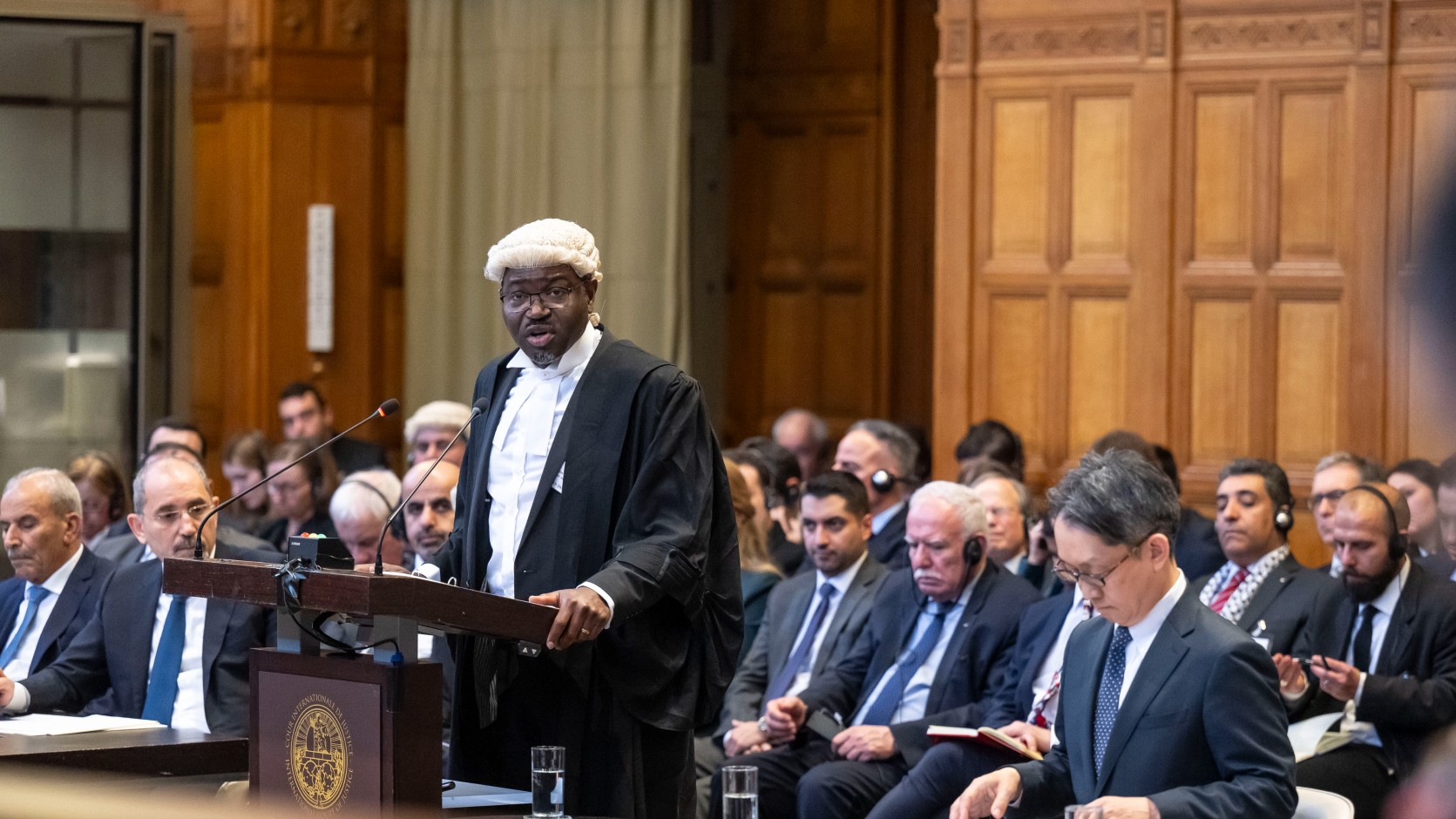
British international lawyer Dapo Akande has been elected to the International Court of Justice (ICJ), restoring a British presence on the United Nations’ highest court after almost a decade. Akande was elected on Tuesday alongside France’s Francois Alabrune, Singapore’s Rena Lee, Jordan’s Mahmoud Daifallah Hmoud and Kenya’s Phoebe Okowa. Nine candidates contested the five seats. Their nine-year terms begin on 6 February 2027. Hmoud and Okowa, already serving after elections to fill vacancies, secured full terms. As a lawyer and scholar, Akande has helped advance arguments on proving genocide and the illegality of annexing Palestinian territory, and he is expected to sit on the bench as the court decides on the ongoing case brought by South Africa accusing Israel of violating the Genocide Convention in Gaza. Akande, Oxford’s Chichele Professor of Public International Law and a member of the UN International Law Commission, will become the first British judge on the court since 2018. New MEE newsletter: Jerusalem Dispatch Sign up to get the latest insights and analysis on Israel-Palestine, alongside Turkey Unpacked and other MEE newsletters The British Foreign Secretary Ed Miliband welcomed the election as "a victory for the UK’s commitment to the rule of law and our ability to stand up for our values on the world stage". Akande describes himself as a “generalist public international lawyer”, whose work spans armed conflict, international criminal law, human rights, international organisations and the settlement of disputes between states. “Dapo is a careful, nuanced jurist and a precise and effective communicator,” said Janina Dill, Akande’s co-director of the Oxford Institute for Ethics, Law, and Armed Conflict. “As a colleague I have most admired his even keel and wisdom. I am glad the court can benefit from these qualities at this moment in time," she told Middle East Eye after Akande's election. Candidates needed an absolute majority in separate votes in the General Assembly and Security Council, 97 votes and eight votes respectively. The council’s permanent members have no veto in judicial elections. The court’s judges serve independently of their governments. Based in The Hague, the ICJ settles disputes between states and issues advisory opinions to authorised UN bodies. Unlike the International Criminal Court (ICC), it determines state responsibility rather than prosecuting individuals. Its judgments in disputes are binding on the parties, although enforcement can depend on action by states and a politically divided Security Council. Previous ICJ interventions Akande’s election follows comes as the ICJ prepares to issue a judgment in The Gambia’s genocide case against Myanmar over atrocities against the predominantly Muslim Rohingya minority. Akande served as counsel for Britain in this case as part of the UK’s legal team alongside Alison Macdonald KC and Naomi Hart. The Rohingya case that could redefine the law on genocide Read More » In this case, Britain intervened jointly with Canada, Denmark, France, Germany and the Netherlands to present arguments about interpreting the Genocide Convention. Their submissions warned against making proof of genocidal intent so demanding that findings become practically unattainable. They argued that genocidal intent, the most difficult element to prove, must be assessed using the evidence as a whole. When inferred from a pattern of conduct, it must be the only reasonable explanation, rather than the only imaginable explanation. The states also argued that genocide encompasses acts beyond killing, including sexual violence and the imposition of destructive living conditions. Children’s particular vulnerabilities must inform assessments of serious harm, deprivation and displacement, they added. The Myanmar case, in which judgment is scheduled for 19 November, has become a focus of US attacks on the court. Last month, US ambassador to the UN Mike Waltz accused ad hoc judge Navi Pillay of seeking to lower the threshold for proving genocide so it could be used against American and allied soldiers. 'If elected, I will decide cases on the basis of a faithful and impartial application of the law' - Dapo Akande, newly elected ICJ judge Waltz warned that Washington would be “watching the ICJ’s handling of these proceedings very closely”, invoking US sanctions against the ICC. Akande has also addressed the ICJ on Israel’s occupation of Palestinian territory, appearing for Japan during the court’s advisory opinion proceedings on the illegality of Israel’s occupation. Akande argued that a state could not get around the ban on taking land by force simply by never formally announcing it had annexed it. He told the judges that moving populations, seizing land, evicting residents, building long-term infrastructure and exploiting natural resources such as water could amount to annexation in practice, especially when officials described those changes as permanent. He also argued that a state could not keep territory it had seized by claiming self-defence. Self-defence allowed a country to protect land it already had, not to gain more, he said, adding: “Permanent annexation can never be a proportionate response to an armed attack.” Criticism of UK positions Despite British support for his candidacy, Akande has previously challenged London’s positions before the court. Representing Zambia in the 2018 Chagos advisory proceedings before the ICJ, he rebutted Britain’s argument that the court should refrain from addressing a bilateral sovereignty dispute without British consent. In the 2018 hearings on the Chagos Islands, which Britain separated from Mauritius before the Indian Ocean island became independent, he appeared for Zambia to rebut the UK's arguments. Britain had argued that the matter was a territorial dispute between it and Mauritius, and that the court should not rule on it without British consent. Akande rejected that, telling the judges: “This case is about the international law obligations regarding decolonisation.” Who is Phoebe Okowa? The newly elected ICJ judge and her opinions on Israel-Palestine Read More » He argued that the right of colonised peoples to decide their own future, known under international law as self-determination, concerned all countries, not just the two involved. He also challenged Britain’s argument that this right was not yet part of international law in 1965, when Chagos was separated from Mauritius. To make the point, he cited Britain’s own statements from that period accepting that all peoples had that right. His criticism of British legal arguments has also extended to military action in the Middle East. In an April 2018 opinion commissioned by then Labour deputy leader Tom Watson, Akande rejected the government’s justification for air strikes against Syria's Assad government. Akande described its position as “significantly flawed”, concluding: “The military action taken was not in accordance with the United Nations Charter and international law.” He argued that international law did not recognise the unilateral right of humanitarian intervention claimed by Britain. Even if such a right existed, he said, the strikes did not appear to meet the government’s own conditions. Akande has also argued against the UK's participation in the 2003 invasion of Iraq. In 2010, he led a group of academics in a submission to the Iraq Inquiry challenging the legal case for the invasion. The government had argued that the Security Council’s 1990 authorisation to use force against Iraq, after it invaded Kuwait, could be revived more than a decade later because Iraq had breached the terms of the 1991 ceasefire. The submission called this “an untenable interpretation of the UN Charter”. It also argued that even if the argument held, the UN Security Council’s resolution of November 2002 did not meet its conditions, so the attorney general, Lord Goldsmith, had been wrong to conclude the invasion was lawful. In his statement as an ICJ candidate, Akande emphasised legal rigour, cooperation across legal traditions and judicial independence. "If elected, I will decide cases on the basis of a faithful and impartial application of the law having listened carefully to the arguments of participants in the proceedings," he wrote.
Dapo Akande elected as ICJ judge, restoring British presence inside highest UN court
Full Article
Original Source
Read the full article at Middleeasteye →KhanList aggregates and links to publicly available news content. We do not host full articles from third-party sources. Always verify important information with original sources.