
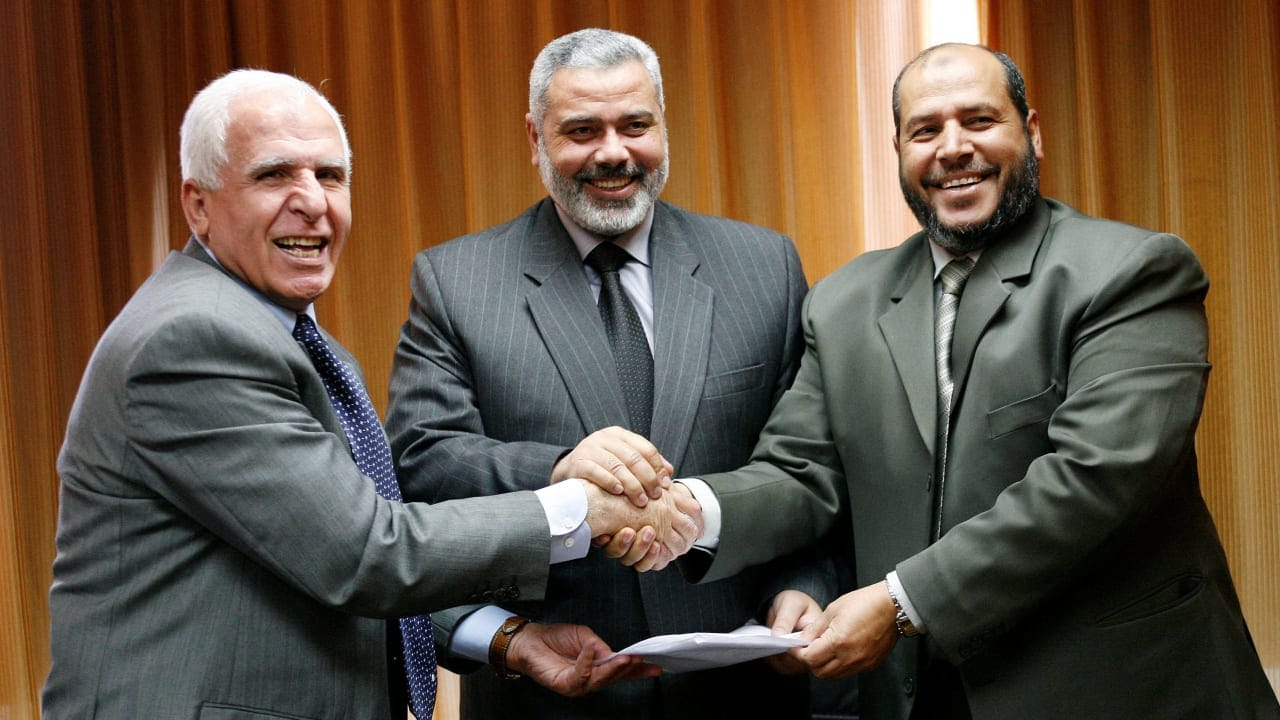
AUGUST 30, 2026 14:51Updated: AUGUST 30, 2026 15:20Fatah’s Democratic Reform (FDR) faction is seeking to unify Hamas, Fatah, and all Palestinian factions, hoping that doing so will allow the groups to focus on building a Palestinian state rather than becoming consumed by internal conflict, according to a copy of the group’s vision that Mohammed Dahlan shared with other members of his faction, as seen by The Jerusalem Post.The document lays out a vision for overcoming the longstanding divisions between Palestinian factions, with a particular focus on ending the internal conflict that has defined Palestinian politics for years.“We may disagree with Hamas, Palestinian Islamic Jihad, or the leadership of the Palestinian Authority, and there may be deep disagreements between us. But disagreement with someone does not give anyone the right to eliminate the other,” Dahlan wrote in a letter translated by the Post. “We want our entire relationship to move from an attempt to weaken one another to cooperation in building the homeland and protecting the national project..."The pluralist ethos in the vision is notable given Dahlan’s troubled relationships with both Hamas and Fatah. A former Fatah official and member of the Palestinian Legislative Council, he has lived in exile in the United Arab Emirates since 2011 after the Palestinian Authority accused him of multiple serious offenses, including involvement in a plot to poison PLO chairman Yasser Arafat, an attempted coup against the Palestinian leadership, and financial corruption. Dahlan has denied the accusations.From confrontation to aiming for a bridgeDahlan’s relationship with Hamas was also once defined by open confrontation. In 2006, he criticized the group over what he described as corruption and was later allegedly involved in a US-backed effort to oust the Islamist group from the Gaza Strip. More recently, however, Dahlan has taken a different approach, holding meetings with Hamas representatives in Cairo as he seeks to position his faction as a potential bridge between the rival Palestinian movements.Palestinian Authority head Mahmoud Abbas is flanked by then-security adviser Mohammed Dahlan (right) and then-prime minister Ismail Haniyeh, at a meeting in Gaza, in April 2007. (credit: MOHAMMED SALEM/REUTERS)Addressing the meetings, Dimitri Diliani, a former member of the Revolutionary Council and spokesperson for the Fatah breakaway faction, told the Post that “Mr. Dahlan meets with all Palestinian people, and us as a faction, because we are a faction made up of institutions.”Explaining that the FDR is in daily contact with all Palestinian factions, Diliani played down the significance of the meetings as a regular occurrence, adding only that Dahlan’s “presence usually solves issues because it presents the importance of it.”“His long-term relationships with many of the faction leaders also smooth things out,” Diliani continued, adding that Dahlan’s “credibility” had already surpassed PA President Mahmoud Abbas thanks to his humanitarian efforts during the “genocide” in Gaza.Dahlan's role in the UAEAs an adviser to the UAE leadership, Dahlan has helped facilitate tens of millions of dollars in aid to the Gaza Strip, which has been distributed to both Hamas’s Islamist support base and secular families alike, earning him some popularity in the territory. That has added weight to his message of Palestinian pluralism.Some of the main points set out in the vision include guaranteeing the rights, freedoms and dignity of all Palestinians, ensuring that the people are partners in decision-making processes, and applying accountability and transparency to all.Dahlan’s vision also calls for an end to the cycle of armed violence, tit-for-tat policies and power struggles that have plagued Palestinian leadership.“The internal fighting was a national crime,” he wrote. “...Weapons do not determine who governs, and force does not confer legitimacy.”Since the PA was violently ousted from Gaza by Hamas in 2007, sporadic outbreaks of violence have occurred between Palestinian factions. In December 2024, Palestinian Islamic Jihad and Hamas violently resisted PA crackdowns on terrorist groups in Jenin, with Hamas even calling for the mobilization of all forces in the West Bank against PA security forces.“We do not call for the abolition of the factions, their identity, or their history, and every power has the right to preserve its program and compete with the people. But what must change is its relationship with the state. A faction can win power, but it may not become the state,” Dahlan insisted. “The state must become a neutral space for everyone, with no faction controlling the judiciary, security, administration, or public employment.”Though some may interpret Dahlan’s comments as critical of the actions of Hamas’s past decisions, Diliani made clear that the PA’s corruption and financial failings had also significantly harmed Palestinian society and that a major reform was needed to repair the economic damage.The vision does not specify what role, if any, Hamas would be allowed to play in the political system, particularly as the group has expressed an intention to run in the upcoming PLC elections in November. Diliani, however, said Hamas’s ideology would be represented even if the organization itself did not participate as a political party.He argued that, to address the limitations in the current system, there should be a temporary mandate granted by the people through elections to transfer authority for institutions from one group to another according to the desire of the majority, “not the redistribution of state institutions as quotas between factions.”Insisting that the use of weapons in internal conflicts must be prohibited and political coups cannot be repeated, Dahlan argued against a system in which a sole authority could unilaterally decide on major issues such as declaring war or making peace agreements.While Dahlan’s vision calls for an end to factional violence and the use of weapons to settle internal political disputes, Diliani insisted that the FDR did not seek to eliminate Palestinian resistance against Israel.“So as long as there is a military occupation, there will always be Hamas. There will always be Fatah, Islamic Jihad, PFLP, DFLP, and you can change the names, but as long as there is one Palestinian out there, there will be a faction under whatever name it is, but it will be to resist the military occupation,” Diliani asserted. “...Only extremely stupid people think that at one point this will be something that we will give up. And from the things that we're seeing, those people are deteriorating in power, in force, in position, and I think the world stage is very clear on that.”Diliani said that all forms of resistance were legal and legitimate under international law when acting against a military occupation, though he said he personally found all forms of violence unethical, claiming that it would only lead to a “failed society” like the “morally failed” Israel, and argued that peace was a necessary development.“Our faction looks at the State of Israel as a state that we need to make peace with in accordance with international law. We don't characterize its nature. It's none of our business, and we demand, as victims of that state, for that state also mind its own business in terms of our composition and views, and look at us as a people that you need to make peace with in order to continue your survival in this Middle East,” he concluded.Follow us on Google
Dahlan’s Fatah Democratic Reform faction seeks to end Palestinian infighting - exclusive
Full Article
Original Source
Read the full article at Jpost →KhanList aggregates and links to publicly available news content. We do not host full articles from third-party sources. Always verify important information with original sources.