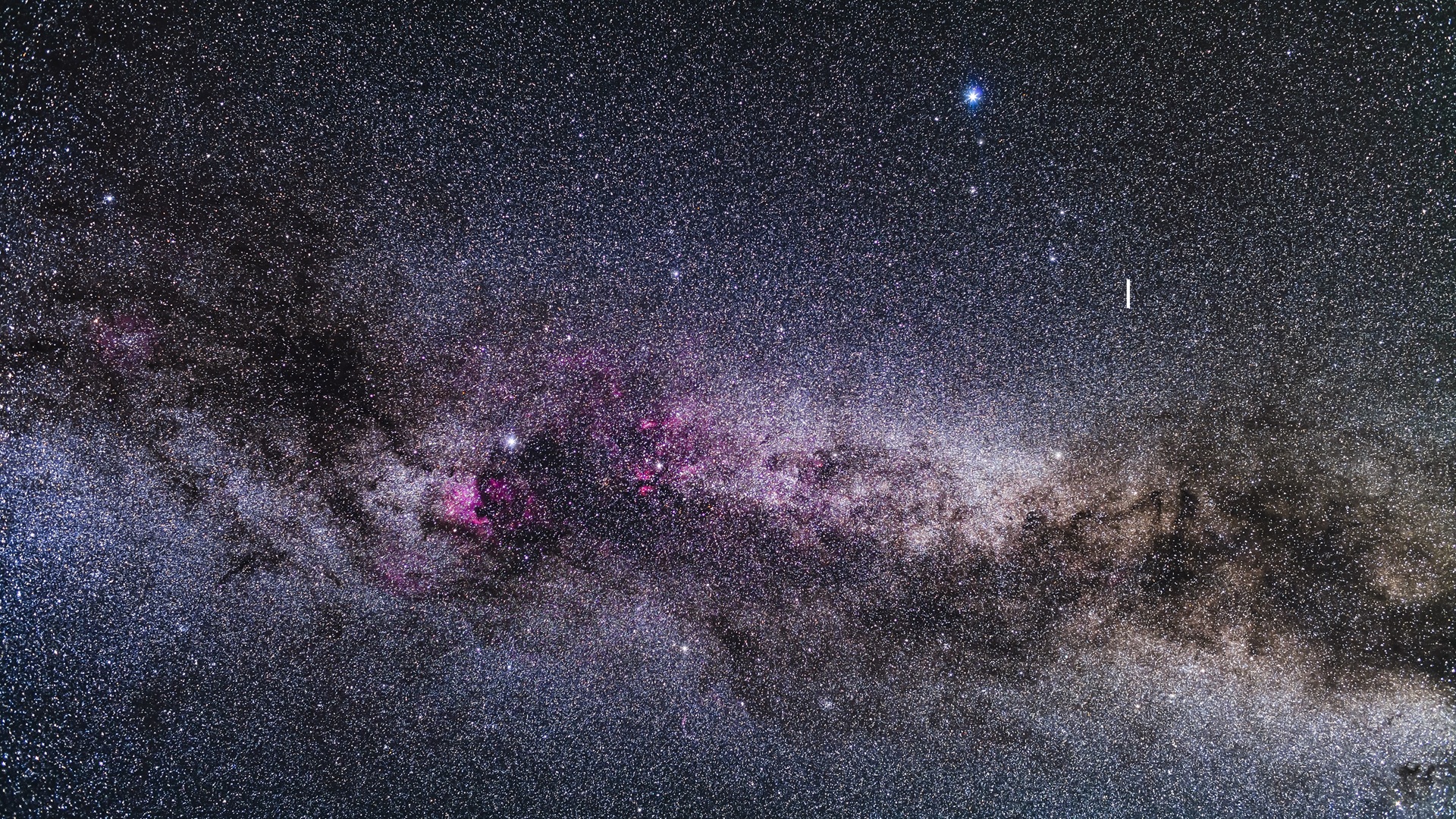
Astronomers have identified the highest-energy gamma-ray source known so far, with observations showing that the peculiar binary system Cygnus X-3 can accelerate particles to at least 30 PeV. The discovery came from China’s Large High Altitude Air Shower Observatory (LHAASO), which detected ultra-high-energy gamma rays from Cygnus X-3 during periods of increased activity. The finding provides direct evidence that the system is an extreme cosmic-ray accelerator. Cygnus X-3 sits in the constellation Cygnus and consists of two compact objects in a close binary system. Its high-energy behavior has long made it an important target for astronomers, but the latest observations reveal an accelerator operating at energies far beyond what current theories predict for sources within the Milky Way. The LHAASO observations also showed something unusual: the source’s ultra-high-energy gamma-ray activity changed in step with emissions detected at much lower GeV energies. The two signals were observed together during flaring periods, while LHAASO detected no corresponding signal when the GeV emission became quiet. Cosmic accelerator reveals itself The signals followed a 4.8-hour cycle, matching the orbital period of the binary system. This timing gave researchers a way to connect the gamma rays to the system itself rather than treating them as unrelated high-energy events. By using the periodic variation to pinpoint the source, researchers localized the accelerator to a region roughly three times the size of the Sun. That is an exceptionally precise measurement for an ultra-high-energy particle accelerator, narrowing down where some of the most energetic particles in our galaxy are being produced. The energy involved is particularly significant. A particle reaching 30 PeV carries vastly more energy than particles produced by today’s most powerful human-made accelerators. The observation therefore challenges existing ideas about how Galactic objects accelerate cosmic rays to extreme energies. The study also establishes Cygnus X-3 as the first ultra-high-energy gamma-ray source known to show temporal variability. That gives astronomers a new way to investigate what happens around compact objects and how their powerful environments generate extreme particles. A new window on extremes Researchers can now use changes in the gamma-ray signal to study the physics of the system over time. Because Cygnus X-3 is a binary, its companion star and compact object continuously interact, creating an environment where energetic particles can collide with intense radiation. The proposed picture involves protons emerging from the base of a jet and interacting with ultraviolet photons from the companion star. These interactions can produce high-energy photons and potentially neutrinos, creating signals that could be studied across different forms of astronomical observation. That makes Cygnus X-3 a potentially important target for multi-messenger astronomy, in which scientists combine observations from particles and electromagnetic radiation to understand extreme cosmic events. The result also expands the search for powerful cosmic-ray accelerators. If objects like Cygnus X-3 can push particles to tens of PeV, they may help explain how some of the highest-energy cosmic rays found in the Milky Way are produced. For LHAASO, the observation demonstrates the value of monitoring the sky at extreme energies while tracking how those signals change over time. The combination of energy measurements and precise timing allowed researchers to isolate the accelerator far more effectively than a static observation could. The study was published in National Science Review. Get the latest in engineering, tech, space & science - delivered daily to your inbox.With over a decade-long career in journalism, Neetika Walter has worked with The Economic Times, ANI, and Hindustan Times, covering politics, business, technology, and the clean energy sector. Passionate about contemporary culture, books, poetry, and storytelling, she brings depth and insight to her writing. When she isn’t chasing stories, she’s likely lost in a book or enjoying the company of her dogs.
Cygnus X-3 becomes the highest-energy gamma-ray source known anywhere in space
Full Article
Original Source
Read the full article at Interestingengineering →KhanList aggregates and links to publicly available news content. We do not host full articles from third-party sources. Always verify important information with original sources.