
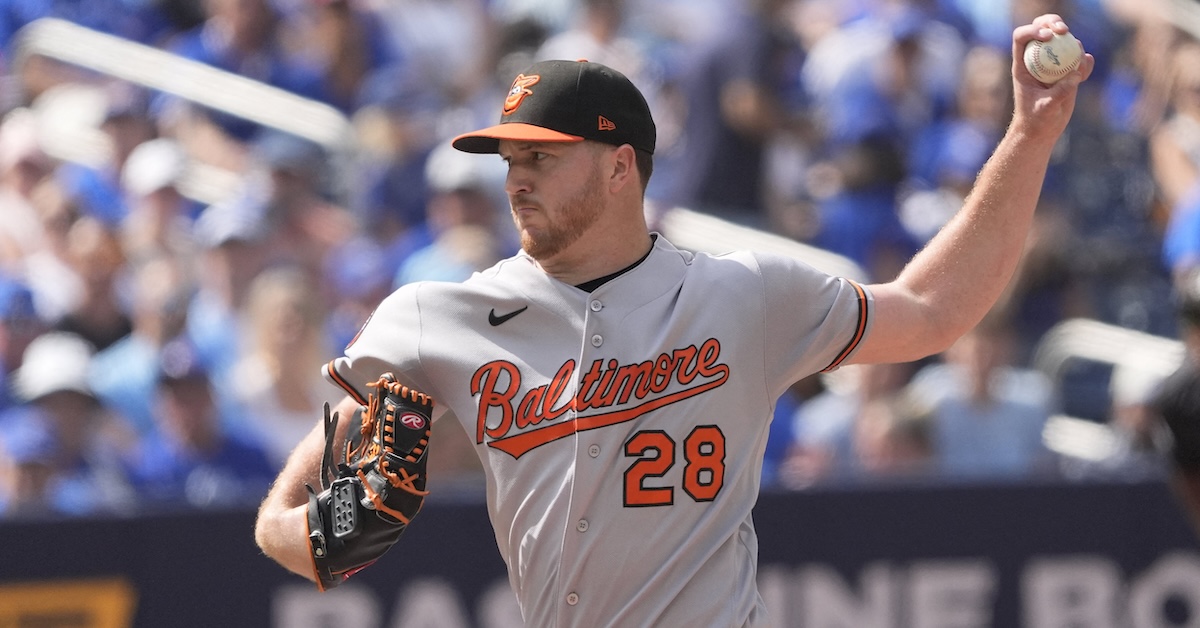
John E. Sokolowski-Imagn Images With Tarik Skubal off the board, the Cubs waited about a day and a half to lock up the second-best left-handed free agent starter available. Trevor Rogers is on the move, bound for Chicago with a five-year, $120 million contract (minus deferred money) in his pocket. That’s a magic number for the Cubs these days; hours later, they signed the top international hitter on the market, Teruaki Sato, to a six-year contract also worth $120 million. Rogers fills an obvious need for the Cubs, but at a price point that illustrates just how expensive starting pitching has become. Offensive production was pretty flat from team to team in 2026. Look at wRC+, which adjusts for the overall offensive environment in the league: Only three teams ended up with a wRC+ greater than 105. In five seasons of the universal DH era, that’s the first time fewer than nine teams posted a wRC+ of 106 or higher. The Cubs, who led the league with a 114 wRC+ and 850 runs scored, were the exception. A rising Pete Crow-Armstrong lifts all boats, yes, but of the 12 Cubs position players to make 200 or more plate appearances, 10 had a wRC+ of 100 or better. The two exceptions — the Gold Glove-winning double play combo of Dansby Swanson and Nico Hoerner — aren’t exactly automatic outs either. Chicago will lose some of that production with the departure of Seiya Suzuki and Ian Happ, though Sato will obviously make up a big chunk of the difference. The offense is still the Cubs’ strength. The pitching, on the other hand… yikes. Offense can be fickle; in two postseason games, the best lineup in baseball got strangled by Michael King and the Padres’ unhittable bullpen Cerberus. One run across the entire playoffs isn’t going to cut it. Especially not with Chicago’s pitching staff in the state it was in. The top five teams in pitcher WAR, and seven of the top eight, all made the playoffs. The Cubs were 28th. Among the 262 playoff teams since 2000, the 2026 Cubs had the second-worst FIP-. It’s not like president of baseball ops Jed Hoyer didn’t know this and try to fix it last year. Injuries didn’t help. Justin Steele missed the entire season recovering from Tommy John surgery. Cade Horton went down for the season after two starts. Daniel Palencia spent 89 days on the IL with elbow and oblique trouble. The club’s big offseason acquisition, hard-throwing righty Edward Cabrera, threw just 80 innings and posted a 5.96 ERA. That’s arguably the Cubs’ three best starters and their closer. Hoyer tried to backfill by trading for Kevin Gausman, David Peterson, and Clay Holmes at the deadline, but all three are now free agents. So are Shota Imanaga, Matthew Boyd, Colin Rea, and Jameson Taillon. The Cubs are losing five of the seven pitchers who threw more than 70 innings for them in 2026. Ben Brown, whose 1.85 ERA in 68 innings might’ve been the only bright spot on the pitching staff, is going to start the season on the IL as he recovers from a stress fracture in his neck. To summarize, the Cubs’ pitching staff was horrendous in 2026. And now they have to replace the whole thing. Is spending $24 million a year on Rogers the best way to do that? I’m not convinced, but I also don’t see a better obvious option. To be honest, the big problem with Rogers is that there’s only one of him, and the Cubs’ rotation isn’t going to be competitive unless they clone him four or five times. Rogers and Steele at the top of the rotation will be better than what the Cubs were working with before, but every other National League contender has at least one of the following: A Cy Young contender at the top of the rotation, more than two trustworthy and healthy starters, and/or a bullpen that can clean up the rotation’s mess. Again, that’s not Rogers’ fault. He can only do so much. You can’t really fill out an entire rotation in a free agent market where $100 million a year will only buy you a full set of no. 4 starters. I’d rather have Skubal at $50 million a year than Rogers at $24 million, but there’s only one Skubal and that price point would be tricky even for a well-heeled team like the Cubs. And the prices on second- and third-tier free agent starters are so wacky these days you start to wonder if they’re subject to global supply chain interruptions. I’d rather have Rogers at five years and $120 million than Freddy Peralta at five years and $125 million, but I don’t feel that strongly about it. I’d much rather have Rogers than Dustin May or Kris Bubic at their respective price points. It looks like the Twins got a pretty good deal on Sonny Gray, but they had to give a backloaded player option to a 37-year-old; there is big downside there. The same is true of Rogers, to an extent. The former Marlins and Orioles left-hander has been a pet cause of mine since early in his career, and his resurgence over two-plus seasons with Baltimore has been a great story. Last season, Rogers threw a career-high 169 2/3 innings with a 4.03 ERA but better peripherals. His 4.0 WAR was his highest total since his rookie year. He’s throwing about two ticks harder than he was at his nadir, and in a class full of old guys, he’s the third-youngest U.S.-based starter on the market, behind only Luis Gil and Josiah Gray. The dollar figure on this contract might be a little bracing, but I don’t know how legitimately surprised anyone is. Ben Clemens had him penciled in for four years at $26 million per, while our median crowdsource estimate was right on the money, down to the year and the dollar amount. But nine figures apparently doesn’t buy you as much as it used to. As of this writing, there are 23 pitchers currently working on contracts worth $100 million or more. (There might be more by the time you read this; three of these contracts came through within the past 48 hours.) Here are those pitchers, along with their stats across the three seasons before their contracts kicked in: The $100 Million Arms Name First Year Length Value G IP K% BB% ERA FIP WAR Tarik Skubal 2027 9 yrs. $450 M 88 546 30.9% 4.5% 2.42 2.48 18.0 Cristopher Sánchez 2027 6 yrs. $104 M 96 590 2/3 24.6% 5.5% 2.90 2.78 17.4 Gerrit Cole 2020 9 yrs. $324 M 98 615 2/3 32.4% 6.8% 3.20 3.14 16.8 Zack Wheeler 2025 3 yrs. $126 M 90 545 27.5% 5.7% 3.01 3.07 15.5 Aaron Nola 2024 7 yrs. $172 M 96 579 1/3 28.1% 4.8% 4.09 3.31 14.5 Framber Valdez 2026 3 yrs. $115 M 90 566 1/3 24.0% 7.8% 3.35 3.38 12.0 Corbin Burnes 2025 6 yrs. $210 M 97 590 26.4% 7.0% 3.08 3.49 11.9 Dylan Cease 2026 7 yrs. $210 M* 98 534 1/3 28.8% 9.5% 4.18 3.45 11.8 Jesús Luzardo 2027 5 yrs. $135 M 74 430 28.1% 7.4% 3.64 3.06 11.6 Carlos Rodón 2023 6 yrs. $162 M 59 318 1/3 33.5% 7.1% 2.80 2.48 11.3 Blake Snell 2025 5 yrs. $182 M* 76 412 32.4% 11.4% 2.82 2.98 10.8 Garrett Crochet 2026 6 yrs. $170 M 77 364 32.3% 6.2% 3.02 2.90 10.2 Max Fried 2025 8 yrs. $218 M 73 437 1/3 23.7% 6.1% 2.80 3.03 10.2 Ranger Suarez 2026 5 yrs. $130 M 75 433 22.8% 7.0% 3.58 3.46 10.0 Luis Castillo 2023 5 yrs. $108 M 70 408 26.2% 8.4% 3.49 3.31 10.0 Jacob deGrom 2023 5 yrs. $185 M 38 244 1/3 42.4% 4.5% 2.05 1.80 9.7 José Berríos 2022 7 yrs. $131 M 76 455 1/3 24.7% 6.4% 3.66 3.72 9.4 Trevor Rogers 2027 5 yrs. $120 M* 73 403 2/3 21.2% 7.4% 3.70 3.61 8.2 Freddy Peralta 2027 5 yrs. $125 M 97 519 1/3 25.7% 9.0% 3.59 4.02 7.7 Joe Musgrove 2023 5 yrs. $100 M 70 402 26.7% 6.8% 3.13 3.62 7.7 Tyler Glasnow 2024 5 yrs. $136.5 M 37 214 2/3 34.7% 7.8% 3.10 2.86 5.9 Chase Burns 2027 7 yrs. $105 M 42 197 2/3 30.8% 8.8% 3.23 3.11 5.7 Yoshinobu Yamamoto 2024 12 yrs. $325 M n/a n/a n/a n/a n/a n/a n/a *Deferrals lower AAV These pitchers vary by age, and Sánchez and Burns signed their deals with oodles of team control remaining. But for the most part, these are contracts signed either on the open market, or within a year or two of the player reaching it. There isn’t as much to go on for Rogers as most of the $100 million men. If you want an upside case for a talented-but-oft-injured former top prospect, there’s Glasnow. But there’s also Musgrove, and Rodón, who’s been good but not great for the Yankees, and not always healthy. My worry for the Cubs is that Rogers’ tremendous rookie season and his 1.81 ERA in 2025 give him the appearance of upside that’s baked into the price of the deal, but might not actually be there in reality. Rogers’ fastball is back, but not all the way, and the rest of the league is throwing harder now. In 2021, Rogers’ four-seamer was 1.8 mph faster than the average lefty’s; in 2026, it was 0.3 mph faster. Strikeouts used to be a big part of Rogers’ game; in 2021, he was 18th among starters with 100 or more innings in strikeout rate, and fifth among lefties, behind Rodón, Robbie Ray, Snell, and Clayton Kershaw. (One perhaps uncharitable way of placing Rogers’ rookie season in contrast would be to say that he hasn’t struck out a batter an inning since Kershaw was good.) In 2026, Rogers was 17th among lefty starters in strikeout rate, and 54th out of 120 overall. He’s put up good FIP numbers in spite of pedestrian strikeout totals because he never walks anyone and he doesn’t give up very many home runs. That latter point is a bit concerning, because Rogers is by no means a groundball pitcher. And that 1.81 ERA and 2.82 FIP that had people telling me he’s an ace a year ago was based on a 5.5% HR/FB ratio. In 2026, Rogers’ HR/FB% climbed up to 8.8% — still below-average, but more or less in line with his career norms — and he posted an ERA of 4.03. That’s about what I’d expect from a pitcher with slightly better-than-average quality-of-contact numbers. This past season, Rogers was in the 67th percentile in hard-hit rate and the 72nd in xERA. As a rookie, he was in the 89th and 80th percentiles for those figures, respectively. Rodón had a 92nd-percentile xERA in his walk year, by comparison. Rogers is a good pitcher; if he’s not the second-best starter on the market this offseason, he’s definitely in the conversation. But he’s not an ace, and I’m not convinced he’s a no. 2 either. But the Cubs have to start somewhere, and given what Peralta, May, and Bubic just signed for, I’d just as soon have Rogers at this price point as any other available option.
Cubs Sign Trevor Rogers, Still Need About Six Other Pitchers Like Him
Full Article
Original Source
Read the full article at Blogs →KhanList aggregates and links to publicly available news content. We do not host full articles from third-party sources. Always verify important information with original sources.