
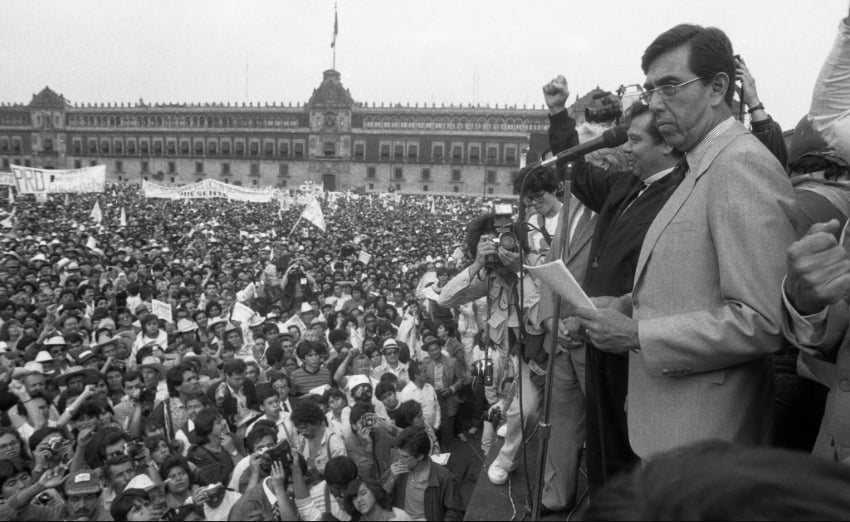
Cuauhtémoc Cárdenas Solórzano, a three-time presidential candidate, a central figure in Mexico’s democratic transition and son of former president Lázaro Cárdenas del Río, died in Mexico City on Wednesday. He was 92. The cause of Cárdenas’ death was not immediately clear. He reportedly passed away in the Ángeles Metropolitano Hospital in the Roma Sur neighborhood of the capital. President Claudia Sheinbaum and former President Andrés Manuel López Obrador acknowledged Cárdena’s death in social media posts on Wednesday night. Sheinbaum called him “a man of steadfast principles who transformed the political life of our country.” López Obrador said Cárdenas was “a precursor of the democratic movement in Mexico’s recent history.” “Without him, the country’s political reality would be different,” he wrote. La presidenta Claudia Sheinbaum encabeza la guardia de honor ante el féretro de Cuauhtémoc Cárdenas, histórico líder de la izquierda mexicana, acompañada por la familia del fallecido político. Más información en López-Dóriga Digital https://t.co/rSlCjtnTUo — Joaquín López-Dóriga (@lopezdoriga) October 29, 2026 Cárdenas is credited with helping to end the Institutional Revolutionary Party’s decades-long rule in Mexico, which spanned much of the 20th century. He was a member of the PRI for more than 30 years, but left the party in 1987 and ran in the 1988 presidential election as the candidate for the National Democratic Front, a coalition of left-wing parties. Cárdenas is widely believed to have won that election, but the PRI’s Carlos Salinas de Gortari was declared the winner. He would go on to contest the 1994 and 2000 elections as the candidate for the Democratic Revolution Party (PRD), which he co-founded. The 2000 election was won by the National Action Party (PAN) candidate Vicente Fox, who became the first president of Mexico from outside the PRI or its predecessors in 71 years. The early years Cárdenas was born in Mexico City on May 1, 1934, exactly two months before his father, Lázaro Cárdenas, won the 1934 presidential election with more than 98% of the vote. His mother was Amalia Solórzano Bravo, who, like his father, was a native of Michoacán. Cárdenas was not yet four years old when his father nationalized Mexico’s oil industry on March 18, 1938. Lázaro Cárdenas is best remembered for that historic decision, but also oversaw significant land reform, redistributing millions of hectares to small-scale farmers, or campesinos. Cuauhtémoc Cárdenas spent his early years living at Los Pinos, the erstwhile residence of the president of Mexico. The New York Times reported that “[a] boyhood friend, José J. Altamirano, remembered the young Cuauhtémoc pushing toy trucks around his father’s feet there.” Cárdenas was educated at private schools before enrolling in a civil engineering degree at the National Autonomous University of Mexico (UNAM). He graduated from UNAM in the mid-1950s and worked as a civil engineer before starting his long political career. Cárdenas wed María Celeste Batel in 1963 and they remained married until her death in 2021. The couple had three children. A political life Cárdenas was a member of the PRI from 1954 to 1987. During that period, he served as a federal senator for Michoacán (1976-80) and governor of Michoacán (1980-86). While in those positions, he was critical of the federal government’s economic decisions — Mexico’s so-called neoliberal period began in 1982 — and the “dedazo,” the colloquial name for the practice in which the sitting president handpicked the PRI’s next presidential candidate. Before he left the PRI, Cárdenas, Porfirio Muñoz, Ifigenia Martínez and others founded the Corriente Democrática (Democratic Current), a progressive and reformist faction of the PRI. Cuauhtémoc Cárdenas at the 100 Hours March in Mexico City in 1987, a protest organized by the Corriente Democrática over the lack of transparency in the selection of PRI presidential candidate Carlos Salinas de Gortari. (Cuartoscuro) The 1988 presidential election Cárdenas had hopes of representing the PRI at the 1988 presidential election, but President Miguel de la Madrid chose Salinas de Gortari — a free trade advocate — as the party’s flag bearer. Having left the PRI, Cárdenas stood as the candidate for the National Democratic Front, which was backed by the Mexican Socialist Party and the Authentic Party of the Mexican Revolution, among other parties and organizations. His message of economic nationalism resonated with voters, and early results on the night of the 1988 election showed that he had a significant lead over Salinas. However, later in the night, election officials claimed that the electoral computer system had broken down and they stopped reporting results. Before midnight on July 6, 1988, Salinas was declared the winner with almost 51% of the vote compared to Cárdenas’ 31%, according to the official, but highly questionable, results. De la Madrid admitted that the results were rigged in his 2004 memoir. The New York Times reported that Cárdenas’ “sway over the Mexican people was so great that he could have, with a few words, set off a bloody civil war after obvious fraud in the 1988 presidential election robbed him of the victory that many believed was his.” “But instead of whipping up their anger, he convinced his followers that they could launch a true revolution, not by taking to the streets but by returning to the polls.” “Se cayó el sistema”. La elección presidencial de 1988 marcó para siempre la trayectoria de Cuauhtémoc Cárdenas. La interrupción del flujo de información, las denuncias de fraude y el triunfo oficial de Carlos Salinas de Gortari abrieron una de las mayores polémicas electorales de México. Así fue aquella histórica elección. @renzochiquito nos cuenta https://t.co/beFZrZj8VB — Azteca Noticias (@AztecaNoticias) October 29, 2026 Cárdenas seeks the presidency again In 1989, Cárdenas, Porfirio Muñoz, Ifigenia Martínez and Andrés Manuel López Obrador founded the PRD, which became Mexico’s main left-wing party. Cárdenas represented the PRD at the 1994 and 2000 presidential elections, finishing third in both. In between his second and third presidential bids, he served as mayor of Mexico City between 1997 and 1999, having won the first direct election of the capital’s head of government, a position previously filled by presidential appointment. President Sheinbaum used the Mexico City mayorship as a springboard to the presidency, but that wasn’t the case for Cárdenas. Fox took the presidency for the PAN in 2000, which, along with Felipe Calderón’s victory in another controversial election in 2006, left the PRI out of power at the federal level for 12 years. The once-dominant party wouldn’t return to the national halls of power until Enrique Peña Nieto took office in late 2012. While he didn’t rise to the national leadership position he appeared to be destined for, Cárdenas “was, in a real sense, one of the midwives of Mexico’s democratic transition,” according to University of California political scientist Kathleen Bruhn. He helped turn the PRD into a competitive political party after the long 20th-century hegemony of the PRI. The party won elections in Mexico City and various states before its recent demise as a result of its poor showing in the 2024 federal elections. Cárdenas left the PRD in 2014, 25 years after co-founding the party, due to differences with its leadership, but he will forever be linked to the party that was Mexico’s preeminent leftist force until the emergence last decade of the National Regeneration Movement, or Morena, which has ruled Mexico since late 2018. Cuauhtémoc Cárdenas with Andrés Manuel López Obrador at a campaign rally in the Mexico City Zócalo in 2000. (Pedro Mera / Cuartoscuro) Symbol of the Mexican left The La Jornada newspaper described Cárdenas as a “symbol of the left in Mexico” and a “historic leader” of the national leftist movement. “Cárdenas left a profound mark on contemporary political history by leading the most significant rupture of the PRI in the decade of the ’80s, the … Corriente Democrática, and by opening a new stage for the Mexican left,” reported the Mexico City-based daily. “… He became closely associated with the emergence of an electoral left, the call for free and competitive elections, and the transformation of the Mexican political system. He also supported causes such as those of the EZLN [the Zapatista Army of National Liberation] and the defense of energy resources and national sovereignty,” La Jornada wrote. El Universal reported that biographers have defined his ideology as “rejection of neoliberalism, defense of the state in strategic sectors, especially energy, austerity, national sovereignty and laicism.” Cárdenas’ autumn years Cárdenas remained engaged in Mexican politics in the later years of his life. He spoke out about the need to combat organized crime groups and retake territory they control, and voiced concerns about issues such as low economic growth, the militarization of public security and insufficient funding for education and healthcare. “I’m very concerned about the situation we’re living, the situation that the country is going through,” he said during a meeting with a cross-party group of senators in 2022. He made those remarks while his former PRD colleague, López Obrador, was in office. Like Cárdenas, AMLO contested three presidential elections, but, in contrast to his political associate, won on his third attempt. In 2011, Cárdenas, at the age of 77, was awarded the Belisario Domínguez medal, the Mexican Senate’s highest honor, in recognition of his political career and contributions to public life. Among those contributions are several books he authored. Cárdenas is survived by his three children Cuauhtémoc, Camila and Lázaro Cárdenas Batel, and his grandchildren. Lázaro, governor of Michoacán between 2002 and 2008, is President Sheinbaum’s chief of staff. With reports from La Jornada, Reforma, El Economista, El Universal and The New York Times
Cuauhtémoc Cárdenas, who helped end decades of one-party rule in Mexico, dies at 92
Full Article
Original Source
Read the full article at Mexiconewsdaily →KhanList aggregates and links to publicly available news content. We do not host full articles from third-party sources. Always verify important information with original sources.