
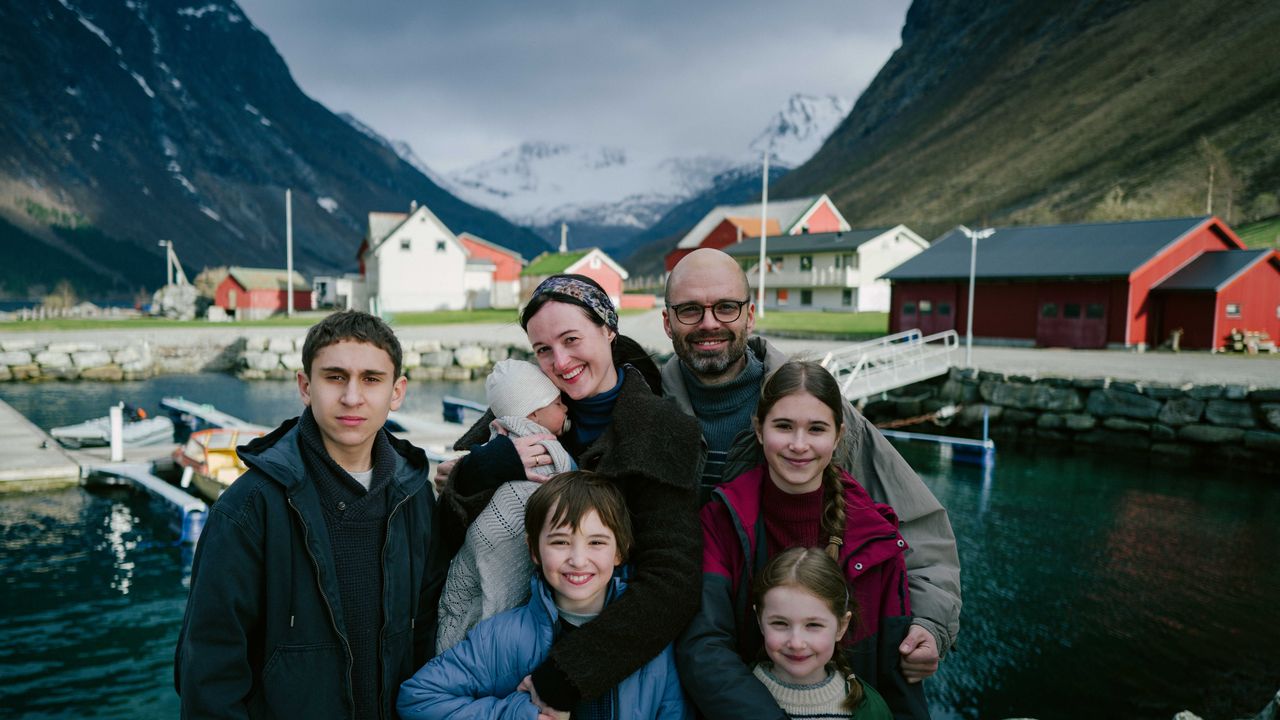
On Location peels back the curtain on some of your favorite films, television shows, and more. This time, we take a look at Fjord.Following in the footsteps of Anatomy of a Fall and Sentimental Value, Cristian Mungiu’s new film Fjord continues a recent trend of complex, critically acclaimed family dramas set against a gorgeous—if appropriately chilly—European backdrop. The Romanian New Wave director won his second Palme d’Or at this year’s Cannes Film Festival for the Norway-set film, which is also his first shot outside of his home country and Romania’s official selection for the best international feature category at the 2027 Oscars.Loosely based on a real court case, Fjord follows a devout evangelical Romanian man named Mihai (Sebastian Stan) and his Norwegian wife Lisbet (Renate Reinsve) who move to a remote fjord village in Norway with their five children. Their conservative lifestyle soon puts them at odds with their progressive neighbors, and they find themselves in a custody battle after child abuse allegations surface, setting up a complicated debate between two opposing cultures and worldviews.Cristian Mungiu’s latest film is based on a real-life court case. Courtesy NeonThe film was shot over 36 days in spring 2025 in Western Norway’s Hjørundfjorden. The dramatic and mostly tourist-free fjord near the city of Ålesund cuts through the Sunnmøre Alps, with peaks rising up to 5,600 feet directly from the water.For the family home, location scouts selected a tiny village called Stenes, comprising just a few rustic buildings scattered on the shores of the fjord’s Norangsfjorden arm. Nearby, they shot church scenes at a simple wooden structure in the town of Øye with school scenes taking place in Sæbø and courthouse scenes being filmed in the “big city” of Ålesund.The symbolic value of the fjordAs the title of the film suggests, the fjord is more than just a mere setting—it’s a poetic space suffused with symbolic meaning for Mungiu. “I was attracted by this idea of a very secluded community where people can’t avoid finally talking to one another,” Mungiu says. “The fjord evokes for me this need for solidarity among people when confronted with extreme coldness and severe weather.”Mungiu sought to balance the epic scale of the fjord setting with the legal drama of the film. Courtesy NeonWhile audiences might expect the grandeur of a fjord to humble the people who live within it, in this movie, Mungiu instead uses the geographical formation to highlight their folly. “Normally, in front of nature’s force, people should become conscious of their fragility,” Mungiu says, “but too often their huge egos make them forget how mortal and insignificant they are, and they end up investing all their energy into imposing their point of view on others.”The landscape worked particularly well within the context of Mungiu’s unique visual storytelling style: He conceives of each scene as a single shot, without cuts or close-ups, letting his characters move through expansive frames. As he describes it, “Every shot needs to be perfectly balanced in terms of light, interpretation, choreography, rhythm.” For this project, he imagined scenes that would call to mind the winter landscapes of Flemish Renaissance master Pieter Bruegel the Elder, who painted small human figures dwarfed by snowy scenery. The wide shots, Mungiu says, “allow the majestic nature to feel a bit intimidating and menacing.”The winter landscapes in the film were inspired by the work of Flemish Renaissance painter Pieter Bruegel the Elder. Courtesy NeonPicking the right fjordWhen it came time to select the perfect fjord, Mungiu was purely pragmatic. “I imagine scenes quite in detail when I write the screenplay and while scouting,” he explains. “I try to find locations as close as possible to what I’ve imagined.” He drew a “very precise sketch” for his location scout of what he was looking for: two neighboring houses at the end of a fjord, “with mountains and forests behind, quiet deep water in front, and a narrow road connecting them to the rest of the world—all this ideally covered in snow during wintertime.”His production team found a spot that looked just as he envisioned in Stenes, deep down the fjord and away from the coast, to maximize the potential for more snow. Then the hardest part started: convincing the homeowners to rent their properties out for the shoot.“Once we started our scouting, we felt that we were visiting a form of paradise,” he says. “The light always comes from an angle, the air is pure, the colors are strong, the calm of the ocean is threatening, the snow on the peaks looks menacing.” Everything in the area, he continues, “is clean, organized, precise, logical, and functional.” Mungiu jokes, “For an OCD person like me, it was the perfect place.”Of course, the wildness of the fjord came with its own set of challenges, from avalanche warnings to a lack of consistent snow cover (they trucked in powder from the mountains). But Mungiu and his team tried to use these issues to their artistic advantage. On the first day of shooting, for instance, a major storm forced them to move production inside and shoot an emotionally complex scene. Inspired by the dramatic gusts, they hung an enormous Norwegian flag just outside the window to thrash and snap in the gale, “adding a visual element to the inner feelings of Lisbet in a very delicate moment for her as a character.”How to visit HjørundfjordenThe primary gateway town for the fjord is Ålesund, a coastal city known for its abundant Art Nouveau architecture. While it’s only about 20 miles from Stenes as the crow flies, the journey takes about two hours of scenic driving and ferry crossings to get to the spots where the movie was shot.Sebastian Stan as Mihai Gheorghiu, the devout evangelical main character who relocates his family to the titular Norwegian fjord. Courtesy NeonIf you want to see the fjord for yourself, an ideal lodging option is the lovely Hotel Union Øye, which opened early for the season to host the cast. Now a member of Relais & Châteaux, the gingerbread-like hotel debuted in 1891 and over the decades has hosted the likes of Henrik Ibsen, Arthur Conan Doyle, and Edvard Grieg, who composed music on the piano in the salon.It’s also possible to visit Hjørundfjorden on one of Norway’s most iconic journeys: a sailing with Hurtigruten, which is part pleasure cruise line, part local passenger ferry, and part cargo vessel for remote communities. In 2027, the line’s Coastal Express route, which hugs the coast from Bergen in the south to Kirkenes in the north, will visit Hjørundfjorden in May and September, while the Svalbard Line will make a stop at Sæbø in the fjord from May through September. (In the film’s Ålesund-set courtroom scenes, you can even see the ferry looming outside the windows.)Havila Voyages, a family-run Hurtigruten competitor, also stops in Hjørundfjorden seasonally from September 1 to October 31; optional excursions include a scenic drive through the surrounding countryside and mountain valleys; an e-bike tour through the narrow Norangsdalen valley along the “Queen’s Route” (so named because it was supposedly visited by seven queens); or a guided hike to a mountain dairy farm, followed by a snack of a svele (crepe).And if you can’t make it to Norway, Mungiu is presenting an exhibition of his photographs from scouting trips and the film’s production called Fjord. The Pictures at New York’s Romanian Cultural Institute in New York (through November 30). His images, all shot on a phone, depict the landscapes, people, architecture, and even weather that helped shape the film’s visual language.
Cristian Mungiu’s Latest Drama Fjord Plunges Into the Depths of Coastal Norway
Full Article
Original Source
Read the full article at Cntraveler →KhanList aggregates and links to publicly available news content. We do not host full articles from third-party sources. Always verify important information with original sources.