
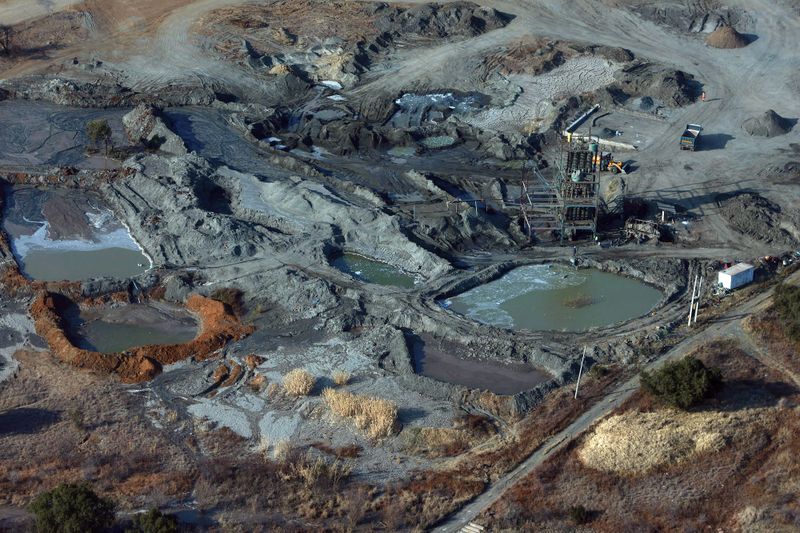
Rising from the soil like serpents with their snake-like coils, the illicit chrome-washing plants that have become a venomous presence between Rustenburg and Brits are jarringly visible from the air and stand as cold-blooded testimony to the consequences of state failure. The plants feed off scaly mining operations that are also hiding in plain sight. These include the pit near the Nkaneng informal settlement where 14 illegal chrome miners were killed on 10 August when the ground above them collapsed. When Daily Maverick flew in a helicopter over the region in late July, a bird’s eye view revealed lorries waiting for their loads near the plants while big yellow machines plied their trade. Elsewhere, mounds of grey rubble next to gouged holes in the earth provided a stark contrast to the surrounding ochre landscape – a tell-tale signature of illegal chrome mining. Community activists in the area have painstakingly documented 66 such operations between Rustenburg and Brits. But the Department of Waters Affairs and Sanitation (DWS) said in response to Daily Maverick’s queries that it had only issued 16 water-use licences for such operations in the region – a glaring discrepancy. The Department of Forestry, Fisheries and the Environment did not respond to requests for comment about any environmental impact assessments it had approved for such operations in the area. The Department of Minerals and Petroleum Resources (DMPR) also did not offer comment. “The Bojanala Platinum District is overrun with illegal mines and chrome-wash plants. They pop up faster than we can object,” Cheryl Phillips, a former DA MP who has been leading the community challenge to this growing menace, told Daily Maverick. “The latest notification was for a change of zoning, with mining just tagged on at the end. When we went to submit objections to the rezoning at the Rustenburg Local Municipality, we were informed that each objection must be accompanied by the objection fee, which is currently R2,955.64. This astronomical fee means that the majority of people in Rustenburg cannot afford to lodge an objection against rezoning which could affect their health and their life investment in their property.”The threats are many: collapsing property values; the fouling of prime agricultural land; the siphoning and polluting of scarce water supplies; and costs for legitimate mining operations and losses for the Treasury as the profits from criminal chrome flow to trans-national organised crime syndicates.These activities are also unfolding in the heart of Magaliesberg Biosphere Reserve, a Unesco designation that recognises the region’s ecological and cultural importance. A by-product of the platinum group metals (PGMs) found in abundance in South Africa’s UG2 reef system, chrome is a key component in the production of stainless steel, which is highly resistant to corrosion. South Africa is by far the world’s biggest producer of both PGMs and chrome, accounting for 70% of global supplies. “Illegal chrome is only one component of a much broader risk landscape confronting the mining sector,” Sibanye-Stillwater CEO Richard Stewart told Daily Maverick. “The more significant challenge is the increasing convergence of organised criminal activity around mining operations. Today, PGM producers face a range of interconnected threats that have the potential to materially affect safety, production and long-term sustainability.”While the eastern limb of the platinum belt has long been regarded as the epicentre of South Africa’s illegal chrome plague, community activists, security sources and mining companies say such activities have surged in recent years on the western limb as criminal networks follow the treasures of the UG2 reef. Landscape of fear and loathing Grey globs and holes in the ground from illegal chrome mining in North West stand out as eye sores in an ochre landscape. (Photo: Felix Dlangamandla) This criminal activity is also transparent from the ground – a point that speaks to the fact that unlike the stainless steel forged from chrome, the South African state is not resistant to corrosion. Indeed, there is a suspicious chrome operation being erected right across the road from Sibanye’s conference centre and game farm near Mooinoi. Phillips took Daily Maverick on a tour of the region and in the space of an hour, we drove past six illegal washing plants – all were plainly visible from mostly public roads. We also visited a formerly productive farm scarred by gaping holes from the stripping of chrome. “This was actually a farmer’s field, he planted potatoes and sunflowers on it and they just went in. The first time they went in with two excavators and the second time they went in with five. The first time we managed to stop them and the second time we couldn’t,” Phillips said.The tailings residue from such operations stand out as dark globs on road sides – no effort has been made to store it in an environmentally sound manner – though as we shall see some of it may have found its way to a tailings dam.The sprawl of out-of-control chrome operations in North West meets the sprawl of an informal settlement on 31 July 2026. (Photo: Felix Dlangammandla) The region is also crucial for agriculture with an accommodating micro-climate and rich soil. At a meeting with affected landowners, Daily Maverick heard tales of woe. “My father bought this farm because it’s in the biosphere so he thought it was fine. But everyday there is dust, noise and disruption,” one farmer told Daily Maverick. “We have 11 boreholes on 11 hectares, but we are running out of water because the wash plants nearby are using so much,” he said. He spoke on condition that his name not be used as he has been threatened, a chilling state of affairs that speaks to another point: the landscape in the region has been transformed into one of fear and loathing. Unesco biosphere threatenedThe Unesco-designated Magaliesberg Biosphere is threatened by a surge of illegal and unregulated chrome operations. (Source: Magaliesberg Biosphere) As their name suggests, the wash plants consume a lot of water. The spiral coils that are their defining feature use water flow and gravity to separate the heavier chrome ore from waste rock and clay. It is cost-effective, efficient and H2O intensive. This heavy illicit water use is concerning as the El Niño weather pattern gathers steam and threatens to unleash scorching droughts this summer. It also poses a threat to aquatic ecosystems in the biosphere. Crossing the Maretlwane River near a washing plant, Belinda Cooper, coordinator of the Magaliesberg Biosphere Reserve, noted with concern that: “It is one of the cleanest in the biosphere and is now threatened by these activities.”The Magaliesberg Biosphere straddles the Highveld grasslands to the south and the African savannah to the north and contains a huge diversity of habitats, from wetlands to valleys to mountains.“Unesco is concerned about the mining in the Magaliesburg Biosphere and how we as the biosphere, together with government and the mining industry, are going to deal with the illegal and unregulated chrome mining problem,” Cooper told Daily Maverick. “And they’ve actually asked us to consider this threat in the next iteration of our management plan.”Dr Jonathan Levine, an honorary research scientist affiliated with Wits University’s Animal, Plant and Environmental Sciences Department, did post-graduate research on the waterways of the region. He highlighted some of the risks in an interview with Daily Maverick. “The first risk from such operations is a silt problem, that’s sediment. These plants usually just wash chrome ore and silt directly into the rivers,” he said. “It smothers the river bed and destroys habitat, specifically for freshwater fish. The sentiment also clogs the gills of these fish which cuts oxygen uptake.”It also destroys habitat for other species such as the insects that fish rely on for food, in a vicious cycle that can transform a vibrant aquatic ecosystem into a dead zone. “The other concern is a water quality or chemical problem,” Levine said. On this front, hexavalent chromium – Chromium (VI) – stands out for its toxicity. “Chromium VI is the really harmful one. It is highly soluble and can move long distances and it's carcinogenic,” Levine said. In short, it is a growing ecological calamity with dire consequences through the web of life. An illegal tailings failureGouges in the earth form the spoor of illicit and unregulated chrome mining. (Photo: Felix Dlangamandla) The scale of the environmental threat from illegal chrome activities – as well as the threat posed to legal mining operations – was on vivid display on 13 August when the Inyoni Tailings Storage Facility (TSF) slimes dam at Samancor’s WCM mine burst its seams. The slimes that oozed out fouled Northam Platinum’s Eland mine, briefly cutting off an access road. The TSF is on Samancor land, but the operator is an unlisted company, One Chrome, which does not even have a website that Daily Maverick could find. Revealingly, the DMPR in its initial notice of orders to Samancor in the wake of the slurry sludge said the operation was illegal. “The said tailings dam appeared to have not been registered with the Department of Water and Sanitation [and] hence illegally operated,” it said in its notice, which has been seen by Daily Maverick. Experts told Daily Maverick that this unregulated operation appears to have been accumulating more material than it could handle, begging the question about the source of the tailings material for the TSF in an area rife with illegal operations. Samancor did not respond to Daily Maverick requests for comment. But a tailings operation that the DMPR has deemed illegal is suspect, and the fact that it lacked a water-use licence speaks volumes to the unregulated chrome free-for-all in the region. “I was always baffled by how the privateer chrome wash plants I see on satellite photos don’t have tailings dams. This stuff is going somewhere,” a mining analyst who has been keeping tabs on the issue told Daily Maverick. Hawks swoop, but prey is elusiveOperating in a unregulated environment, small-scale chrome mines are popping up in plain sight along busy roads between Rustenburg and Brits in North West. (Photo: Felix Dlangamandla) This all begs an obvious question: what are the police doing? They have had some successes. In early August, the Hawks swooped on one operation and seized four excavators and a dump truck. “Twenty-three cases related to illegal mining were registered in the past two years in the Rustenburg area with 63 accused charged. These illegal activities include mining of chrome and platinum. Twenty trucks and 15 excavators have been seized in the past two years,” Hawks spokesperson Lieutenant-Colonel Tinyiko Mathebula told Daily Maverick.But that is just the tip of an expanding ice berg and the perception is that enforcement is effectively nil – unless it is triggered by legitimate mining companies. “There is currently no enforcement. We see illegal operations popping up continuously in plain sight, and no enforcement takes place unless mining houses like us initiate action,” Sibanye’s Stewart told Daily Maverick. Mining security sources told Daily Maverick that initiatives to combat illegal gold mining have seen some zama zamas (illegal miners) down tools in that sector and move into the illegal chrome space.It is telling that most of the 14 miners killed in the 10 August incident hailed from Lesotho – a demographic profile that mirrors that of the illegal gold miners. It is also revealing to note that the DMPR confirmed in a statement that “[...] the incident occurred within the boundaries of an area where a valid mining permit has been issued. The department further confirms that the site is a surface opencast mining operation and does not include an underground mine shaft.”Well, the guys were underground. And this raises questions about the DMPR’s issuing of mining permits and its oversight. Unlike a fully fledged mining right, a mining permit only covers up to five hectares and is far less onerous to obtain. An unfolding land grab in Mpumalanga that Daily Maverick first reported on three years ago highlights how such lax requirements have triggered a deluge of dubious applications for coal mining permits. It is a pattern repeating itself with chrome, raising suspicions about corruption in the DMPR’s regional offices – as well as a lack of regulatory oversight as witnessed by the recent fatalities at a chrome operation with a mining permit sanctioned by the department. Mining security sources and a lawyer familiar with the matter said that washing plants were also being erected within the boundaries of issued mining permits, which is illegal, as the two are different activities. While the extent of illegal and unregulated chrome operations is blindingly visible, a lot remains opaque. On the issue of permitting, a functional mining cadastre would shine the light of transparency. But after years of needless delays, the current timeline for the launch of South Africa’s is next March – and another postponement would surprise no one. The torch of transparency would also help unveil where illicit chrome is entering global supply chains. A significant portion of the world’s stainless steel is stained by the illicit chrome operations that killed 14 zama zamas recently – but consumers at the end of such supply chains are blissfully unaware of the blood tainting their kitchen cutlery. We will scour this overlooked terrain in Part 2. DM
CRIMINAL CHROME (Part 1): Illegal chrome mining — An aerial view into the void of state failure
Full Article
Original Source
Read the full article at Dailymaverick →KhanList aggregates and links to publicly available news content. We do not host full articles from third-party sources. Always verify important information with original sources.